



Stockholm-based private equity firm EQT has entered into a definitive agreement to acquire Exolaunch, a Germany-based satellite deployment technology and launch mission management company, marking the investment firm’s first move into the space sector.
The acquisition is being made through EQT’s X fund, with the transaction expected to close during the fourth quarter of 2026. Financial terms weren’t disclosed.
Exolaunch has deployed more than 790 satellites across 47 missions for more than 200 commercial and government customers. The company has maintained a strategic relationship with SpaceX since 2020, participating in every Falcon 9 Transporter and Bandwagon rideshare mission since those programs began, and recently secured its first dedicated Falcon 9 launches, missions designated Exo-1 and Exo-2, scheduled for 2027 and 2028.
-0-
MDA Space has signed a definitive agreement to acquire Blue Canyon Technologies from RTX’s Raytheon business for $620 million in an all-cash transaction.
Blue Canyon has launched more than 85 spacecraft and has more than 3,500 products on orbit. The company employs more than 400 people across two manufacturing facilities in Denver, CO.
The transaction is fully committed and financed through senior secured debt at signing. MDA Space expects the deal to close by the end of 2026, pending customary closing conditions and required regulatory approvals. At current exchange rates, the purchase price represents an enterprise value of approximately 874 million Canadian dollars.
-0-
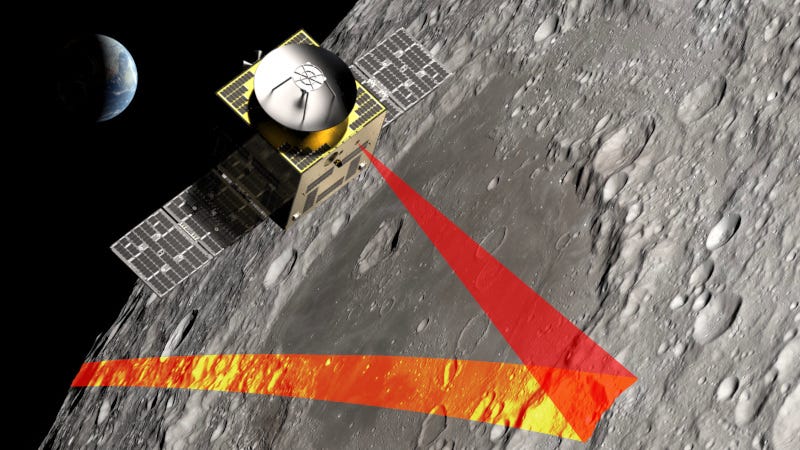
The European Space Agency has selected the NUVIEW Moonraker mission for a Phase A study under ESA’s Small Missions for Exploration, Destination the Moon program, moving the Berlin-based company’s lunar terrain mapping effort into a formal feasibility phase.
NUVIEW serves as prime contractor and leads an international consortium developing space-based LiDAR for lunar applications. Moonraker would downlink LiDAR data directly to Earth, where it’d be processed into three-dimensional Digital Elevation Models, intended to support landing site identification, hazard assessment, and surface planning for future robotic and human missions.
-0-
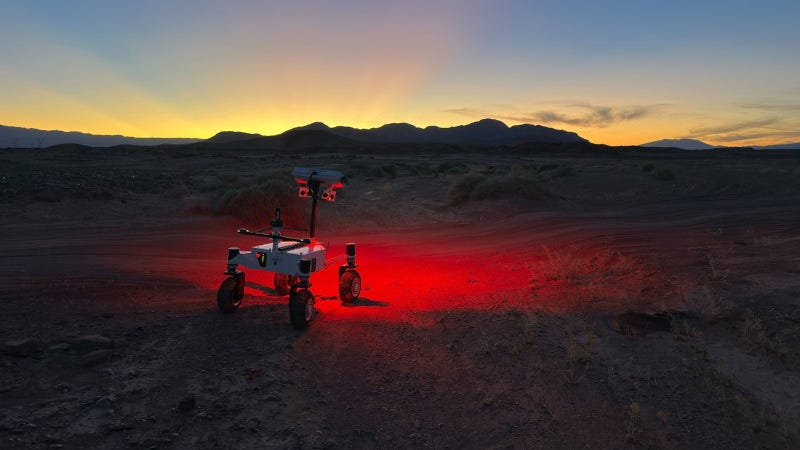
A compact four-wheeled rover prototype developed at NASA’s Jet Propulsion Laboratory is expanding the boundaries of robotic autonomy and terrain mobility, with implications for future missions to the Moon and Mars.
The prototype, known as ERNEST, short for Exploration Rover for Navigating Extreme Sloped Terrain, recently completed a seven-day field campaign in the Colorado Desert of Southern California, covering 16 miles over 37 hours with minimal human intervention. That’s an order of magnitude faster than NASA’s current Mars rovers, Curiosity and Perseverance, can navigate.
The ERNEST team is now launching a new autonomy project to integrate active suspension capabilities with longer-range intelligent navigation, enabling the rover to plan efficient paths around or through obstacles.
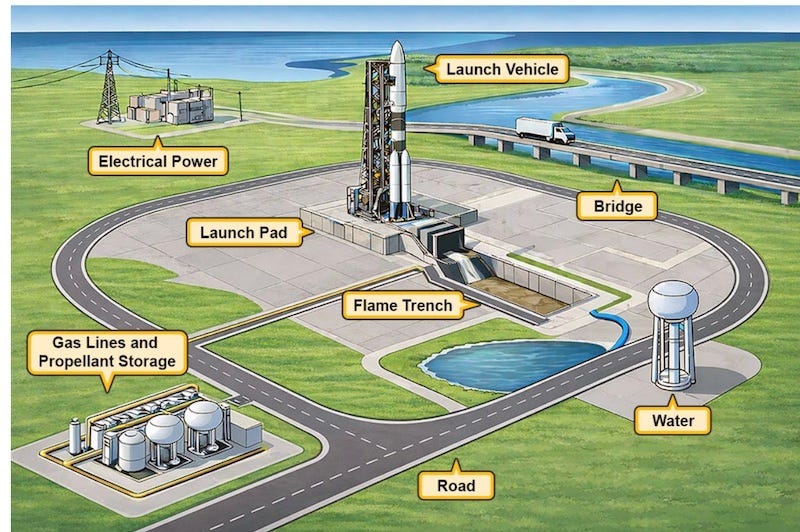
A federal audit released Monday warns that NASA’s two primary launch sites are running out of capacity to support a dramatic surge in commercial and government launches, with aging infrastructure, some dating to the Apollo era, at risk of causing mission delays unless Congress removes funding barriers and the agency accelerates long-deferred repairs.
The NASA Office of Inspector General report “NASA’s Launch Infrastructure”, found that Kennedy Space Center in Florida and Wallops Flight Facility in Virginia are both projected to approach or reach operational capacity by 2028 to 2029. Launches supported by Kennedy grew from 31 in 2020 to 109 in 2025, a 252 percent increase, and are projected to reach 268 per year by 2030. Wallops saw an even steeper climb, from 3 launches in 2020 to 17 in 2025, a 467 percent jump, with projections reaching 44 launches annually by 2030.
This week on The Journal of Space Commerce Podcast, I talked with Dr. Tom Colvin, Managing Partner and Chief Technologist at Rational Futures, to unpack the findings of the firm’s recent report “SCRUBBED: America’s Launch Capacity Challenge,” commissioned by the Commercial Space Federation.
Colvin acknowledged that traditional launch sites like Cape Canaveral and Vandenberg are already straining under congestion, infrastructure coordination failures, and regulatory friction.
“Right now, operators are experiencing friction at the current launch cadence. The predictions for future launches are kind of off the charts, and nobody knows really what the capacity of even our existing infrastructure is, or when we’ll hit that capacity limit, what’s the biggest bang for the buck to fix it,” Colvin said. “And so we were taking a first sort of stab at making a much more rigorous, physically grounded and traceable analysis that people who are trying to plan for future infrastructure can use. Because if you’re going to build new infrastructure, you want it to be right-sized to the amount of demand or services that you’re going to have to provide. So that was effectively what we were doing, we pitched that we can also bring in certain technical constraints that we haven’t seen other people address.”
Non-traditional sites, inland and sea-based spaceports, hold theoretical promise, but face massive capital requirements and a demand problem that market forces alone aren’t likely to solve. Proposals for orbital data center constellations totaling over one million satellites represent a demand scenario so large it’d require an entirely different conception of what American launch infrastructure looks like.
-0-
NASA Administrator Jared Isaacman has moved quickly to collapse the agency’s mission directorate structure from seven directorates down to three, the Exploration Systems Development Mission Directorate, a reconstituted Science Mission Directorate, and the Space Operations Mission Directorate. [Paywall]
The Space Technology and Aeronautics Research directorates are being wound down, with programs distributed across the three survivors or terminated. As of this week, NASA hasn’t published a complete roster showing which programs land where. That gap is the operational risk. Every active contract carries a funding authority and a contracting officer. When that chain changes, modifications take time, and where contracting officers of record change, the FAR Part 42 novation process can add weeks or months of administrative lag.
The restructuring is running simultaneously with a proposed fiscal year 2027 budget that recommends cutting the Science Mission Directorate by approximately 50 percent relative to fiscal year 2025 enacted levels. Congress hasn’t acted on that proposal. But supplier behavior, including workforce planning, hiring decisions and subcontract renewals, is already adjusting to a budget that hasn’t been passed.
-0-
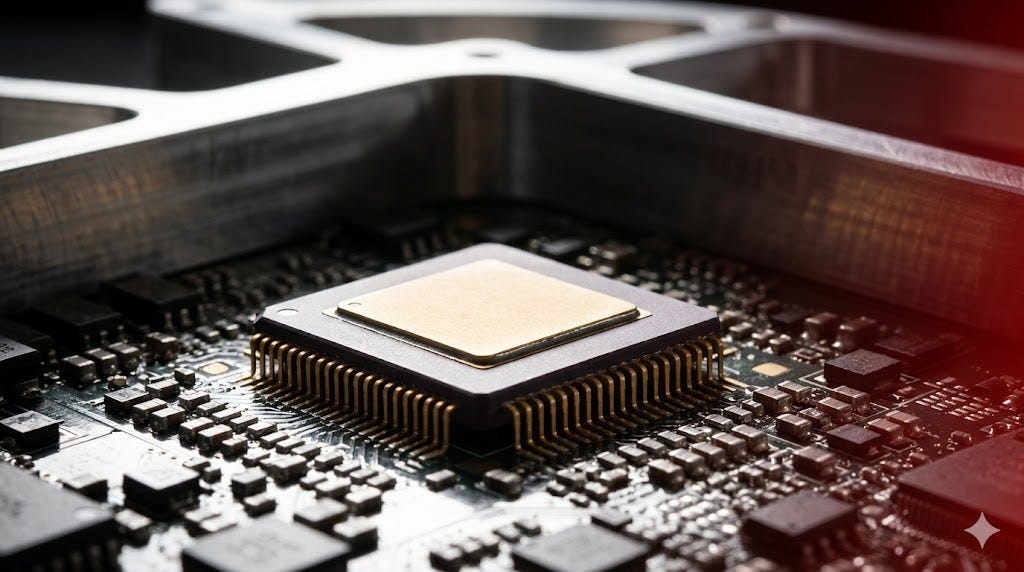
Every U.S. government satellite in production depends on radiation-hardened semiconductors fabricated at one of a small number of domestically qualified foundries, and right now, three major program families are drawing from that same pool at the same time. [Paywall]
The Defense Microelectronics Activity Trusted Foundry Program lists fewer than five domestic qualified fabs. Among them: Microchip Technology, BAE Systems Electronic Systems, Honeywell Aerospace, and SkyWater Technology. These foundries operate on process nodes from roughly 90 to 350 nanometers, and moving a chip program to a different foundry means requalifying from scratch, at timelines that typically run 18 to 36 months.
The concurrent demand: the Space Development Agency’s proliferated low Earth orbit constellation has Tranche 2 production underway with Tranche 3 solicitation activity already on SAM.gov. The GPS III Follow-On with Lockheed Martin is a sustained multi-year draw through the late 2020s. And NRO next-generation procurement is active in the same window, additive to the capacity calculation, and invisible to the other two program offices. No public disclosure mechanism requires a prime contractor to reveal a foundry booking conflict before it becomes a delivery slip.
The government has acknowledged the gap, SkyWater received a DoD CHIPS for America award. But new process qualification runs three to five years. That investment doesn’t rescue a 2026 or 2027 delivery schedule.
-0-
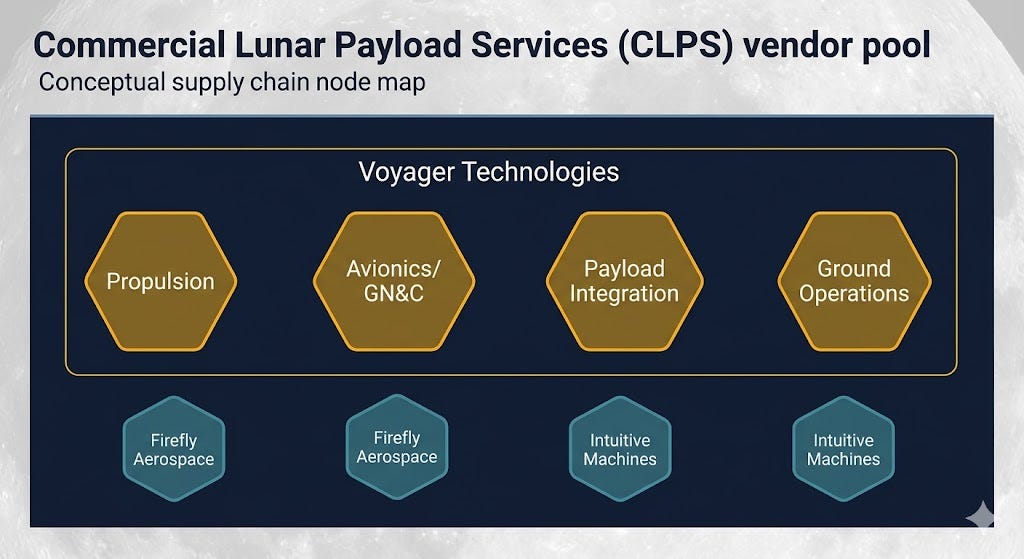
Voyager Technologies acquired Astrobotic Technology in early 2025, and with it, the most active lander portfolio in NASA’s Commercial Lunar Payload Services program. It also came with a heritage record that consists of one flight attempt that didn’t reach lunar orbit. [Paywall]
Peregrine Mission 1 launched in January 2024, and suffered a propellant leak within hours of separation. The spacecraft reentered Earth’s atmosphere ten days later. NASA hasn’t released a final root-cause determination. Voyager-Astrobotic now owns that propulsion architecture, the avionics and guidance stack, the payload integration interface specifications, and the ground operations infrastructure for both the Peregrine and Griffin landers.
Griffin is the more consequential issue. NASA canceled the VIPER mission, Griffin’s primary payload, in July 2024, before the acquisition closed. Griffin is currently a large-class lander without a confirmed payload customer. Any organization that has designed a payload to Astrobotic’s interface specifications and needs to re-manifest to an alternative platform is looking at 18 to 24 months of re-qualification work, minimum.
Two alternatives with active flight records exist: Firefly Aerospace, whose Blue Ghost Mission 1 landed successfully in March 2025, and Intuitive Machines, publicly traded as LUNR, with the Nova-C lander’s IM-1 Odysseus flight in February 2024. The pool isn’t empty, but it’s thinner than the vendor count suggests once you account for interface re-qualification.
-0-
You Might have Missed
South Australia Range Signs U.S. Firm for Multiple Orbital Reentry Missions
Pentagon Awards Quantum Space Contract to Demonstrate Orbital Fuel Depot
Satellite Thruster Pointing Production to Increase Tenfold With Austrian Facility Expansion
One Factory Fire Away [Paywall]
Theme Stock Music “Interesting Facts” Provided by Pond 5


