


What This Means
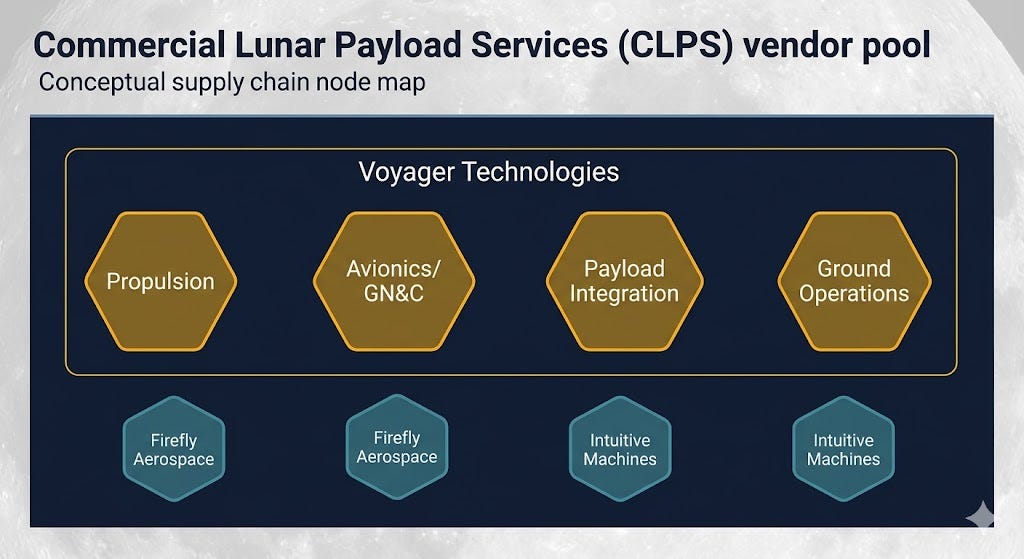
Voyager Technologies’ acquisition of Astrobotic Technology consolidates the Commercial Lunar Payload Services (CLPS) program’s most operationally active lander portfolio, covering propulsion, avionics, payload integration, and ground operations, inside a single defense-integrator parent. That consolidation creates identifiable single-entity choke points at each of those capability nodes. Griffin, Astrobotic’s large-class lander, has no active primary payload manifest following NASA’s cancellation of the Volatiles Investigating Polar Exploration Rover (VIPER) mission. For prime contractor supply chain executives and program managers with active or anticipated CLPS payload integration responsibilities, the operative question is not whether this deal was strategically sound for Voyager, but whether your organization’s sub-tier sourcing strategy still holds in a vendor pool that just became structurally thinner.
The Signal: What Changed Hands
Voyager Technologies confirmed its acquisition of Astrobotic Technology, Inc. in early 2025. The deal transferred Astrobotic’s full CLPS task order portfolio under NASA contract vehicle NNH19ZCQ001K, its lander programs, its operational assets, and its accumulated mission heritage record into Voyager’s corporate structure.
Contract novation status on the CLPS task orders should be confirmed against current SAM.gov entity records before any organization relies on Voyager-Astrobotic as a contracted counterparty. A signed acquisition and a formally novated government contract are not the same instrument. The Griffin and Peregrine task order status on USASpending.gov should be treated as the authoritative reference until novation is confirmed.
What Voyager acquired in structural terms: the CLPS program’s most extensive lander portfolio by program count, a sub-tier supply chain assembled across two lander development programs, a ground operations infrastructure developed for Peregrine Mission 1, and a corporate mission heritage record consisting of one flight attempt that ended before reaching lunar orbit.
That sentence is not an indictment of the deal. It is the current heritage record.
Voyager Technologies is a defense and national security systems integrator whose contract history on USASpending.gov reflects a portfolio that, based on Voyager’s publicly available USASpending.gov record and its stated organizational focus, appears weighted toward intelligence community and Department of Defense (DoD) customers. It had no prior commercial lunar program operating record before this acquisition. What it now has is Astrobotic’s program portfolio and the liability that comes with that heritage.
No publicly disclosed financial terms, including purchase price, earnout structures, or integration timelines, have been released. The analysis that follows does not depend on any undisclosed financial data.
The Supply Chain Map: Four Nodes, One Parent
The CLPS program contract vehicle was explicitly designed to maintain a competitive, multi-vendor pool. That design rationale, spread mission risk across independent supplier entities, is structurally weakened when a single corporate parent controls the most active lander portfolio in the pool. The Voyager-Astrobotic acquisition is the first major ownership-consolidation event within the CLPS vendor pool. (Astrobotic itself acquired the assets of Masten Space Systems in 2022 after Masten’s bankruptcy, but Masten held no active CLPS task orders at the time and did not constitute a mission-capable acquisition target within the pool.)
Here is what Voyager-Astrobotic now controls across four supply chain nodes relevant to prime contractor sourcing decisions.
Node 1: Propulsion
Astrobotic’s Peregrine Mission 1 launched January 8, 2024, aboard United Launch Alliance’s (ULA’s) Vulcan Centaur rocket. Within hours of separation, a propellant leak compromised attitude control. The spacecraft reentered Earth’s atmosphere approximately January 18, 2024. The mission-level failure and propellant system anomaly are established in official Astrobotic and NASA communications. NASA has not publicly released a final root-cause determination assigning confirmed subsystem attribution as of mid-2025. The risk characterization in what follows is scoped to the propellant failure sequence as officially documented, not to a confirmed valve-level or line-level root cause.
What the official record does establish: Voyager-Astrobotic now owns a propulsion architecture with a documented in-flight failure on its only operational flight. The integration work that produced that architecture, including whatever contributed to the anomaly, is now Voyager’s engineering inheritance. That is a risk signal that belongs on a prime contractor’s risk register regardless of what a future root-cause determination concludes.
Griffin’s propulsion system was developed for a heavier payload class than Peregrine. The two systems are not identical. Whether the anomaly’s contributing factors, whatever they prove to be, are relevant to Griffin’s architecture is a question your engineering team should be asking now, not after Griffin’s first flight attempt.
Node 2: Avionics and Guidance, Navigation, and Control (GN&C)
[Class 2, Inference] Trade press coverage (SpaceNews, Aviation Week) identifies Astrobotic as having relied on a mix of commercially sourced inertial measurement units and flight computer components common across the small satellite and planetary spacecraft community. Class 1 sub-award records on USASpending.gov do not, as of mid-2025, identify specific avionics sub-tier vendors by name at the component level. The supply chain map at this node is bounded by what the public record permits: Voyager-Astrobotic controls the integration architecture and interface heritage for both Peregrine and Griffin avionics stacks. Sub-tier component suppliers in the commercial avionics market are not exclusive to Astrobotic. The lock-in risk at this node is not component availability; it is interface specification and integration heritage. A payload designed to Astrobotic’s Guidance, Navigation, and Control interface standards requires re-qualification to operate on an alternative lander platform. Organizations seeking more granular sub-tier avionics data may find it through formal requests under Federal Acquisition Regulation sub-award reporting requirements.
The next section maps the payload integration node where interface-specification lock-in is most consequential, estimates the re-qualification lead time if your program needs to re-manifest, identifies the staffing continuity risk that no public record can currently resolve, and names the five immediate verification steps your team can execute today. Subscribers also receive the complete Decision Questions section calibrated by organizational role and the Related Decisions checklist built on Class 1 public sources.
