

Behind NASA’s Three-Directorate Restructuring
Why This is a Procurement Story, Not an Org Chart Story

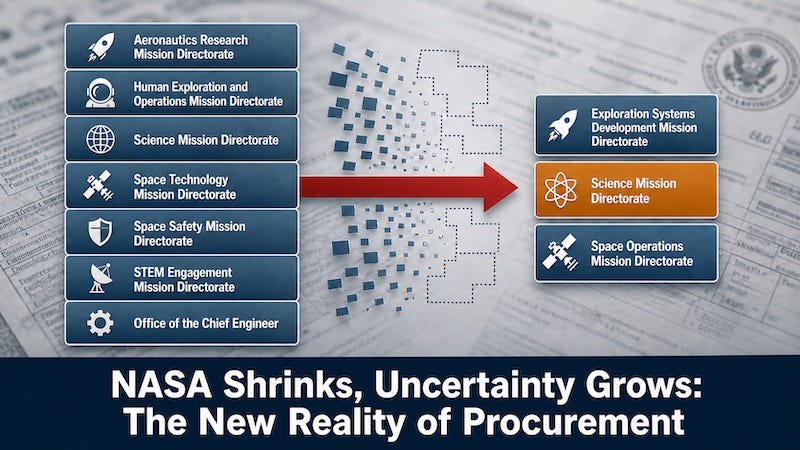
What This Means: The National Aeronautics and Space Administration (NASA) has collapsed its organizational structure from seven mission directorates to three, and the consequences are already moving through contracting chains. The Science Mission Directorate faces a proposed budget reduction of approximately 50 percent relative to the fiscal year (FY) 2025 enacted level, while Axiom Space, Vast Space, and Blue Origin are managing forward production plans against a Commercial Low Earth Orbit Destinations (CLD) payment schedule that NASA restructured earlier this year. Program managers and contractors who built acquisition strategies around the old structure face a window of genuine uncertainty: not because missions have changed, but because the organizational seams through which money and tasking travel have moved. The contracting implications are not hypothetical. They are arriving now.
NASA’s new administrator, Jared Isaacman, took office in April 2026 with a clear mandate to cut administrative layers and redirect resources toward what the agency calls core exploration and science priorities. Within weeks, NASA began consolidating its mission directorate structure from seven directorates to three: the Exploration Systems Development Mission Directorate (ESDMD), a reconstituted Science Mission Directorate (SMD), and a Space Operations Mission Directorate (SOMD).
The change ranks among the most significant administrative restructurings at NASA since the 2004 Vision for Space Exploration, which itself triggered years of contracting realignment. The question for government buyers, policy professionals, and contractors is which programs will survive the reorganization intact, which face delays while authorities are reassigned, and which suppliers are now working against an uncertain tasking clock.
The Signal: Seven to Three, and What That Arithmetic Means for Procurement
The old structure included the ESDMD, the SMD, the SOMD, the Space Technology Mission Directorate (STMD), the Aeronautics Research Mission Directorate (ARMD), the Mission Support Directorate, and the Office of STEM Engagement. The incoming structure absorbs or eliminates several of those lanes.
Reporting by SpaceNews and Ars Technica as of mid-2026 indicates that the STMD is being wound down as a standalone entity, with its programs being distributed across the three surviving directorates or terminated outright. The ARMD faces similar treatment. No specific NASA press release or Federal Register notice had publicly confirmed the complete transition roster as of June 2026; the directorate-wind-down claims reflect multiple media sources and leadership statements rather than a single definitive official document, and readers should treat the program routing details as directional until NASA releases formal documentation.
That qualification matters less for what it obscures and more for what it reveals: even the agency’s own contracting community cannot yet confirm, from public documentation, where every migrating program lands. That ambiguity is itself the risk. Every active contract carries a funding authority, a contracting officer, and a program management chain. When that chain changes, even temporarily, delivery timelines shift. Amendments take time. Novation for transferred contracts adds administrative drag. Suppliers with work tied to the legacy STMD or ARMD structures need to know their program’s new administrative home before they can forecast their next task order or delivery order.
