

Pentagon Awards Quantum Space Contract to Demonstrate Orbital Fuel Depot
OECIF Funding Targets Routine In-Space Refueling to Extend Spacecraft Life and Expand Space Force Options

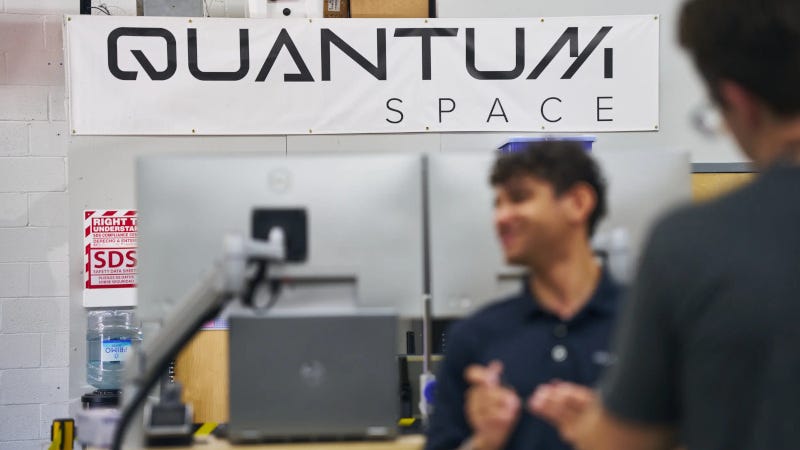
A Department of War contract will fund a fuel depot spacecraft demonstration by Rockville, Maryland-based Quantum Space, the company announced June 18.
“National security in space depends on the ability to maneuver, adapt, and sustain operations over time.”
Jim Bridenstine, Quantum Space
The award comes through the Operational Energy Capability Improvement Fund, or OECIF, a Defense Department program that invests in energy technologies to advance military operational capabilities. Financial terms were not disclosed.
Quantum Space is building the fuel depot on its Ranger platform, a maneuverable spacecraft engineered for operations across multiple orbital regimes, including geostationary orbit and cislunar space. The depot architecture is designed to refuel spacecraft and provide on-orbit logistics capabilities the company says are critical for sustaining U.S. space superiority in contested domains. Ranger uses a patented multimode propulsion system that combines chemical and electric capability on a single vehicle using a single fuel type, enabling both high-thrust maneuvering and high-efficiency sustained operations.
Jim Bridenstine, CEO of Quantum Space and former NASA Administrator, said the contract moves the company toward a broader logistics architecture.
“National security in space depends on the ability to maneuver, adapt, and sustain operations over time,” Bridenstine said. “This fuel depot contract is a transformational step toward building the in-space logistics architecture the United States requires for resilient, enduring space operations. It extends the life of high-value assets and creates operational options that fixed architectures simply cannot provide.”
Chris DePuma, OECIF’s Operational Energy and Combat Power portfolio lead, said the award converts a long-held concept into funded action.
“For years, in-space refueling has been a concept on our capability roadmaps,” DePuma said. “Today, we are investing to make it an operational reality. The OECIF award accelerates the deployment of critical refueling infrastructure, answering the urgent call for a persistent, maneuverable space logistics network. By removing traditional fuel constraints, we are not just keeping our vital assets ready — we are unlocking entirely new mission sets and novel operations, giving our space warfighters the sustained agility they need to outmaneuver threats in a dynamic domain.”
Ben Reed, co-founder of Quantum Space, said the industry has reached an inflection point. Reed brings two decades of NASA experience, including roles on three Hubble Space Telescope servicing missions and leadership as Division Chief of the agency’s robotic satellite servicing program.
“The time for a shift from demonstrations toward operational depots is now,” Reed said. “The technologies are mature, the mission need is urgent, and Quantum Space possesses capital for delivery.”
Quantum Space also holds a contract for the U.S. Space Force’s Andromeda program, which the company said reflects growing institutional recognition that dynamic space operations require persistent, maneuverable, and serviceable infrastructure across multiple orbits.
The company recently announced a proposed business combination with Inflection Point Acquisition Corp. VI (Nasdaq: IPFX) that is expected to result in a Nasdaq listing later this year, subject to shareholder approvals and regulatory clearances.