

Studying Space Weather’s Reach Into Earth’s Atmosphere
NASA Greenlights Twin-Satellite DAPHNE Mission To Improve Space Weather Forecasting

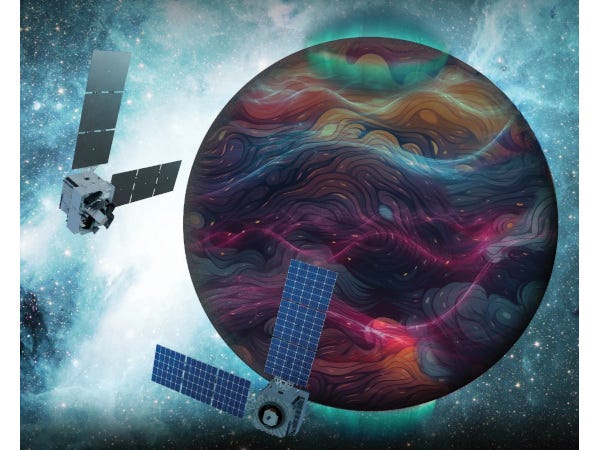
A new NASA mission will use a pair of identical satellites to track how disturbances from the Sun and changes in Earth’s lower atmosphere interact in the thin region where the planet’s air gives way to space.
“DAPHNE will join the NASA science fleet strategically located across the solar system to provide data that will help mission planners predict and mitigate the effects of space weather.”
Nicola Fox, NASA
The DAPHNE (Dynamic Atmosphere-Ionosphere Explorer) mission has been cleared to enter Phase B, where engineers and scientists will complete detailed planning and design for flight hardware and mission operations. The mission will rely on twin spacecraft flying through the thermosphere and ionosphere to take coordinated measurements of neutral winds, temperature, and atmospheric composition, data that feed directly into models used to protect spacecraft, communications and navigation services, and astronauts in orbit.
NASA Associate Administrator for the Science Mission Directorate Nicola “Nicky” Fox said the mission is part of a broader effort to strengthen the nation’s resilience to solar storms and related effects on technology. “As NASA sends astronauts beyond Earth’s magnetic protection to the Moon, Mars, and beyond, DAPHNE will join the NASA science fleet strategically located across the solar system to provide data that will help mission planners predict and mitigate the effects of space weather for the benefit of all,” Fox said in the announcement.
DAPHNE is designed as what the agency describes as a low-risk, high-return mission concept, using identical instruments on both satellites to capture multi-point data in a part of the upper atmosphere that remains difficult to model. The thermosphere and ionosphere form a thin shell around Earth where the neutral atmosphere transitions into ionized plasma, and where conditions are driven both by activity on the Sun and by energy and waves propagating upward from the lower atmosphere.
By bringing together measurements of those neutral winds and temperatures with information on how energy from below moves into the upper atmosphere, the mission team expects to refine space weather prediction tools that operators rely on to plan safe satellite operations and protect critical services such as GPS. The science team is led by principal investigator Aimee Merkel of the Laboratory for Atmospheric and Space Physics at the University of Colorado Boulder.
The mission will undergo a confirmation review in 2027 to assess technical progress and budget. If approved to proceed, DAPHNE’s lifecycle cost excluding launch is capped at the equivalent of about $250 million in 2023 U.S. dollars, and the satellites would launch no earlier than 2029.
DAPHNE originated as a concept proposed under NASA’s DYNAMIC (Dynamical Neutral Atmosphere-Ionosphere Coupling) mission announcement of opportunity. It is managed under the agency’s Solar Terrestrial Probes program at NASA’s Goddard Space Flight Center in Greenbelt, Maryland, which oversees a portfolio of heliophysics missions that study how the Sun and the space environment interact with Earth.