

NASA Launch Sites Face Capacity Crisis as Commercial Space Boom Strains Aging Infrastructure
Federal Watchdog Warns Kennedy Space Center Could Hit Operational Limits by 2029; Needs at Least $1 Billion in Upgrades

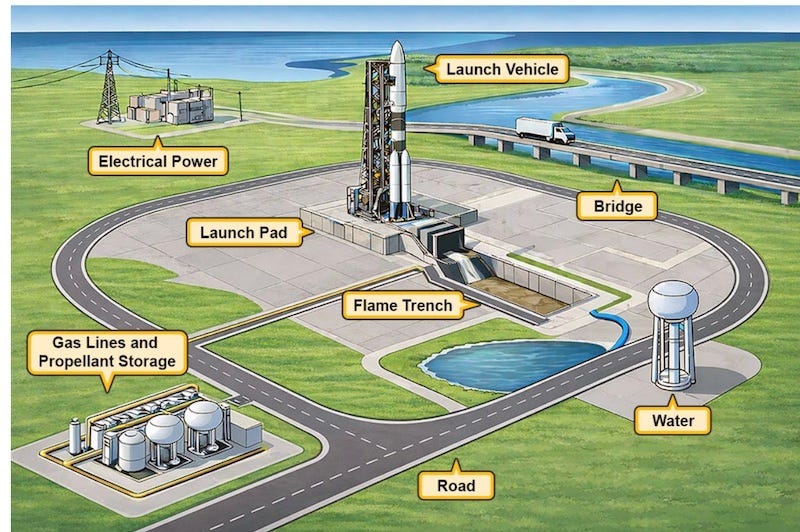
A federal audit released Monday warns that NASA’s two primary launch sites are running out of capacity to support a dramatic surge in commercial and government launches, with aging infrastructure — some dating to the Apollo era — at risk of causing mission delays unless Congress removes funding barriers and the agency accelerates long-deferred repairs.
“Without timely fixes to NASA’s launch infrastructure challenges, ambitious national goals to return humans to the Moon before the end of the decade and accelerate missions to Mars could be at risk.”
NASA OIG Report
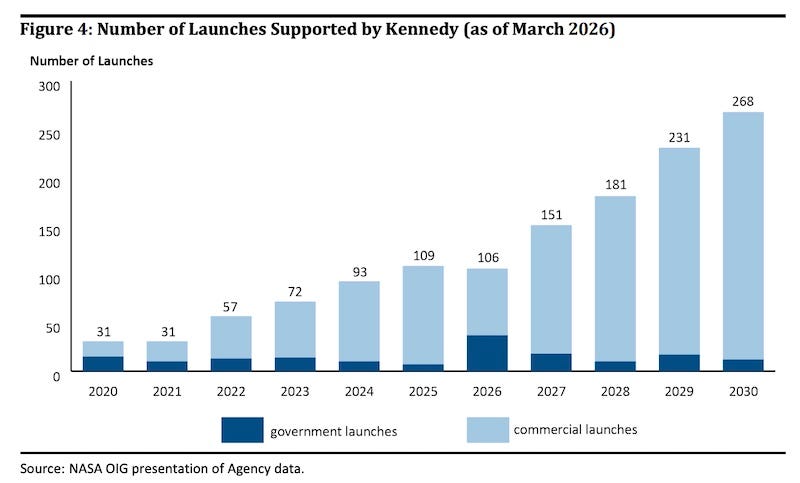
The NASA Office of Inspector General report, “NASA’s Launch Infrastructure” (IG-26-010), found that Kennedy Space Center in Florida and Wallops Flight Facility in Virginia are both projected to approach or reach operational capacity by 2028 to 2029, driven largely by an explosion in commercial launches. Launches supported by Kennedy grew from 31 in 2020 to 109 in 2025 — a 252 percent increase — and are projected to reach 268 per year by 2030. Wallops saw an even steeper climb, from 3 launches in 2020 to 17 in 2025, a 467 percent jump, with projections reaching 44 launches annually by 2030.
“Without timely fixes to NASA’s launch infrastructure challenges, ambitious national goals to return humans to the Moon before the end of the decade and accelerate missions to Mars could be at risk,” the report stated.
Much of Kennedy’s critical shared infrastructure — electrical power distribution systems, gas supply pipelines, and roads — was built in the 1960s to support the Apollo program, designed to accommodate one mission at a time with months between launches. Today, that same infrastructure must support dozens of launches per year by SpaceX, Blue Origin, United Launch Alliance, and others, in addition to NASA’s own Artemis missions.
The report found that underground electrical conduits, known as duct banks, installed using Orangeburg pipe — a wood fiber and coal tar material with a 50-year useful life not used in construction since the 1970s — have partially collapsed. The three high-power transformers at Kennedy’s C-5 Substation are also in poor condition, with two of the three installed in 1995 now at the end of their 30-year design life, and corrosion worsening in Florida’s heat and humidity. Kennedy officials told auditors that a transformer failure could halt launch operations for at least a month.
Repairs to replace the collapsed duct banks and aging transformers are planned but carry a combined price tag of $136 million and are not expected to begin until the end of fiscal year 2026, leaving current launch operations exposed in the interim.
Gas supply infrastructure presents additional scheduling risks. Kennedy’s gaseous nitrogen system cannot simultaneously support multiple high-demand users. Blue Origin officials told auditors the constraint created a “major scheduling challenge” ahead of the New Glenn-1 mission in January 2025, and warned of potential one- to two-month nitrogen pipeline blackout periods during future Space Launch System launches. A proposed new nitrogen system to address the problem is estimated at up to $25 million but remains unfunded.
Electrical power demand is also expected to outpace current capacity. A single SpaceX Starship launch could potentially exceed the available power at Launch Complex 39A. SpaceX plans to use Tesla Megapack battery storage systems as a short-term workaround, but long-term plans for on-site propellant generation at the pad will require substantially more power than existing infrastructure can deliver.
Kennedy’s road network — 231 miles of paved roads and six bridges — is under mounting strain as well. Heavy truck traffic has risen from 1,956 trips in 2019 to 8,752 trips in 2025, a 347 percent increase. Auditors noted that a full pavement condition survey has not been conducted since 2011, leaving officials without a clear picture of the extent of deterioration. With launch rates continuing to climb, the report estimated roadway traffic will grow by approximately 19,000 additional truck trips per year.
Wallops fared better in the audit due to recent upgrades to its shared infrastructure, though auditors noted it could reach its current capacity limit of 32 launches per year as early as 2028.
Funding is central to the problem. The agency’s construction and maintenance budgets have declined between 11 and 47 percent in inflation-adjusted terms over the past five years. Statutory restrictions prevent NASA from directly accepting money from commercial partners — who account for approximately 70 percent of launches since 2020 — to fund shared infrastructure repairs. A proposed Infrastructure Investment Fund that would allow NASA to accept contributions from public and private entities for large-scale shared infrastructure projects was first proposed a decade ago, but enabling legislation has never passed.
Kennedy received $250 million for infrastructure improvements through the H.R.1 reconciliation bill, but Kennedy officials estimated the center would need at least $1 billion to fully modernize its launch infrastructure.
The Inspector General made three recommendations to the Kennedy Space Center Director: conduct a traffic impact study on roadways and establish a mitigation plan; prioritize reconciliation bill funding to address electrical power, gas, and transportation infrastructure; and assess whether an “Other Approved Indirect Rate” can be charged to commercial partners on reimbursable agreements — a cost-recovery mechanism Wallops already uses but Kennedy does not. NASA management concurred with all three recommendations.