


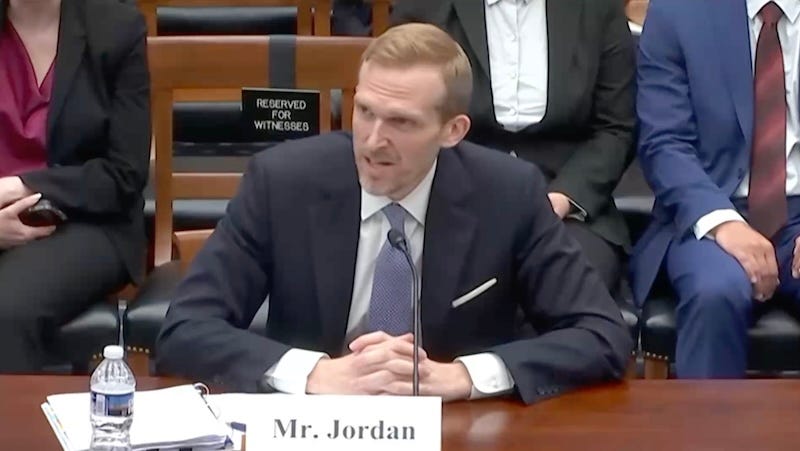
Office of Space Commerce Director Taylor Jordan testified before the House Science, Space, and Technology Committee’s space subcommittee on July 15, defending a new framework called the Space Commerce Certification.
The proposal is the Trump administration’s answer to a long‑standing problem: a growing number of commercial space activities don’t fall under any existing federal license.
Currently, the FAA regulates launch and re‑entry, the FCC regulates radio frequency transmission, and the Department of Commerce regulates remote sensing. But satellite servicing, in‑space manufacturing, commercial space stations, and lunar operations don’t clearly belong to anyone.
Taylor Jordan told lawmakers the gap isn’t just a paperwork problem, it’s a compliance issue under Article Six of the 1967 Outer Space Treaty. That document requires the U.S. to authorize and supervise the activities of its non‑governmental actors in space.
“Everything else is shoehorned into legacy processes never designed to handle them. U.S. regulations simply do not offer a clear path to “yes” for novel activities,” Jordan said. “Instead, they risk trapping our industry in an endless maze. executive.”
Under the plan, the Office of Space Commerce would act as a single clearinghouse. Companies would submit one application, which OSC would then circulate to the Department of War, the FAA, the FCC, the State Department, and NASA for review.
It wouldn’t strip any agency of its existing authority, but it could let the FAA or FCC waive parts of their own review if a mission already holds a Space Commerce Certification.
Jordan outlined one of the core components of the framework: a presumption of approval for novel space activities, which he said would give investors the predictability they need and require the government to justify a “no” instead of forcing industry to beg for a “yes”.
“A key pillar of our process is the presumption of approval. For novel space activities, regulatory ambiguity prevents the free flow of capital,” Jordan said. “This process would give investors the predictability they need that supports the growth of the industry. It would require the government to justify a no rather than forcing industry to beg for a yes.”
But the plan drew pointed questions from both sides of the aisle, and not every lawmaker was convinced the agency is positioned to pull it off.
Ranking Member Zoe Lofgren of California raised concerns about the agency’s funding level, noting that the White House requested just 11 million dollars for the Office of Space Commerce for fiscal year 2027, an 80 percent cut from the fiscal year 2026 appropriation.
“Should we conclude from this budget request that the administration does not prioritize ensuring that the United States remains the world leader in commercial space?,” Lofgren said. “It’s not clear to me how the office of space commerce would be able to take on the added responsibilities we’re about to hear about today.”
Republican Pete Sessions of Texas pressed Jordan on whether the government is trying to catch up with industry or holding it back. Jordan said the goal is to build a system that works alongside fast‑moving commercial activity.
“So we are trying to catch up. But the truth of the matter is we will never catch up to what industry is doing and how fast they are going. Creating a system today that is modular is the best way to move forward because industry is going to do what industry does and that’s move fast and provide capabilities that the US federal government relies on,” Jordan said. “We need to give them the confidence and the clarity to keep doing what they do. Now we also need to catch up if you will allow me on the international front. We have today cobbled together our ability to respond to the Outer Space Treaty through existing regulations. And sure we meet the bare minimum requirements for our treaty obligations but we need to meet the moment and meet industry where they are. So to be clear we need to catch up because we are not meeting industry where they are at today.”
For now, the certification framework remains voluntary and is still awaiting formal sign‑off from the White House. Jordan told the committee that once it’s approved, OSC plans to launch an initial pilot phase focused on mature technologies nearing operational status, and refine the process from there.
-0-

In-space logistics company Kall Morris is turning International Space Station experiment time into a playbook for debris‑removal and satellite‑servicing missions.
The company’s REACCH system, short for Responsive Engaging Arms for Captive Care and Handling, ran more than 170 capture trials on the station using tentacle‑like arms with gecko‑inspired adhesive pads.
Astronauts varied surface materials and motion through the campaign, building a dataset that would’ve been prohibitively expensive to collect with one‑off small satellites.
Instead of wrapping a target, REACCH attaches to a surface and then pushes, allowing it to move unprepared objects larger than itself away from collision paths or toward controlled deorbit.
The system is designed specifically for unprepared targets that weren’t built with capture interfaces, which sets it apart from servicing systems that require cooperative spacecraft.
Kall Morris is now planning follow‑on tests beyond the station and positioning REACCH for life‑extension, relocation, and debris‑removal missions in low Earth orbit, where operators and insurers are looking for practical tools to manage congestion.
-0-

Relativity Space is expanding its Florida footprint with a new facility aimed at supporting production and testing for its next‑generation launch vehicle.
The company plans to bring more of its large‑scale metal 3D printing closer to customers and the range, tightening the loop between design, manufacturing, and flight.
State and local incentives are tied to jobs and capital investment, reflecting how launch‑adjacent manufacturing is being treated as industrial base, not just spaceport support.
For suppliers, the new facility signals ongoing demand for materials and precision parts compatible with additive manufacturing, and for program managers it underscores Florida’s dual role as both launch site and production hub.
Relativity says co‑locating these functions should accelerate development cycles, a priority as customers push for faster, more responsive launch options.
-0-

Redwire is adding capacity in Indiana with a new facility focused on advanced manufacturing for space infrastructure and microgravity‑related products.
The site will give the company more room to scale hardware for stations, satellites, and in‑space manufacturing platforms that were stretching existing facilities.
Officials are tying the project to regional workforce development, drawing on Midwestern manufacturing skills for aerospace‑grade production.
For primes and integrators, an additional U.S. Redwire plant diversifies the source for critical components and reduces logistics risk as more platforms move to commercial operating models.
As those platforms come online, program and supply chain teams will have a broader domestic base to tap when they structure multiyear contracts.
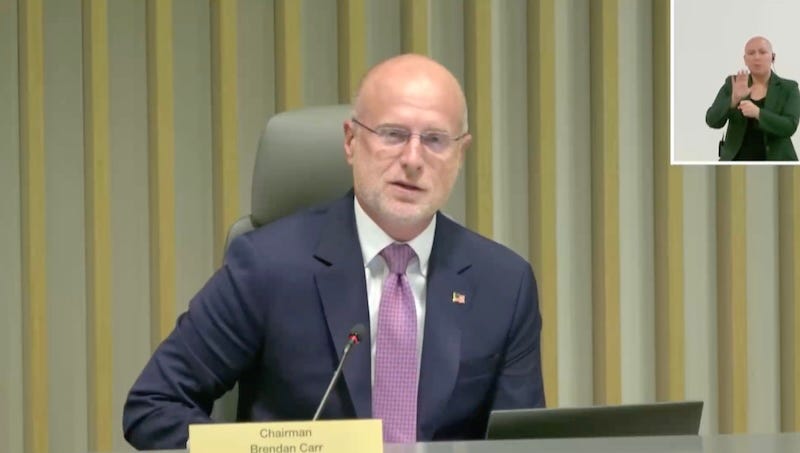
The Federal Communications Commission approved a new Part 100 to unify satellite spectrum sharing rules and move away from case‑by‑case coordination under Part 25 at their July monthly meeting on Wednesday.
In International Bureau Docket 25‑306, the agency outlines a power spectral flux density formula that would cap how much signal any non‑geostationary system can direct toward Earth or the geostationary arc in shared bands.
The change is meant to scale a framework that was built for a handful of constellations into one that will accomodate dozens of broadband, direct‑to‑device, and servicing systems all competing for Ku‑, Ka‑, and V‑band access.
During the commission’s July monthly meeting, FCC Space Bureau Acting Associate Division Chief of the Satellite Programs and Policy Division Brandon Padgett, outlined the provisions of the new Part 100.
“This report in order would replace Part 25 of the Commission’s rules with Part 100. In doing so, it would delete unnecessary and outdated rules and organize the new rules in a manner that’s easier to understand. Additionally, it would create an application processing framework based on bright-line criteria presumed to be in the public interest, modify processing round procedures, and remove bond requirement for certain space stations,” Padgett said. “It would also create a new variable trajectory space station license category, extend license terms for most space and earth stations to 20 years, allow for a nationwide blanket licensing approach for earth stations, and require space station operators to share space situational awareness data. In addition, the item includes a further notice of proposed rulemaking that would seek comment on additional proposals and reforms intended to build upon the new Part 100.”
There was no objection to the change on the three-member commission. Prior to the vote, Chairman Brendan Carr said the commission was making an unprecedented move.
“We’re scrapping our old rules in their entirety and replacing them with better new ones. This kind of ambition shouldn’t be taken for granted. Regulators tend to tinker around the edges. They don’t throw away the rule book and rewrite it from scratch. They take years and decades to reform, not 18 months. The Space Bureau landed the rare trifecta on that, all while pushing through other game-changing reforms on spectrum sharing and spectrum abundance. There’s so much to like in the new Part 100 rules for one speed and predictability is built into the DNA,” Carr said. “The new rules establish bright lines and eliminate fuzzy standards. They keep licensing focused on the FCC’s core statutory responsibilities, spectrum management, harmful interference, national security, and orbital debris. They eliminate guessing games and hidden requirements. While most applications will breeze through a fast lane, the new rules outline the limited situations when more targeted review is needed. And if an application falls within the four corners of our new Part 100, it’s presumed to serve the public interest. That’s just not making promises. The rules say this with clarity.” 9:57
Newer entrants generally see a clear formula as a way to prevent incumbents from stretching out negotiations, while established non‑geostationary and geostationary operators worry about retroactive constraints and aggregate interference.
Part 100 would also create a separate lane for in‑space servicing, assembly, and manufacturing missions with added debris‑mitigation bonding, so proximity‑operations programs will need to align designs and timelines with that category.
The Part-100 rule was approved unanimously.
-0-

Last week, the FCC approved Reflect Orbital’s Earendil‑1 satellite, a testbed for space‑based reflector technology designed to redirect sunlight to specific areas on the ground.
The single non‑geostationary spacecraft is authorized in the Space Operation and Space Research services, with operations at an altitude of about 390 miles at a near‑polar inclination, and use of S‑, X‑, and UHF‑band links.
Reflect Orbital told the FCC the concept could extend usable hours for solar cells and provide illumination for critical operations. The order conditions operations so links occur only when the satellite is visible to designated earth stations.
The Space Bureau rejected a “petition to deny” from the American Astronomical Society, but said concerns from astronomers and the public are addressed through the technical and operational limits in the authorization.
For operators, Earendil‑1 is an early test of whether reflected sunlight from orbit can become an infrastructure tool for power and operations.
Also of Interest:
Network Demand Drives $70 Million Funding Round for Small GEO Satellite Manufacturer
National Council Forms To Coordinate State Space Capacity
Weather Satellites To Gain Higher-Precision Navigation For 2032 GeoXO Missions
Theme Stock Music Provided by Pond 5


