


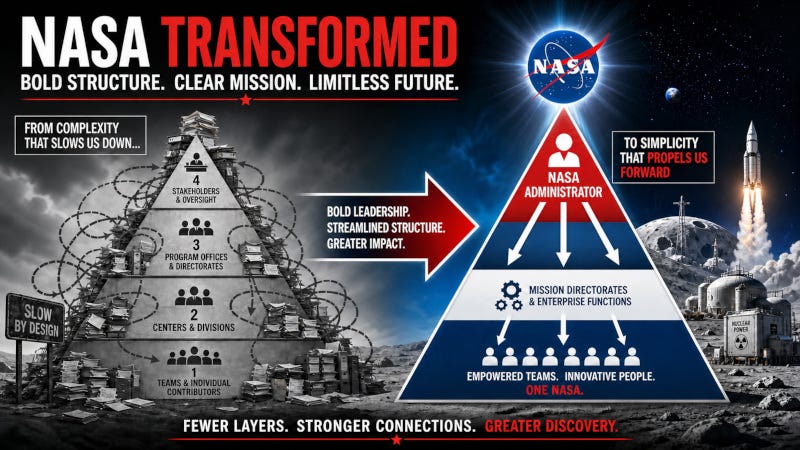
NASA is reshaping its leadership structure in what Administrator Jared Isaacman is calling a realignment to accelerate mission delivery.
Under the reorganization announced last week, the agency is consolidating its five mission directorates into three. The ‘Exploration Systems Development’ mission directorate and the ‘Space Operations’ mission directorate are merging into a new ‘Human Spaceflight’ mission directorate. On the technology side, the ‘Aeronautics Research’ and ‘Space Technology’ directorates will combine into a new ‘Research and Technology’ mission directorate, which will also take on nuclear power and propulsion development. The ‘Science Mission Directorate’ remains unchanged.
One of the more significant structural shifts: all directorate leaders will now report directly to the Administrator, rather than through layers of management. Isaacman says the goal is to cut bureaucratic drag and focus the agency’s talent on its top priorities, returning humans to the Moon, building a sustainable lunar base, and expanding the commercial economy in low Earth orbit.
The reorganization also brings new leadership to three field centers, Goddard, Glenn, and Kennedy, and sets up a competition for the contract to manage the Jet Propulsion Laboratory when Caltech’s current agreement expires in 2028.
For the commercial space industry, the realignment signals where NASA is directing its institutional weight. A leaner, more mission-focused NASA, with directorates reporting directly to the top, could mean faster decisions on commercial partnerships, procurement actions, and program commitments. That matters for anyone in the supply chain waiting on a government signal to move.
-0-
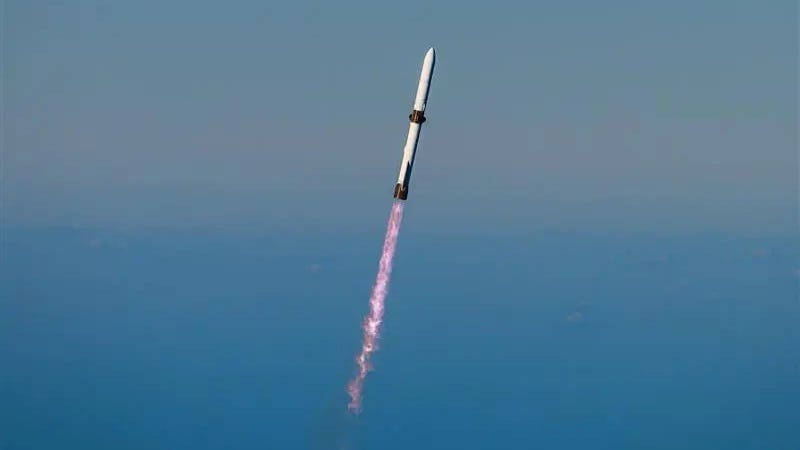
Blue Origin is making one of the largest single manufacturing investments in Florida’s space history.
The Jeff Bezos-founded rocket company announced a 600-million-dollar expansion of its Rocket Park campus at Cape Canaveral, a project the company is calling Project Horizon. The centerpiece is an 830-thousand-square-foot upper stage manufacturing facility designed to increase the volume and mass Blue Origin can deliver to orbit from Florida.
The project is expected to generate 500 aerospace jobs, with average salaries topping 98-thousand dollars a year.
For the Space Coast, this is more than a construction announcement. Upper stage manufacturing is a high-precision, high-skill segment of the launch supply chain, the kind of facility that anchors a regional industrial base and draws sub-tier suppliers into the area. Blue Origin’s investment is a long-term signal that it intends to compete aggressively in the launch market from Florida. And the ripple effects on local suppliers, workforce pipelines, and adjacent infrastructure could be substantial.
-0-
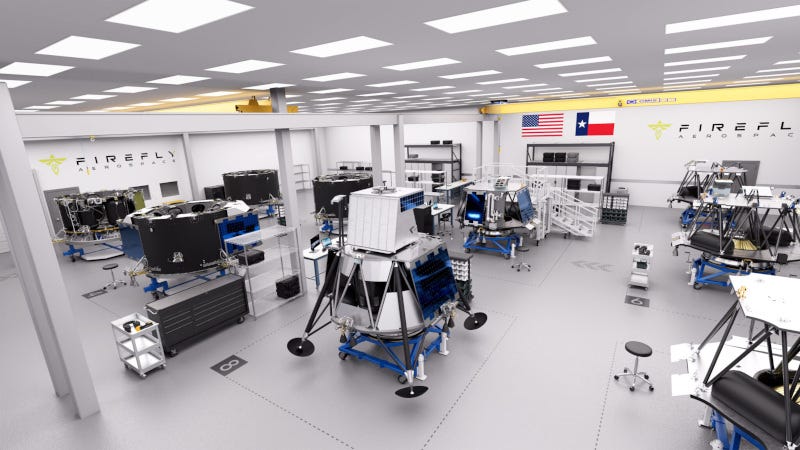
Meanwhile, about 1,000 miles to the west, Firefly Aerospace is executing a different kind of manufacturing buildout, one focused on turning spacecraft production from a one-at-a-time process into a repeatable assembly line.
The Cedar Park, Texas company has moved into a new headquarters campus, adding two new buildings to its existing spacecraft facility. Put together, the new buildings give Firefly roughly 144-thousand square feet of unified space — double what it had before. That campus sits less than 30 miles from the Rocket Ranch in Briggs, Texas, a 200-acre complex with six test stands dedicated to launch vehicle development.
The centerpiece of the expansion is a new cleanroom ... four times larger than Firefly’s existing one and funded by a Texas Space Commission grant ... designed to support dedicated assembly lines for Blue Ghost lunar landers and Elytra orbital vehicles. Running multiple vehicles through integration concurrently is a direct answer to the production bottlenecks that have slowed spacecraft manufacturers trying to scale.
Firefly has also established an in-house innovation lab called Gloworks, bringing propulsion, carbon composites, robotics, and 3-D printing capabilities under one roof. The idea is to compress lead times and keep critical intellectual property inside the company rather than farming it out to external suppliers.
The company says the Cedar Park investments allow Firefly to template its Blue Ghost lunar lander into a production line capable of supporting multiple lunar missions per year. For a commercial space industrial base that is still largely built around one-off fabrication, that kind of throughput ambition is worth watching closely.
-0-
A new report released at the 2026 ASCEND Conference is putting hard numbers on a concern that has been building quietly in the launch industry: the United States may not have enough capacity to handle what’s coming.
The report is titled “SCRUBBED: America’s Launch Capacity Challenge”. It was produced by Rational Futures in partnership with the Commercial Space Federation using FCC regulatory filings, government budget data, and orbital mechanics modeling to map three demand scenarios against existing U.S. launch infrastructure.
The numbers are significant. With more than 180 launches conducted from U.S. soil in 2025, the report finds that demand could require up to 7,000 launches per year depending on which satellite constellations move to full operation. Annual spacecraft demand could range from 6,000 to as many as 230,000 satellites.
The report identifies two categories of concern. At traditional launch sites like Cape Canaveral and Vandenberg, the primary obstacle isn’t physical space, it’s coordination. The report calls for a central management authority to handle zoning, shared infrastructure scheduling, and a reduction of evacuation zones through improved analysis of methane explosive yield.
For newer and non-traditional inland spaceports, the challenge is economics. Standing up a site capable of supporting 10 to 20 orbital launches per year costs roughly 200-million dollars, a figure that market activity alone is unlikely to recover. The report identifies federal tools that could bridge the gap, including anchor tenancy arrangements and direct capital funding.
The findings are landing at a policy-active moment. The Trump Administration is currently revising the National Space Transportation Policy, and the report’s authors are explicit: waiting for market forces to solve this problem on their own is not a viable approach.
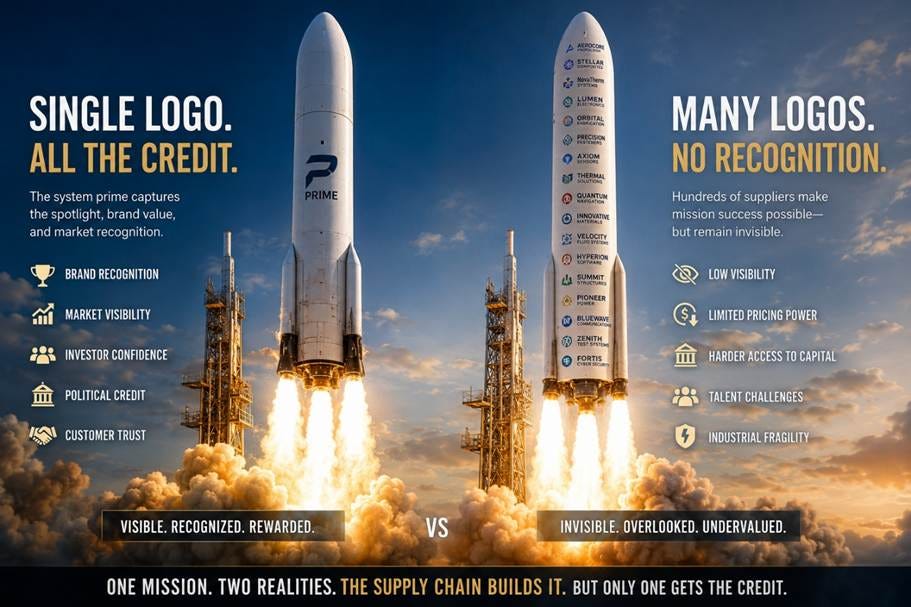
Every time a rocket lifts off, the camera follows the name on the side of the vehicle. The prime contractor gets the headline, the press release, and the investor call. The hundreds of suppliers who built the guidance system, the valves, the thermal protection, the power electronics, they get nothing but a purchase order. [Paywall]
That gap between visibility and contribution has a name. Michael Daily, president of NewSpace Brand Builders and Ex Terra Media contributor, calls it the Integration Illusion, and he argues it isn’t just a communications problem. It’s a strategic market power problem with consequences that run through the entire space industrial base.
Here’s how it works. System primes capture nearly all market visibility, investor attention, political prestige, and public brand authority. The component suppliers who enable mission success remain commercially anonymous, even when their technology is the actual source of mission differentiation. A propulsion supplier may solve an historic efficiency problem. A sensor company may create breakthrough imaging capability. A materials firm may engineer survivability essential for deep space. But the market only remembers the name painted on the spacecraft exterior.
Daily identifies four downstream effects that should concern anyone tracking the health of the space industrial base.
First, invisibility weakens supplier pricing power. When buyers treat subsystem providers as interchangeable, procurement gets driven by cost pressure alone. That compresses margins across the supply chain and discourages long-term innovation investment.
Second, it damages capital formation. Investors gravitate toward companies with visible market narratives. Suppliers without strategic brand presence often struggle to communicate their relevance beyond technical specs, and their innovations end up hidden inside someone else’s story.
Third, invisible suppliers lose the talent competition. The next generation of engineers increasingly wants to work for companies associated with purpose and recognition. Technical excellence isn’t enough if nobody knows you exist.
Fourth, and this is the one that should keep program managers up at night, invisibility increases systemic industrial fragility. If critical suppliers can’t sustain profitability, attract investment, or recruit expertise, the broader ecosystem becomes structurally vulnerable. Large primes may appear stable while the niche suppliers beneath them are quietly undercapitalized and at risk.
Daily’s prescription isn’t louder marketing. It’s repositioning. Suppliers need to stop describing themselves through technical specifications and start communicating strategic consequence. Not “we manufacture radiation-hardened electronics.” But rather: mission survivability and national space resilience depend on our capability.
That’s the kind of narrative that changes a procurement conversation.
-0-

The regulatory door for commercial on-orbit refueling has officially opened, and the suppliers who were already positioning themselves are pulling ahead. [Paywall]
On March 24th of this year, the Office of Space Commerce released its proposal for a voluntary Space Commerce Certification process. The framework creates a consolidated interagency review pathway for commercial activities that fall outside existing regulatory regimes, explicitly including satellite servicing, on-orbit refueling, proximity operations, and orbital computing.
The certification process is opt-in, not mandatory. But it provides something more valuable than a mandate: a predictable approval process that institutional customers, including the Department of War, can point to when justifying commercial service contracts. That’s the bridge between demonstration missions and recurring revenue.
And the demonstrations are coming fast. Four U.S. government missions in 2026 represent the most concentrated refueling test push the industry has ever seen.
Astroscale U.S. is the highest-profile. Funded by the Space Force’s Space Systems Command, its refueler is manifested for a summer 2026 launch. It will attempt the first-ever hydrazine refueling operations above geosynchronous Earth orbit, targeting Space Force Tetra-5 satellites. This is a live operational mission, not a lab experiment.
Orbit Fab is pursuing a parallel commercial track. Its Rapid Attachable Fluid Transfer Interface, known as RAFTI, was approved by the Defense Innovation Unit as an accepted standard in 2024 and is already embedded in government procurement language. Orbit Fab has signed the first government and commercial fuel delivery agreements in geosynchronous orbit. The company holds a European Space Agency contract worth approximately 830-thousand dollars to work with telecom primes on integrating xenon refueling technology into commercial satellites.
The standardization angle is critical. RAFTI is positioning itself the way USB-C positioned itself in consumer electronics, a single interface that makes every compatible satellite a potential refueling customer. Every GEO satellite launched without that interface is a satellite that cannot access Orbit Fab’s service. That’s a supply chain dependency that satellite manufacturers, operators, and investors need to be mapping right now.
The commercial refueling market entered 2026 with analyst estimates in the range of $1.65-billion. The question isn’t whether the market is real. The question is whether your supply chain is positioned to capture the first contract cycle, or whether you’ll be watching someone else walk through the door.
-0-

A geopolitical sorting mechanism is quietly restructuring the technology supply chains behind commercial space hardware, and it’s moving faster than most vendor qualification timelines. [Paywall]
In December 2025, the United States launched the Pax Silica Initiative, aligning twelve nations around a shared trusted-vendor framework for semiconductors, artificial intelligence hardware, critical mineral refining, and advanced manufacturing. The founding coalition includes Japan, South Korea, the Netherlands, Israel, Australia, Singapore, the United Arab Emirates, the United Kingdom, India, and Qatar.
Under-Secretary of State Jacob Helberg described the coalition as equivalent to what the G7 was to the industrial age. U.S. diplomats have been directed globally to use Pax Silica to identify infrastructure projects and coordinate economic security practices. Export controls, foreign investment screening, and anti-dumping enforcement are being coordinated across member nations.
Those input categories; semiconductors, AI hardware, critical minerals, and advanced manufacturing, run through virtually every satellite, launch vehicle, and space-services platform in commercial production today.
The companies with the most immediate exposure share two characteristics: significant revenue from U.S. government or allied-nation primes, and a production or sourcing base concentrated in China. In the commercial space sector, that describes a meaningful slice of the hardware ecosystem. Firms supplying radio-frequency systems, printed circuit board assemblies, power electronics, and electro-optical sensors frequently source sub-tier inputs from Chinese manufacturers. The same applies to launch vehicle suppliers sourcing carbon fiber composites, precision-machined aluminum structures, and rare-earth permanent magnets used in actuators and reaction wheels.
The practical deadline is Q3 2026. Coalition members are actively identifying supply chain chokepoints and designing joint ventures to displace them. Suppliers whose sourcing remains China-anchored, without a documented diversification plan, are accumulating qualification exposure that will surface as program award risk before the end of this year.
Worth a Second Look
Strategic Investment Backs Commercial Space Station as ISS Retirement Nears
Vertical Integration Powers Rocket Lab’s $90M Space Force GEO Satellite Award
NASA Outlines First Missions, Awards Rover Contracts for Permanent Moon Base
The Professional Infrastructure Gap in Space Communications [Paywall]
European Launch Capacity as a U.S. Supply Chain Hedge [Paywall]


