

BRAND:Space - The Integration Illusion
How System Primes Capture Brand Credit While Component Suppliers Stay Invisible

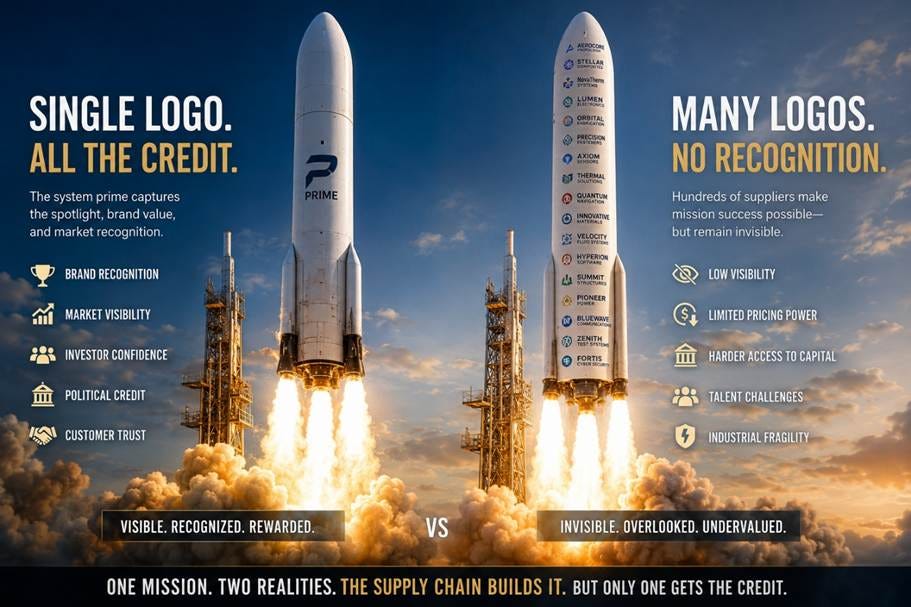
Image: OpenAI ChatGPT ((2026)
The modern space industry is built upon an illusion of singular achievement.
A launch vehicle rises from the pad carrying the logo of a prime contractor. A satellite constellation activates beneath the banner of a recognizable commercial brand. A lunar mission is announced through polished videos and executive interviews that reinforce the perception of centralized innovation. Public attention naturally gravitates toward the visible integrator because the human mind prefers simplicity. Audiences want a name, a face, and a symbol attached to success.
Yet the reality of the space supply chain tells a very different story.
No modern space system is truly built by a single company. Every launch, spacecraft, propulsion system, sensor architecture, communications payload, and orbital platform is the cumulative product of hundreds, sometimes thousands, of specialized suppliers operating beneath the surface of public recognition. The visible “space brand” is often only the final layer of integration resting atop an industrial ecosystem of hidden expertise.
This creates what may be called the Integration Illusion.
The illusion occurs when the system prime captures nearly all market visibility, investor attention, political prestige, and public brand authority while the enabling component suppliers remain strategically invisible despite contributing critical technologies that make mission success possible.
In many ways, the space industry has recreated the same structural branding imbalance long present within the defense aerospace sector. Few members of the public know who manufactures flight computers, thermal systems, radiation shielding, reaction wheels, deployable structures, star trackers, valves, connectors, or onboard cybersecurity architectures. The prime contractor becomes the narrative owner while the supply chain becomes operationally essential yet commercially anonymous.
This is not simply a communications issue.
It is a strategic market power issue.
Brand visibility increasingly determines access to investment, partnerships, recruiting strength, government influence, and long-term market positioning. The companies that own the narrative often gain disproportionate economic leverage over the companies that actually enable technical differentiation.
Within the NewSpace economy, this imbalance is becoming more severe.
Commercial space is moving rapidly toward platform consolidation. Large integrators increasingly position themselves as end-to-end ecosystem providers capable of launch, satellite deployment, communications integration, data services, analytics, and customer interface management. As this consolidation expands, subsystem suppliers risk becoming commoditized even when their technologies represent the true source of mission innovation.
A propulsion supplier may solve a historic efficiency problem.
A sensor company may create breakthrough imaging capability.
A materials firm may engineer survivability improvements essential for deep space operations.
Yet the market remembers only the name painted on the spacecraft exterior.
This invisibility creates dangerous second-order effects for the broader industrial base.
First, it weakens supplier pricing power.
When buyers perceive subsystem providers as interchangeable rather than strategically differentiated, procurement becomes driven primarily by cost pressure. This accelerates margin compression across the supply chain and discourages long-term innovation investment among smaller technical firms.
Second, invisibility damages capital formation.
Investors are naturally attracted to companies with visible market narratives, recognizable positioning, and public momentum. Suppliers operating without strategic brand presence often struggle to communicate their relevance beyond technical specifications. Their innovations become hidden inside someone else’s story.
Third, invisibility affects workforce competition.
The next generation of engineers increasingly seeks companies associated with purpose, recognition, innovation leadership, and cultural identity. Invisible suppliers may possess extraordinary technical capabilities yet fail to attract talent because their contributions are not publicly understood.
Fourth, invisibility increases systemic industrial fragility.
If critical suppliers cannot sustain profitability, attract investment, or recruit specialized expertise, the broader space ecosystem becomes structurally vulnerable. The public often assumes resilience exists because large primes appear stable. In reality, the ecosystem may depend upon a small collection of undercapitalized niche suppliers whose disappearance could cripple entire mission architectures.
The Integration Illusion therefore creates a paradox.
The most strategically important companies within the supply chain are often the least publicly recognized.
This problem becomes even more pronounced during periods of geopolitical competition.
As nations increasingly frame space capability as an indicator of technological prestige and national power, governments naturally celebrate visible system integrators. Public policy discussions emphasize launch providers, major satellite operators, and flagship manufacturers. Yet true national space resilience depends upon the depth, diversity, and survivability of the underlying supplier ecosystem.
A country without a healthy subsystem industrial base does not possess sustainable space power.
It possesses branding theater.
This distinction matters.
History repeatedly demonstrates that industrial depth determines strategic endurance. During every major technological competition, victory has depended less upon symbolic flagship programs and more upon distributed manufacturing capacity, supplier adaptability, and ecosystem-wide innovation networks.
The same principle applies to modern space commerce.
The future winners of the global space economy will not simply be the companies with the most recognizable launch footage or the most polished investor presentations. They will be the nations and industrial ecosystems capable of sustaining dense layers of specialized technical contributors beneath the visible integration layer.
For component suppliers, the strategic response cannot simply be louder marketing.
The solution requires repositioning.
Suppliers must stop describing themselves solely through technical specifications and begin communicating strategic consequence. Most space suppliers speak in the language of engineering performance while primes speak in the language of mission outcomes.
That difference is decisive.
A subsystem company should not merely state that it manufactures advanced radiation-hardened electronics. It should explain how mission survivability, operational continuity, and national space resilience depend upon its capability.
Narrative ownership begins when suppliers connect their technical contribution to broader strategic meaning.
This also requires suppliers to build identity beyond procurement relationships. Too many space supply chain firms define themselves almost entirely through association with larger customers. Their public positioning becomes dependent upon the visibility of the primes they support.
That model is increasingly dangerous.
The companies most likely to survive future market consolidation will be those capable of establishing independent strategic authority within their niche sectors. They must become known not merely as vendors, but as category-defining experts whose presence materially reduces mission risk.
This is where branding becomes misunderstood within the space industry.
Branding is not aesthetics.
Branding is strategic visibility attached to perceived relevance.
The supplier that owns perception within a specialized technical category gains disproportionate influence over procurement confidence, partnership selection, investor trust, and industry credibility.
Visibility creates leverage.
And in the emerging space economy, leverage increasingly determines survival.
The Integration Illusion will continue because system primes naturally occupy the public foreground. That reality is unlikely to change. Large integrators will always dominate headlines because they represent simplified symbols of achievement that audiences can easily understand.
But beneath every visible space success exists an invisible architecture of suppliers whose innovations make those successes possible.
The future strength of the global space industry may depend less upon celebrating the primes at the top of the pyramid and more upon recognizing, sustaining, and strategically elevating the industrial ecosystem beneath them.
Because in space, the companies that history remembers are not always the companies that made success possible.
About the Author

Michael Daily is the President of NewSpace Brand Builders, a strategic consultancy dedicated to advancing the branding, marketing, and communications excellence of the global space industry. With an extensive background in brand strategy, public affairs, and community strategy development, Daily established NewSpace Brand Builders to help organizations define their identity, strengthen their market position, and contribute to a sustainable and innovative space ecosystem. You can reach Mike at mike.daily@newspacebb.com or visit https://newspacebrandbuilders.com/
 | A guest post by
|