

Spacecraft Production Capacity Expands in Central Texas
Firefly Aerospace Doubles Cedar Park Campus, Launches Innovation Lab to Drive Lunar Lander Assembly Lines

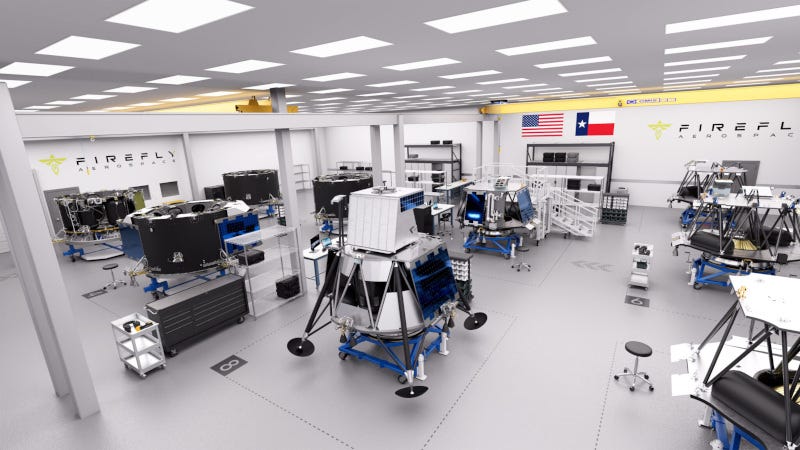
An expanded manufacturing campus and a new in-house innovation lab are accelerating a push by Firefly Aerospace to move spacecraft production from individual builds to a repeatable, assembly-line model — consolidating its supply chain within a single Central Texas corridor.
“The strategic investments we’ve made in our Cedar Park campus allow us to template our successful Blue Ghost lunar lander into a production line.”
Ramon Sanchez, Firefly Aerospace
Firefly Aerospace (Nasdaq: FLY) has moved into a new headquarters campus in Cedar Park, Texas, adding two new buildings adjacent to its existing spacecraft facility to create a unified, 144,000-square-foot site for spacecraft assembly and testing, mission control, avionics and component production, engineering, and business operations. The campus is twice the size of Firefly’s former Cedar Park facilities and sits less than 30 miles from the company’s 200-acre Rocket Ranch in Briggs, Texas, where six test stands and 217,000 square feet of facilities support launch vehicle engineering, manufacturing, and integration.
That co-location strategy is the backbone of Firefly’s vertical integration approach. With rockets and spacecraft engineering, manufacturing, and test operations anchored in the same geographic cluster, the company is reducing handoff distances and external dependencies across its production supply chain.
“With operations centralized in Texas, Firefly is producing rockets and spacecraft at scale to meet the demand of the rapidly growing defense, exploration, and commercial space markets,” said Ramon Sanchez, chief operating officer of Firefly Aerospace. “The strategic investments we’ve made in our Cedar Park campus allow us to template our successful Blue Ghost lunar lander into a production line for multiple lunar missions a year that support NASA’s Moon Base initiative and the larger commercial lunar economy.”
A centerpiece of the Cedar Park expansion is a new cleanroom four times larger than Firefly’s existing cleanroom. Funded by a Texas Space Commission grant, the facility is designed to support dedicated assembly lines for Blue Ghost lunar landers and Elytra orbital vehicles — a supply chain leap from one-at-a-time fabrication to sustained, rate-driven throughput. The larger footprint allows multiple vehicles to move through integration concurrently, directly addressing the production bottlenecks that have limited scale at similar spacecraft manufacturers.
Alongside the cleanroom, Firefly has established Gloworks, an in-house innovation lab focused on rapid development of next-generation components. The lab internalizes capabilities in propulsion, carbon composites, robotics, and 3D printing, and is equipped with 3D and titanium printers, plasma cutters, composite fabrication equipment, welding stations, and automated milling machines. By bringing these capabilities under one roof, Firefly reduces its reliance on external suppliers for prototype and advanced-component development — compressing lead times and keeping critical intellectual property within its own supply chain.
“Gloworks allows us to amplify our rapid, innovative mindset to tackle the problems of the future, including everything from surviving the lunar night to efficiently deorbiting spacecraft that reach end of life,” said Shea Ferring, chief technology officer at Firefly Aerospace. “This lab is the incubator driving key space technologies and differentiators that disrupt the future without disrupting our existing production line.”
Supply chain strengthening extends to the Rocket Ranch as well. Firefly has added two new mezzanines at the Briggs facility, generating 30,000 square feet of additional engineering and manufacturing workspace. The company is also making continuous upgrades to automated carbon composite and propulsion machinery, with improvements to production and integration workflows designed to enhance quality control and scalability across its vehicle programs.
Further upgrades to Firefly’s Eclipse engine test stand will allow multiple engines to be tested simultaneously, increasing testing cadence and removing test-stand availability as a rate-limiting constraint on propulsion supply throughput. Alpha’s stage test stand is also being enhanced to streamline test operations and improve ground system reliability.
Together, the Cedar Park campus expansion, the Gloworks innovation lab, and the Rocket Ranch upgrades form an integrated supply chain architecture — one designed to support multiple lunar missions per year and a growing manifest of defense, exploration, and commercial programs, all without leaving Central Texas.