

Sunlight Reflector Test Satellite Wins FCC Approval
Order Grants Earendil-1 Authorization While Denying Astronomy Group’s Challenge

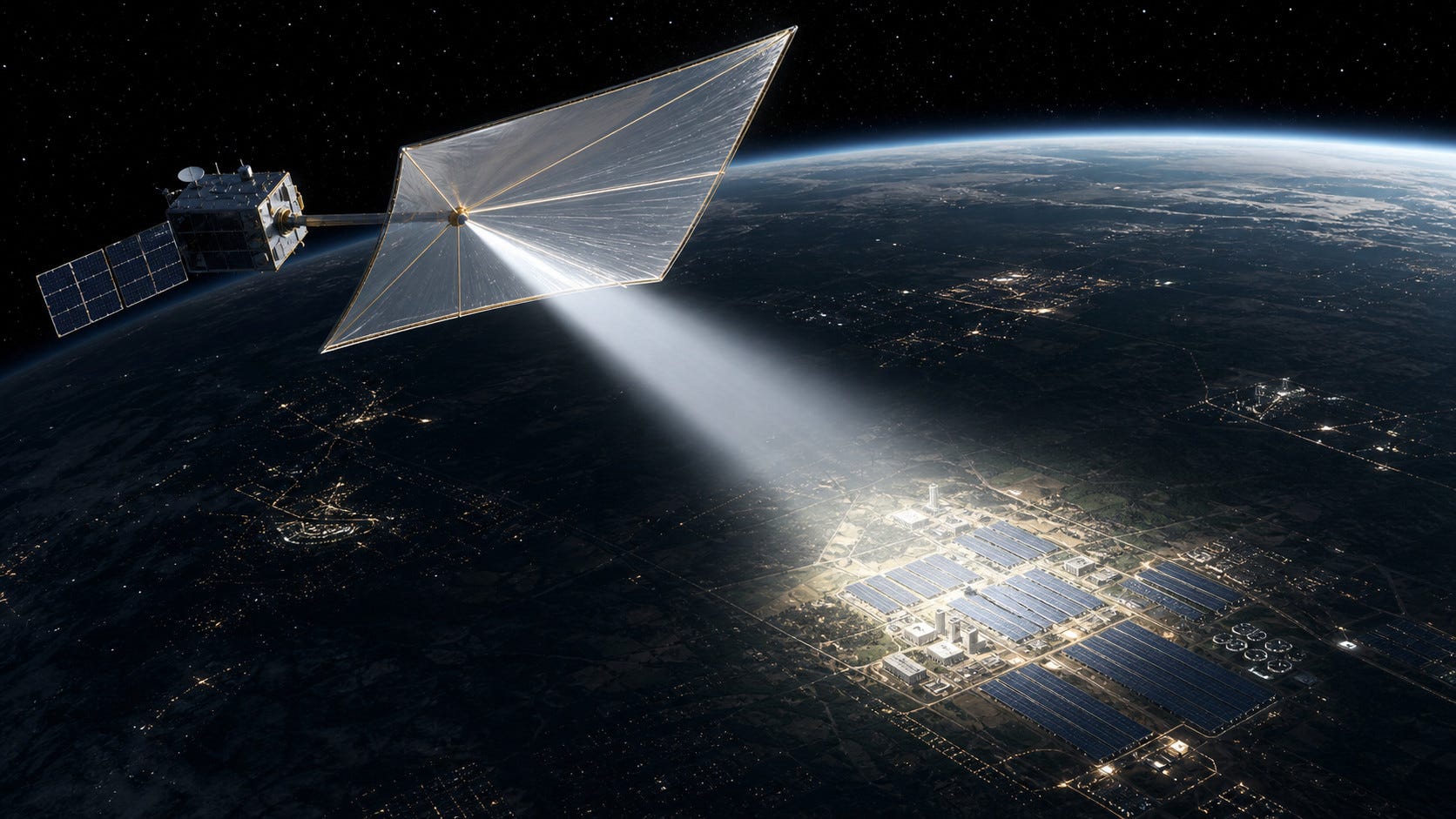
The Federal Communications Commission has granted Reflect Orbital Inc. authority to construct, launch and operate its Earendil-1 non-geostationary satellite, a test spacecraft intended to demonstrate space-based reflector technology.
The FCC’s Space Bureau adopted and released the order July 9, 2026, under ICFS File No. SAT-LOA-20250701-00129. The grant covers operation of a single satellite in the Space Operation Service and Space Research Service under call sign S00711, with authority to use radio frequencies in the S-, X- and UHF-bands.
Earendil-1 is licensed for deployment to an insertion orbit at 510 kilometers, plus or minus 20 kilometers, and for operations at 625 kilometers, plus or minus 25 kilometers, at an inclination of 88 degrees, plus or minus 2 degrees. Converted to U.S. units, that is about 317 miles for insertion and about 388 miles for on-orbit operations.
The authorization identifies Earendil-1 as a testbed for reflector technology that Reflect Orbital said could be used to direct reflected sunlight to specific areas. In its application, the company said the concept could support uses including extending usable hours for solar cells and providing illumination for critical operations.
The order also resolves opposition to the application. The Space Bureau denies a petition to deny filed by the American Astronomical Society, while stating that issues raised in that petition, along with comments and letters from other organizations and members of the public, are addressed in the accompanying order.
The grant is conditioned. Among other terms, the FCC states that space-to-Earth and Earth-to-space operations must be limited to periods when Earendil-1 is visible to the earth stations listed in the appendix, subject to any additional restrictions in the order.
The authorization lists a global service area and identifies coordinated earth station sites in Norway, Antarctica, Australia, New Zealand, South Africa, Chile, Iceland, Sweden and the United States. U.S. locations named in the appendix include Deadhorse and Fairbanks, Alaska; El Segundo, California; and Denver, Colorado.
The frequency plan includes 401–402 MHz for space-to-Earth operations and 2025–2110 MHz for Earth-to-space command uplinks tied to deploy-and-test reflector functionality. It also includes 2200–2290 MHz for telemetry downlinks outside the United States and 8450–8500 MHz for payload data downlinks.
The order closes with a formal grant of Reflect Orbital’s application under sections 0.51 and 0.261 of the FCC’s rules and section 309(a) of the Communications Act. It also formally denies the astronomy society’s petition to deny.