

Satellite Thruster Pointing Production to Increase Tenfold With Austrian Facility Expansion
New Austria Cleanroom, 50 Jobs Part of $4.9 Million Investment

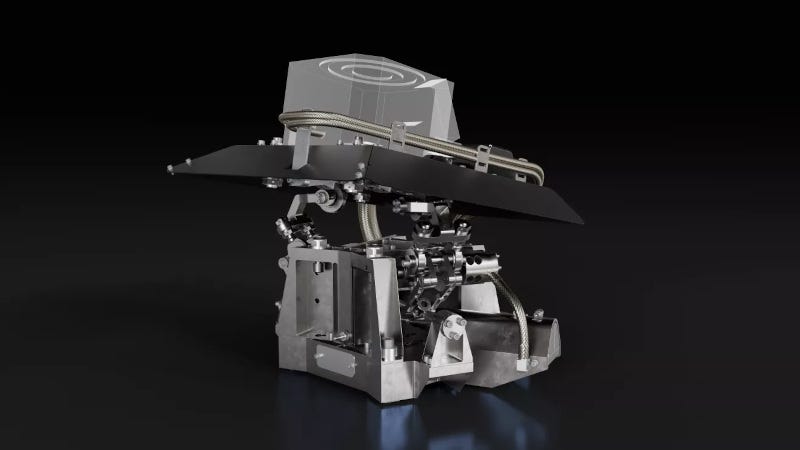
A major expansion of satellite thruster pointing mechanism production is underway in Berndorf, Austria, where space hardware supplier Beyond Gravity is doubling its facility footprint to meet surging global demand. Beginning in spring 2027, the site will be capable of producing 100 electric propulsion pointing mechanisms per year in a single shift — a tenfold increase over current capacity.
“We are investing 4.5 million euros to double our production facility in Berndorf, Austria. This is a significant step in the further industrialization of our different production lines.”
Dr. Barbara Frei-Spreiter, Beyond Gravity.
Beyond Gravity is investing €4.5 million (approximately $4.9 million) to expand its Berndorf facility to roughly 54,000 square feet, located about 25 miles south of Vienna. The company will move into an adjacent existing hall that will be outfitted with advanced machinery, including Austria’s largest cleanroom dedicated to space production.
“We are investing 4.5 million euros to double our production facility in Berndorf, Austria. This is a significant step in the further industrialization of our different production lines,” said Dr. Barbara Frei-Spreiter, CEO of Beyond Gravity.
The expansion is driven by strong demand from both commercial and institutional space programs, particularly in the United States and Europe. “The space market continues to accelerate. We are seeing strong, sustained demand for our high-performance electrical propulsion pointing mechanisms, especially from customers in the U.S. and Europe,” said Oliver Grassmann, Beyond Gravity’s Chief Operating Officer.
The Berndorf site, already the company’s production hub for satellite and launch vehicle thermal insulation, will evolve into a dual-focus facility. Over the next three years, the expansion is expected to create approximately 50 skilled industrial jobs at the site.
A key driver of the expansion is a contract with SWISSto12 to supply APPMAX3 thruster pointing mechanisms for its HummingSat telecommunications satellites. The three-axis mechanism operates like a robotic arm to precisely orient electric thrusters. Beyond Gravity will consolidate serial production of its full APPMAX (Advanced Electric Propulsion Pointing Mechanism) product family at Berndorf, including:
APPMAX3, a three-axis robotic arm mechanism
APPMAX2, available in heavy and small two-axis variants
APPMAX2-XS, a newly introduced variant designed for small satellites and low Earth orbit constellations
The APPMAX2-XS was unveiled at the Space Tech Expo USA in June. It uses commercial off-the-shelf components and streamlined production processes to deliver high-quality gimbals at lower mass and cost, with faster delivery timelines.
Pointing mechanisms improve satellite performance by optimizing thruster alignment, reducing wasted propellant. “Currently, a lot of satellites are burning propellant, but not because of the spacecraft’s thrusters. It is because of the pointing of the thruster,” said Dominik Inschlag, Director of Sales and Marketing for Thermal and Mechanisms at Beyond Gravity. The mechanisms can extend satellite operational lifetimes by up to two years and are described as the most cost-effective solution for satellites with heavier propulsion systems. They also play a role after launch, enabling efficient orbit-raising maneuvers.
The Berndorf expansion follows a 2025 announcement that Beyond Gravity was scaling up solar array drive mechanism production at its Zurich, Switzerland facility by fivefold. A mechanisms development cleanroom in Vienna, modernized in 2024, will continue to serve as the center for prototyping and lower-volume production.
Josef Aschbacher, Director General of the European Space Agency, cited the expansion as evidence of European industrial strength. “Space technology is gaining geostrategic importance. It is essential that we have a strong, capable space industry in Europe. The strong international demand for pointing mechanisms demonstrates the innovative strength and competitiveness of the European space industry.”
Austrian Minister of Innovation and Space Peter Hanke linked the growth to broader economic strategy: “The space industry is one of the fastest-growing domestic economic sectors. It is therefore also one of the nine key technologies and areas of strength in Austria’s industrial strategy.”