


The Federal Communications Commission made two significant moves this week that together paint a clear picture: the agency is on a mission to make America the global leader in direct-to-device satellite connectivity.
First, the big-picture move. The FCC’s Space Bureau released a decision reaffirming exclusive spectrum rights for existing licensees in key direct-to-device frequency bands — and dismissed multiple requests from rival operators to enter those same bands. The Bureau also rejected two petitions that sought to rewrite the agency’s longstanding spectrum rules.
FCC Chairman Brendan Carr called direct-to-device connectivity — meaning fast, broadband service delivered directly from a satellite to your standard smartphone — one of the most exciting frontiers in wireless communications. He said the FCC is laser-focused on making its rules as friendly as possible for investment and innovation in this space, and promised more actions to come.
In the 18 months leading up to this week, there’s been more than 28 billion dollars in deal flow across at least 130 megahertz of spectrum intended for direct-to-device services. Chairman Carr called consumers the big winners as competition in this market intensifies.
The second and more specific action directly benefited AST SpaceMobile, a company based in Midland, Texas. The FCC granted AST a permanent commercial license — formally clearing a 248-satellite constellation in low Earth orbit to deliver cellular broadband coverage directly to unmodified smartphones across the United States.
This isn’t a minor update. The FCC order substantially expands AST’s previously authorized constellation from 25 satellites to 248, using premium low-band spectrum — 700 megahertz and 800 megahertz — frequencies known for superior signal penetration and coverage range, especially in rural and underserved areas. The service is designed to work with existing phones through AST’s partnerships with Verizon, AT&T, and FirstNet — the national public safety broadband network. No new device. No new plan. Your current phone would simply connect to space when you’re outside terrestrial range.
Deployment milestones are binding: AST must get at least 124 satellites into orbit by August 2nd, 2030, and have the full 248-satellite system operational by August 2nd, 2033.
The company isn’t without challenges. Its seventh operational broadband satellite — BlueBird 7 — ended up in a lower-than-planned orbit following a Blue Origin New Glenn launch from Kennedy Space Center on April 19th. The company is assessing its options. But the regulatory win is substantial. AST reported nearly $71 million in full-year 2025 revenue, and is targeting between 45 and 60 new satellite launches this year alone. Direct-to-device service in initial U.S. markets is the near-term goal.
-0-

The IPO pipeline for commercial space is getting busier. HawkEye 360 — a radio frequency intelligence and geospatial analytics company — has officially launched its roadshow for a proposed initial public offering.
The company is offering 16 million shares of common stock, with an initial price expected to land between 24 and 26 dollars per share. The underwriters also have a 30-day option to purchase up to an additional 2.4 million shares at the offering price. HawkEye 360 plans to list on the New York Stock Exchange under the ticker symbol HAWK.
Goldman Sachs and Morgan Stanley are leading the offering as joint book-running managers, with RBC Capital Markets, Jefferies, and BofA Securities serving as additional managers. Baird, Raymond James, and William Blair round out the bookrunner team.
A registration statement has been filed with the SEC, but has not yet been declared effective. HawkEye 360 uses a constellation of satellites to detect and geolocate radio frequency signals — a capability with broad applications across maritime monitoring, national security, and commercial intelligence. This IPO, if priced at the midpoint, would value the offering at approximately 400 million dollars.
-0-
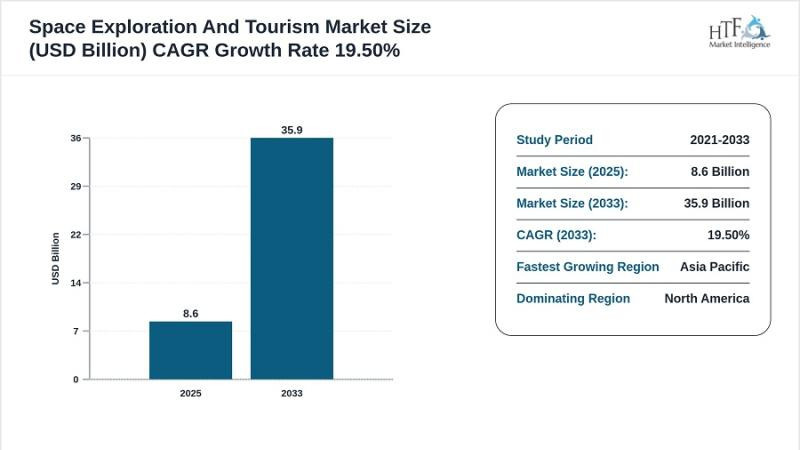
There was a moment, not long ago, when space tourism felt like a billionaire’s novelty. A new market report suggests the business case has matured well beyond that.
According to a new analysis from HTF Market Intelligence Consulting, the global space exploration and tourism market is forecast to grow from $8.6 billion in 2025 to $35.9 billion by 2033 — a compound annual growth rate of 19.5 percent.
The report credits reusable rocket technology as the primary driver — the same innovation that made SpaceX, Blue Origin, and Virgin Galactic viable — for dramatically lowering the cost of access to space. The market now encompasses suborbital civilian flights, private research missions, and longer-term concepts like orbital hotels and lunar stays.
Regionally, North America dominates — the U.S. leads the world in reusable rockets and crewed spacecraft. But Asia-Pacific is the fastest-growing region, with China, India, and Japan all expanding their space programs and commercial partnerships. Europe holds a significant share, backed by collaborative programs and strong government funding.
The regulatory environment is also evolving rapidly, with governments worldwide introducing licensing systems, safety standards, and liability frameworks to govern commercial human spaceflight. The analysts see space hotels, orbital stations, and lunar missions as the long-term opportunities that will carry this market well into the next decade.
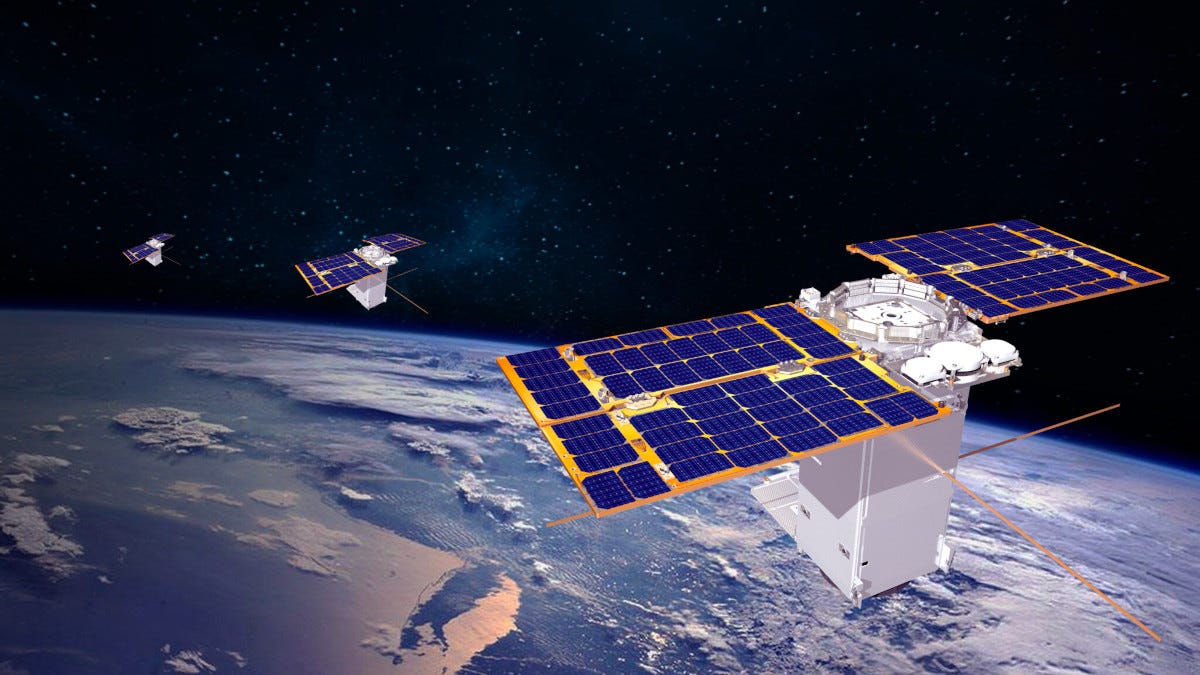
The small satellite market is heading into what analysts are calling its most consequential decade yet — and the numbers are staggering.
Space analytics firm Novaspace has released the 11th edition of its Prospects for the Small Satellite Market report, covering 2026 through 2035 — and the headline figure is nearly 16,900 small satellites projected to reach orbit over that period. That’s an average of about 1,410 pounds of hardware lifted to space every single day.
The report defines small satellites as spacecraft weighing under approximately 1,100 pounds — a category expected to account for one-third of all satellites launched in the period, though only 6 percent of total launch mass. Private investment in the sector reached about $11.5 billion in 2025 alone.
The big story isn’t just the volume — it’s the diversification. While SpaceX’s Starlink has historically dominated near-term smallsat demand, Novaspace sees national space programs increasingly stepping in. Sovereign governments are building their own constellations for security, communications resilience, and Earth observation, which distributes market demand across a wider, more stable customer base.
But the competitive picture is tightening. Novaspace highlights accelerating vertical integration among constellation operators — meaning the big players are building more of their own components in-house — which is squeezing the market for independent suppliers. The report noted that the smallsat market is entering a more mature phase, where industrial maturity, production readiness, and secure access to demand will determine who succeeds. The key question is no longer who has a concept, but who can execute at scale.
This is an industry in transition — from innovation to execution. The companies with established manufacturing, proven supply chains, and contracted customers are positioned to consolidate. Those still scaling face real headwinds.
-0-
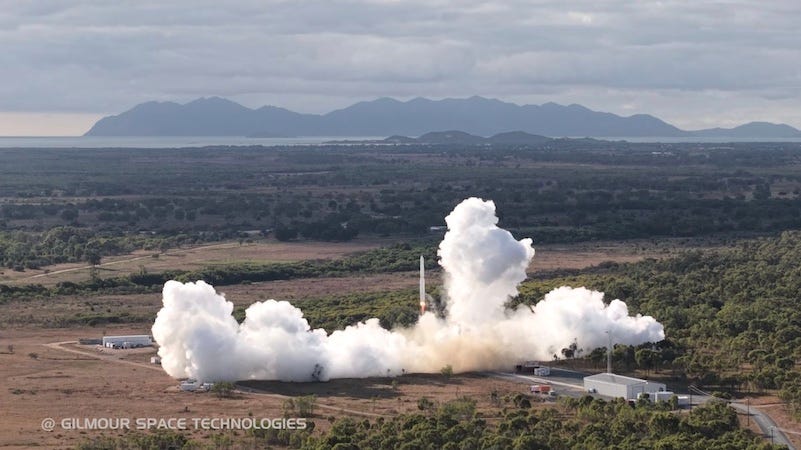
An investigation is complete — and we now know what brought down Australia’s first homegrown orbital rocket last summer.
Gilmour Space Technologies has released the findings from its investigation into the July 2025 in-flight failure of the Eris TestFlight1 rocket. The conclusion: electrical and thermal faults in the oxidizer pump system of two first-stage motors caused the loss of the vehicle.
The Eris rocket lifted off from the Bowen Orbital Spaceport in Queensland on July 30th, 2025 — the nation’s first orbital launch attempt in more than 50 years. The vehicle climbed briefly before losing control and came down in the designated safety area approximately 14 seconds after liftoff.
According to the investigation, one of the four first-stage hybrid rocket motors lost thrust about nine seconds after ignition. A second motor followed at around 17 seconds. Together, the failures ended the mission before it ever had a chance.
Gilmour Space said in a statement — quote — “Analysis identified two independent failure modes originating from the oxidizer pump subsystem. Electrical and thermal faults were observed in the electric pump motors and associated inverters, including components sourced from an external supplier.”
Design, qualification, and process improvements are now underway. The company notes this test flight was always designed to generate data under real flight conditions — and they say that data is already informing updates to vehicle design and operations. A final report has been submitted to the Australian Space Agency.
CEO and co-founder Adam Gilmour said the next Eris rocket test is still planned for later this year. The company has since opened a representative office in South Australia and selected new laser communications technology for future missions. Additional launch attempts are planned for the latter portions of 2026.
-0-
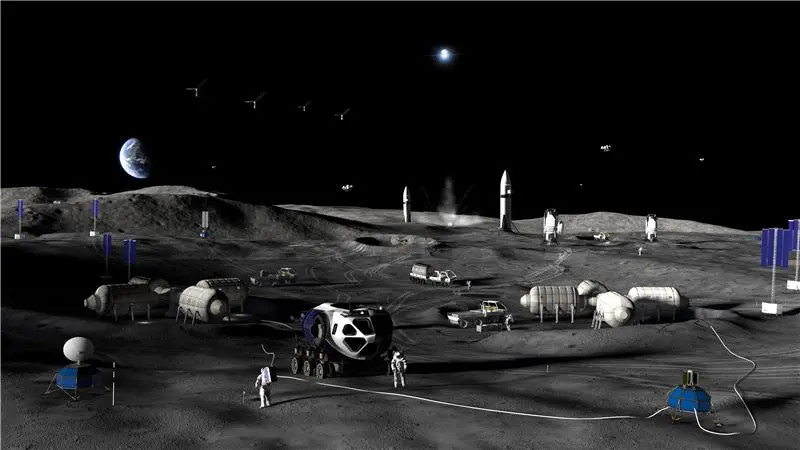
In-depth this week — we’re looking at something that didn’t make many headlines coming out of the 41st Space Symposium in Colorado Springs, but probably should have. [Paywall]
While the big crowds gathered around commercial space station displays and AI panels, two exhibits near the back of the hall at The Broadmoor quietly told a more commercially important story. And our in-depth analysis this week argues those two booths contained more actionable supply chain intelligence than most of the post-Symposium coverage combined.
Here’s the core argument: the space industry covers missions. Supply chains are harder to frame as a press moment. So they go unreported — and the commercial window they represent stays open longer for the people who are paying attention.
Signal One: Lunar Mobility. Bridgestone — yes, the tire company — had a display of next-generation lunar rover elastic wheel prototypes. No press release. No contract announcement. Just the wheels. And almost no one stopped.
That’s a mistake. Lunar surface mobility is one of the least-capitalized and most structurally necessary segments of the emerging lunar economy. Apollo-era wire-mesh wheels won’t cut it for Artemis. Polar terrain, abrasive regolith that’s never been weathered by wind or water, thermal swings of 300 degrees Celsius — those conditions require something categorically different. Bridgestone’s elastic wheel architecture uses thin metal spokes engineered to flex over obstacles without pressurized air — and the company has been developing it with JAXA since 2019. They’ve since signed joint development agreements with Astrobotic and ispace. Almost no one else is working at equivalent technical depth. That’s either a program resilience risk for NASA — or an investment thesis. Depending on which chair you’re sitting in.
Signal Two: Debris Detection. The Naval Research Laboratory showed a concept called LARADO — designed to detect small orbital debris objects too small for ground-based radar to track. Objects below ten centimeters. Objects that can still kill a satellite at orbital velocities. No production contract exists yet — but the policy environment around commercial space situational awareness is accelerating rapidly. The Space Domain Awareness market is estimated at $1.7 to $2.2 billion in 2025, growing toward 5 billion by the early 2030s. USSPACECOM has formally named SDA as a commercial procurement priority. A commercial operator that can build a LARADO-class debris sensing capability — and sell it as a subscription data product — is sitting in front of a government customer that has already pre-validated demand through official doctrine.
Signal Three: Proximity Operations. The Naval Research Lab also showcased a detailed model of its 45-by-100-foot Proximity Operations Laboratory — a simulation facility for rendezvous, docking, and robotic satellite grappling. On-orbit servicing is real and growing. Northrop Grumman has completed commercial life-extension missions. Astroscale has demonstrated debris inspection operations. The global on-orbit satellite servicing market is estimated at up to $4.7 billion today, with projections above 12 billion by 2034.
What the NRL exhibit made visible is that government still holds most of the foundational engineering knowledge — and translating it into a commercial supply chain is an unsolved industrial problem. Three chokepoints stand out: force-torque sensors and robotic actuators rated for vacuum and cryogenic conditions; proximity navigation guidance and control systems; and standardized grapple fixtures. That last one is the most urgent. When grapple fixture standards lock — expected within two to three years — qualified suppliers who moved early will have a structural moat. The window to influence the standard, or at least begin qualification against the leading design, is closing now.
The bottom line from all three signals: qualification timelines are long. Government-commercial data relationships are forming now. And early movers in each of these supply chain categories will be dramatically better positioned when procurement catches up to the opportunity — and it will.
Paid subscribers can read the full analysis on The Journal of Space Commerce under the Supply Chain tab. They’ll also find additional exclusive in-depth coverage of the issues of interest at Space Symposium. And next week on The Journal of Space Commerce Podcast, I’ll be talking with Rich Cooper, vice president of Strategic Communications & Outreach at Space Foundation.
Might have Missed
Record-Setting Test Fires Up Next-Gen Rocket Engine Technology
ESA Advances Lunar Remote Camp Initiative With Award of Parallel Design Contracts
Lunar Payload Contract Ceiling Set to Rise 62% to Back Expanded Moon Landing Cadence
The 2028 Deadline Is Real [Paywall]
Theme Stock Music Provided by Pond 5