



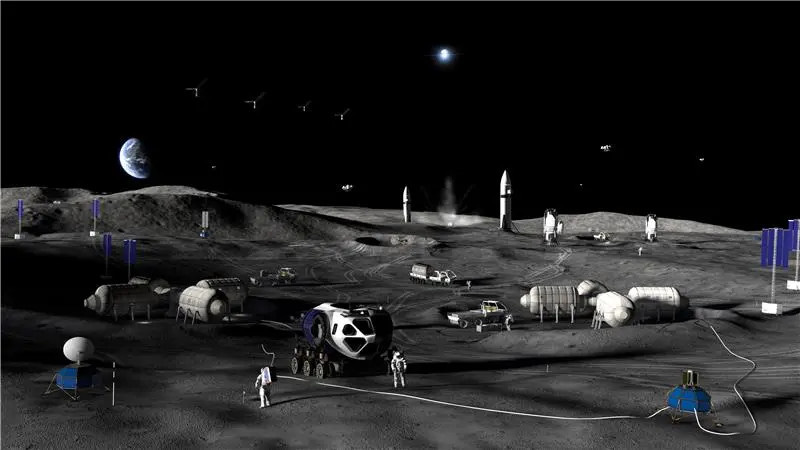
NASA is not tiptoeing into the future. It is sprinting, and using nuclear power.
NASA this week unveiled a sweeping set of initiatives at its recent “Ignition” event, doubling down on its ambitions to return Americans to the Moon — and this time, to stay.
At the heart of the announcement is an accelerated Artemis program. NASA aims to land astronauts on the lunar surface by 2027, with missions launching at least once a year after that, and eventually every six months. But this isn’t just about planting a flag. NASA is laying out a three-phase roadmap to build a permanent Moon base — starting with robotic deliveries and technology tests, moving toward semi-habitable infrastructure supported by international partners like Japan, Italy, and Canada, and ultimately establishing a continuous human presence on the lunar surface.
Administrator Jared Isaacman explained some of the steps the agency is taking to meet those goals.
“We are standardizing the SLS architecture with the Centaur 5 upper stage. We’re rebuilding and focusing expertise on ML1 pad turnaround and establishing the muscle memory required to support a higher launch cadence. The programs we left behind in this effort were not success stories. NASA takes ownership for the shortcomings, but contributing billions more and time that we do not have was not a pathway to success,” Isaacman said. “On that note, I welcome the interest from industry to make use of these capabilities in furtherance of our shared priorities. As we move forward, we intend to launch Artemis 3 in 2027 to test the integrated operations of Orion and one or both lunar landers in Earth orbit. What we learn from that mission will ideally give us the confidence to begin lunar landing attempts starting with Artemis 4 in 2028.”
In low Earth orbit, NASA is rethinking the future of the International Space Station. Rather than abruptly handing operations over to private companies, the agency is exploring a phased transition — potentially attaching a government-owned module to the ISS, then gradually spinning off commercial stations — all to avoid any gap in America’s presence in orbit.
On the science front, the Nancy Grace Roman Space Telescope is set to launch as early as this fall, and NASA is targeting up to 30 robotic lunar landings beginning in 2027.
But perhaps the boldest announcement is this: NASA will launch Space Reactor-1 Freedom — the world’s first nuclear-powered interplanetary spacecraft — to Mars before the end of 2028, marking a historic leap in deep-space propulsion.
Steve Sinacore is NASA’s program executive for Fission Surface Power.
“Nuclear power also unlocks deep space. Past Jupiter, the sun is just another star. Solar cell efficiency drops to 4% at Jupiter, requiring extremely large solar panels, and it’s effectively 0 beyond that. And for deep space missions, chemical propulsion cannot escape its own mass fraction. These are not engineering problems. They are physics constraints, and nuclear power is the answer,” Sinacore said. “Additionally, nuclear-powered electric propulsion spacecraft will move cargo in space like railroads move freight on Earth, with incredibly high efficiency compared to chemical propulsion. And nuclear also brings more innovation to the game, allowing for higher power, more thrust, and eventually exotic propulsion concepts that will open up the art of the possible for future exploration missions.”
To support all of this, NASA says it’s investing heavily in its workforce — converting contractor roles to civil service positions and opening new pathways for early-career talent.
-0-

We turn now to the quarterly earnings front, where several commercial space companies wrapped up 2025 with results that tell very different stories — but point toward the same direction: growth.
Start with York Space Systems. The Denver-based company closed 2025 with revenue up 52 percent to $386 million, powered largely by work on Space Development Agency Transport Layer Tranche 2 contracts. Gross margin expanded by nearly seven percentage points to 19-and-a-half percent, lifting gross profit 133 percent. York’s net loss is narrowing — down 15 percent to $84.5 million — and adjusted EBITDA losses shrank 81 percent to just $8.3 million.
CEO Dirk Wallinger called 2025 the year York defined what a modern mission prime looks like. The company delivered 21 Tranche 1 Transport Layer satellites — the first prime to complete an on-orbit delivery under that program — and turned around the Dragoon mission from contract to orbit in just seven months. That is roughly 75 percent faster than the traditional 30-month timeline.
York completed its IPO in January, raising more than $580 million in net proceeds. Combined with existing liquidity, the company entered 2026 with nearly $900 million available. Management is guiding for full-year 2026 revenue of $545 to $595 million — and says more than 70 percent of the midpoint is already covered by existing backlog.
Now to Planet Labs. The Earth imaging company posted record results for its most recent fiscal year. Planet CEO Will Marshall outlined the top line numbers to open his earnings call.
“We generated a record $308 million in revenue, representing approximately 26% year-over-year growth. Non-GAAP gross margin was 59% for the year. Adjusted EBITDA profit came in at $15.5 million, and free cash flow was $53 million, representing our first full fiscal year of non-GAAP profitability, an excellent milestone for the team as we strike a balance between profit and growth,” he said. “Q4 was also a record for revenue, representing 41% year-over-year growth and our fifth consecutive quarter of adjusted EBITDA profitability. For the second sequential quarter, we achieved Rule of 40, which is our revenue growth plus adjusted EBITDA margin. And on an annual basis, we achieved Rule of 30, a full year earlier than we anticipated. “
Fourth-quarter revenue came in at $86.8 million — a 41 percent jump year over year.
The headline GAAP losses look severe — a full-year net loss of nearly $247 million — but most of that stems from non-cash accounting charges tied to warrant revaluations connected to a rising share price. Adjusted EBITDA for the year was a positive $15.5 million, a sharp swing from a loss of more than $10 million the year before.
Planet ended the year with a backlog of more than $900 million — 79 percent growth year over year — and nearly $640 million in cash.
And then there’s Spire Global, which reported full-year 2025 revenue of $71.6 million — right at the midpoint of its guidance — but those numbers require context. Spire sold its maritime division in April 2025, which pulled down the top-line comparison. Strip out the maritime business, and revenue actually grew 44 percent in the fourth quarter.
Spire CEO Theresa Condor explained some of the dynamics that led to these results.
“The global demand environment for space-based intelligence has fundamentally shifted in SPIRE’s favor, and we are uniquely positioned to capture it. Three forces are converging. First, defense and intelligence spending on space is surging, not just in the United States, where the administration has targeted a $1.5 trillion defense budget for fiscal year 2027,” she said, “but across Europe, where nations are making historic investments in strategic autonomy. Second, civil agencies like NOAA and NASA are shifting decisively toward commercial data procurement, with NOAA projecting billions of dollars in commercial weather data purchases over the next decade. And third, commercial industries from agriculture to aviation are adopting space-based intelligence at an accelerating pace. driven by AI and the operational advantages our data provides.”
The company narrowed its net loss nearly in half year over year in Q4, and ended the year with more than $81 million in cash with no debt. Looking ahead, Spire is projecting full-year 2026 revenue — excluding maritime — of between $71 and $81 million, representing 41 to 61 percent growth over its remaining core business.

The space industry has spent years building better eyes. Slingshot Aerospace says it’s time to build a better brain.
The Austin-based company is introducing a framework it calls Space Operations Intelligence and Autonomy — or SOIA — which it describes as a new market category designed to move the industry beyond simply observing the space domain toward actively operating within it.
I talked with Slingshot CEO Tim Solms about the development and what it means for Space Domain Awareness.
(See audio transcript)
Tim Solms is the CEO of Slingshot Aerospace
-0-
The Federal Communications Commission has voted to start a proceeding to bring greater spectrum abundance to cutting-edge, emergent ventures in space, namely supporting telemetry, tracking, and command (TT&C) for on-the-horizon endeavors like orbital laboratories, satellite repairs, and private inhabitable spacecraft. The new “Weird Space Stuff” proceeding looks to address shortages of available, reliable spectrum for such operations. The Commission will seek comment on ways to expand access, modernize the FCC’s rules, and give America’s space activities the predictable spectrum environment they need to thrive.
The Notice of Proposed Rulemaking (NPRM) looks to find ways to use market-based principles to see spectrum resources put to more intensive use in the service of the space economy. The NPRM seeks to clarify and expand the FCC’s traditional regulatory classifications so that emergent operations have more predictable spectrum access. The proceeding will also explore new spectrum bands that could support new use cases on a dedicated basis to provide a clear, reliable, and expeditious path to support the groundbreaking technologies and services that companies are developing in space.
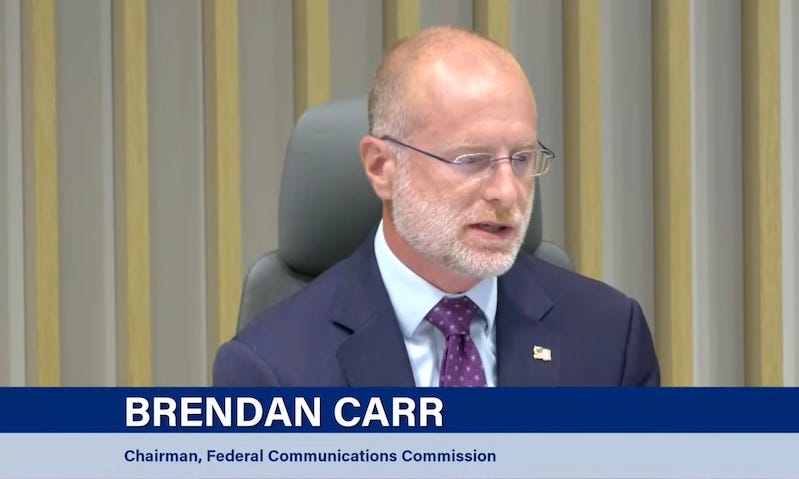
In their March meeting, FCC Chairman Brendan Carr said that everything in space needs spectrum.
“Spectrum provides the necessary link for safety and control operations, or what we call TT&C. Unfortunately, next-gen missions have been constrained by a shortage of predictable commercial spectrum for this type of operation. It’s proven to be a real limit on the ability to launch and deploy unconventional services. Today, we tackled that challenge head on,” Carr said. “We propose to clarify for good when cutting-edge missions can use commercial spectrum for TTNC. We explore market-based approaches that can put existing spectrum bands to more intensive use for these purposes. And we examine new spectrum bands that could support cutting-edge missions on a dedicated basis. America’s spectrum companies, even the weird ones and the cool ones, need plentiful access to spectrum. With today’s action, we continue our spectrum abundance agenda to support our builders in space.”
We’ll explore this topic more in depth on an upcoming edition of The Journal of Space Commerce podcast with FCC Space Bureau Chief Jay Schwartz.
-0-

In Depth this week — a growing disconnect between what advanced manufacturing shops can build and what aerospace primes are legally allowed to buy from them is emerging as one of the most significant bottlenecks in commercial space. (Paywall)
This matters if you are anywhere in the space supply chain.
Three recent developments have brought the issue into sharp focus. In January, spacecraft company Momentus and metal 3-D printing firm Velo3D announced flight testing of an additively manufactured fuel tank aboard Momentus’s Vigoride-7 orbital vehicle — a supply chain move as much as a technology milestone. Last August, NASA and industrial 3-D printing company EOS signed a formal agreement to launch a hands-on training program for manufacturers seeking to qualify hardware under NASA flight standards. And this month, industry consortium America Makes issued a funding call specifically aimed at developing manufacturers capable of meeting prime contractor quality requirements.
Taken together, the signals point to a system under pressure. To win a spot on a prime contractor’s approved supplier list, an additive manufacturing shop must navigate four layers of requirements — federal standards, mandatory aerospace quality certifications, prime-specific procurement rules, and a formal qualification process that can stretch well beyond a year. Most shops stall somewhere in the middle.
The consequences are real. Single-source dependence on legacy suppliers remains common across critical space hardware categories. Standards bodies are still catching up to hardware that’s already flying. And quality flow-down requirements in supplier contracts from companies like Redwire and L3Harris mean that gaps anywhere in a shop’s supply chain can surface — often at the worst possible moment.
The stakes are climbing fast. Department of War spending on additive manufacturing is projected to grow from roughly 800 million dollars in 2024 to 2-point-6 billion dollars by 2030. Programs including the Space Development Agency’s Tranche 2 satellite constellation and NASA’s Commercial Low Earth Orbit Destinations initiative are building procurement pipelines that will require flight-qualified suppliers — and qualification timelines don’t compress just because a program schedule demands it.
Paid subscribers can read the full analysis on The Journal of Space Commerce under the Supply Chain tab. Other premium articles this week include how AT&T and Verizon may be funding their own displacement, how to build trust with terrestrial industries that don’t speak space, and what dual-use space funds like NATO’s Innovation Fund actually cost institutional limited partners.
Worth a Second Look
Vast Completes Haven Demo Mission
UK Space Supply Chain Strength Demonstrated in ForgeStar-1 Mission
NASA CLPS Award Expands Lunar Operations


