

Vast Completes Haven Demo Mission
Eyes 2027 Launch of World’s First Commercial Space Station

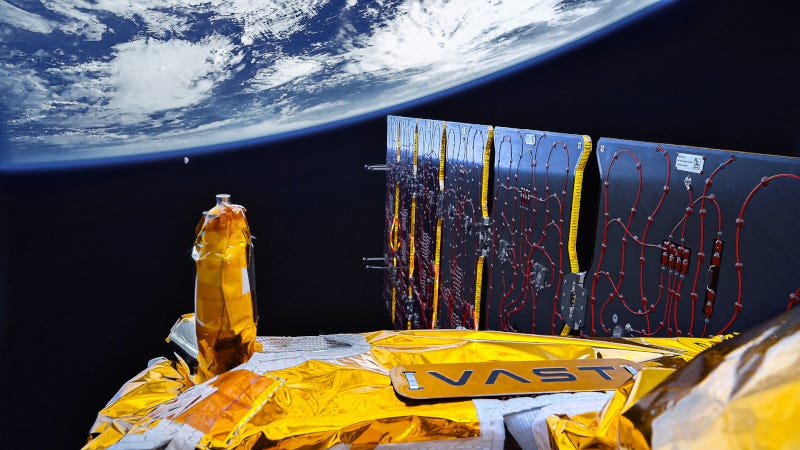
Commercial space station company Vast has successfully concluded its Haven Demo mission, marking a pivotal milestone on the path to Haven-1, which is on track to become the world’s first crewed commercial space station.
“Haven Demo gave us exactly what we needed: real flight data.”
Jim Martz, Vast
On February 4, 2026, Vast Mission Control Center in Long Beach, California confirmed the successful controlled deorbit of Haven Demo, the company’s in-space testbed for Haven-1 and future station technologies.
Over its three-month mission, Haven Demo completed 49 test objectives and remained power positive for the duration of its flight, even enduring historical spikes in volatile space weather. With the mission’s conclusion, Vast has become the first operational commercial space station company to design, manufacture, fly, operate, and deorbit a spacecraft.
Haven Demo launched on November 2, 2025, aboard the Bandwagon-4 rideshare mission from Cape Canaveral, deploying its solar panels just four minutes after separation and achieving first contact with mission control 23 minutes later.
While in orbit, the spacecraft served as a proving ground for the core technologies that will power Haven-1. Systems tested included guidance, navigation, and control hardware and algorithms, avionics, solar arrays, radio frequency communications, thermal control, in-space propulsion, and flight software.
“Haven Demo gave us exactly what we needed: real flight data,” said Jim Martz, SVP of Engineering at Vast. “You can model propulsion, radiation effects, and navigation on the ground, but until you operate in orbit, you don’t truly know how your systems perform.”
Notable on-orbit findings included GPS signal anomalies — likely due to radio interference over conflict regions — which were resolved through software updates that allowed the navigation system to filter out unreliable position signals.
Radiation effects and propellant performance both aligned closely with ground-based predictions. The final deorbit burn on February 4, 2026 at 7:40 PM PST brought Haven Demo to a controlled splashdown in the South Pacific Ocean, coordinated closely with NASA and aviation and maritime safety authorities.
With the Haven Demo mission complete, Vast says it is now roughly 40% of the way to delivering a continuously crewed space station. Haven-1 is expected to be flight-ready in Q1 2027 and will feature a pressurized module, a closed-loop life support system, spacecraft docking capability, and a microgravity laboratory.
For Haven-1’s inaugural mission, four crew members will embark on a series of two-week missions, with opportunities for advanced science, research, and in-space manufacturing.
The flight primary structure has already passed full-scale pressure and static load testing and is currently undergoing Phase 1 integration at Vast’s Long Beach headquarters.
Looking further ahead, Haven-2 is designed to build on the ISS legacy with continuous crew capability. Beginning in 2028, Vast plans to launch Haven-2 modules every six months, reaching a four-module station capable of supporting a continuous crew by the end of 2030.
“This mission was about more than a single spacecraft,” Martz said. “It was also about building a world-class team and demonstrating that Vast can design, build, operate, and safely deorbit space infrastructure. That end-to-end capability is what enables Haven-1, and ultimately a permanent human presence in LEO.”