


The Federal Communications Commission is on the verge of a major overhaul in how satellites share spectrum — and the economic stakes are enormous.
F-C-C Chairman Brendan Carr announced the Commission will vote on a new order to modernize its satellite spectrum-sharing rules. If adopted, the changes could unlock more than two billion dollars in economic benefits and enable up to seven times more capacity for space-based broadband services.
At the heart of the order is a proposal to replace the decades-old Equivalent Power Flux Density framework — known as EPFD — with modern, performance-based rules that account for today’s satellite technology, including adaptive coding and modulation.
Under the new approach, non-geostationary and geostationary orbit operators would be encouraged to negotiate voluntary, private agreements for interference protections — a shift the F-C-C says builds on its time-tested framework for good-faith coordination.
In a news release posted online, Carr said “The FCC is moving fast to unleash affordable, high-speed Internet.”
The public draft was released ahead of the Commission’s next monthly open meeting scheduled for April 30th.
-0-

Amazon is making its most significant move yet in the satellite connectivity market — agreeing to acquire Globalstar in a deal that would dramatically expand its Amazon Leo network and add direct-to-device service to its growing low Earth orbit system.
Under the terms of the merger agreement, Globalstar stockholders will receive either 90 dollars per share in cash or Amazon stock of equivalent value. The transaction is expected to close in 2027, pending regulatory approvals and certain satellite deployment milestones.
The deal brings together Globalstar’s mobile satellite service spectrum licenses — which carry global authorizations — with Amazon Leo’s broadband infrastructure. That combination would allow Amazon to deliver continuous connectivity for consumer, enterprise, and government customers well beyond the reach of traditional cellular networks.
The acquisition also carries strategic urgency for Amazon. The company faces an F-C-C deadline to have 1,616 Leo satellites in orbit by July 30th of this year — a threshold that determines whether it retains full licensed spectrum rights. Acquiring Globalstar’s existing fleet and spectrum gives Amazon a significant shortcut.
Alongside the merger, Amazon and Apple announced a separate agreement for Amazon Leo to power satellite services for iPhone and Apple Watch — including Emergency S-O-S via satellite — building on the partnership Apple currently holds with Globalstar.
Beginning in 2028, Amazon Leo plans to deploy its own next-generation direct-to-device satellite system, offering voice, data, and messaging to mobile phones and cellular devices.
-0-
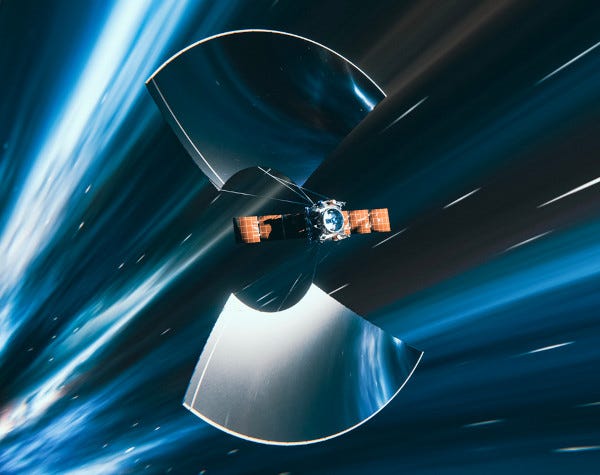
A spacecraft manufacturer building rapidly maneuverable vehicles for operations across and between orbital regimes has closed a 50-million-dollar Series A round.
Portal Space Systems says the financing was led by Geodesic Capital and Mach33, with participation from Booz Allen Ventures, ARK Invest, AlleyCorp, and FUSE. The round follows a $17.5 million seed round in 2025 — one of the largest publicly disclosed seed financings in the sector at the time.
The investment reflects a growing recognition across both commercial and defense markets that access to orbit is no longer enough. Most satellites today are designed for fixed mission profiles with limited maneuverability — a liability as space becomes more congested, contested, and operationally complex.
The participation of Booz Allen Ventures would appear to signal particular interest from the national security community.
Portal C-E-O Jeff Thornburg said in a news release that ‘the systems that succeed in this next phase of space exploration will be those that can move quickly, deliberately, and repeatedly across and between orbits.”
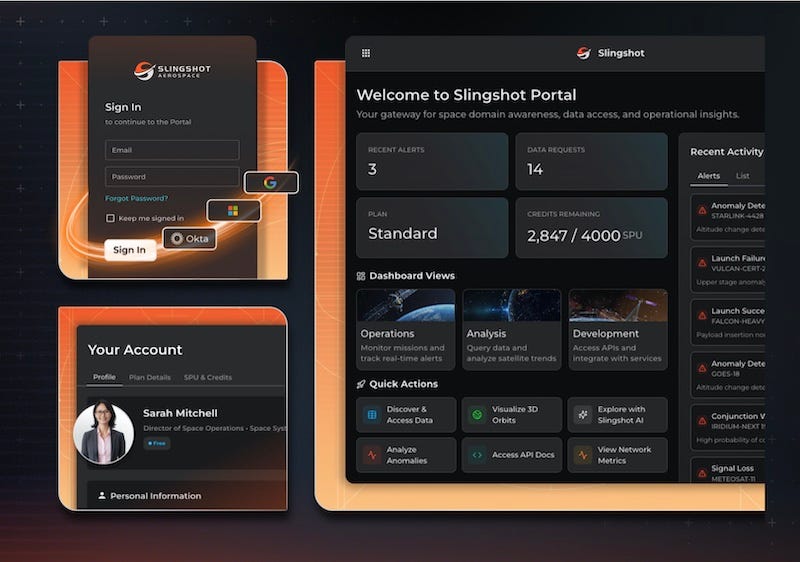
As the number of objects in orbit continues to grow, one company is betting that operators need a single platform that takes them from detection all the way to decision — without ever switching screens.
Slingshot Aerospace this week introduced Slingshot Portal — an A-I-native platform built to support mission-ready space operations across defense, civil, and commercial sectors. The company calls it the first platform purpose-built to operationalize what it terms Space Operations Intelligence and Autonomy in live mission environments.
For more on what Slingshot Portal means for space domain awareness, I recently spoke with Erik Ekwurzel — Chief Data and Information Officer at Slingshot Aerospace.
(See Transcript Provided with Podcast)
Slingshot demonstrated the technology this week at Space Symposium, with additional capabilities — including advanced maneuver intelligence and predictive analytics — rolling out throughout 2026.
-0-
Defense and space technology company Voyager Technologies says it has doubled satellite propulsion production capacity at its Denver-area facility over the past year — and is already planning to double it again.
The Voyager Littleton, Colorado facility has grown from 8,000 to 40,000 square feet following its October 2025 acquisition of ExoTerra Resource, a developer of electric propulsion systems. The expansion added workforce, test equipment, and training — and has enabled full vertical integration of mission-critical propulsion technologies.
Each propulsion module integrates a propellant tank, electronics controller, thruster, and distribution system into a compact unit engineered for precise orbital maneuvering, threat avoidance, and sustained mission effectiveness.
Matt Magaña, Voyager’s president of Space, Defense and National Security, tied the expansion directly to the current national security environment, citing programs like Golden Dome.
Voyager says it holds propulsion module contracts across both commercial and government customers and is targeting quadruple its year-ago capacity.
-0-

And finally — what happens when a government program doesn’t get cancelled, but doesn’t move forward either?
In Depth this week, for dozens of companies deep in the supply chain behind NASA’s Commercial LEO Destinations program — known as C-L-D — that question is no longer hypothetical. [Paywall]
On January 28th, NASA’s Johnson Space Center posted a short notice to the federal contracting database S-A-M-dot-gov, which said “This modification is to notify industry that the Commercial Low-Earth Orbit Destination Contract acquisition is on hold until further notice.”
Five words: “On hold until further notice.”
That language does not trigger a termination settlement. It does not create a formal recovery pathway. And it does not release suppliers from program commitments their prime contractors still expect them to honor if Phase 2 restarts.
The hold did not come without warning. In August 2025, NASA had already restructured the entire Phase 2 acquisition — shifting from a firm-fixed-price federal contract to Funded Space Act Agreements — citing a four-billion-dollar budget shortfall. The procurement pause arrived before any of that could be executed.
Then came March 24th. During a House Science Committee hearing, NASA officials unveiled a new concept called “Ignition” — a government-owned core module attached to the I-S-S, with private companies docking commercial add-ons before eventually separating into free-flying stations. NASA signaled it could afford only a single commercial provider. Commercial Space Federation President Dave Cavossa testified it was, quote, “sowing concern and, really, sowing confusion.”
For tier-2 and tier-3 suppliers — the companies building life-support systems, solar arrays, propulsion hardware, and pressurized module structures — pipeline commitments built around a specific station configuration could now be stranded in a competition that selects only one winner.
There is a critical legal distinction: a formal cancellation triggers defined settlement protections. A procurement hold that arrives before contract execution does not. Most suppliers who aligned capacity to C-L-D hold only teaming agreements or verbal commitments — instruments with zero formal cost-recovery protection.
The question for every supplier in this pipeline is not whether Phase 2 will restart. It is what legal instrument you hold today — and whether your committed costs have any recovery pathway if it doesn’t.
Paid subscribers can read the full analysis on The Journal of Space Commerce under the Supply Chain tab. Other premium articles this week include The Space Commerce Cycle in 2026, how SpaceX’s engine production rate became the invisible chokepoint in NASA’s lunar architecture, and columnist Mike Daily explores why NASA and DoD approvals have become vendor selection tools for enterprise customers.
Worth a Second Look
Space Control Platform MDA Midnight Unveiled by MDA Space
On-Orbit Precision Acquisition and Tracking Demonstrated by Star Catcher
NASA Awards Seventh Private Astronaut Mission to Voyager
Satellite Constellation Expansion Planned by Vantor
Satellite Broadcast’s Final Chapter [Paywall]


