

AI-Driven Platform for Space Operations Introduced
Slingshot ‘Portal’ Designed for Defense, Civil and Commercial Applications

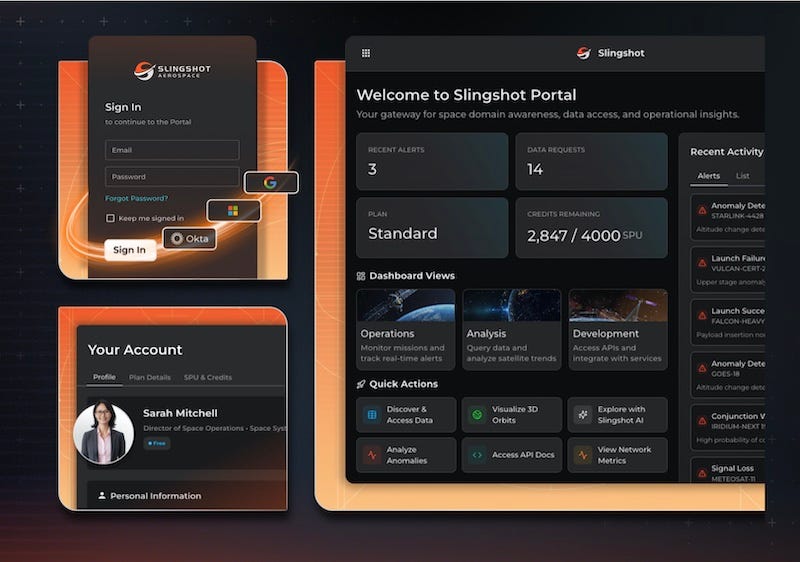
An AI-native platform built to support mission-ready space operations across defense, civil, and commercial sectors has been introduced by Slingshot Aerospace. Slingshot Portal is the first platform purpose-built to operationalize Space Operations Intelligence & Autonomy in live mission environments. As orbit becomes more congested, competitive, and contested, the ability to detect, interpret, and respond to activity in space is now a core operational requirement.
“Space is a dynamic, contested operating environment, and the tools built for yesterday’s orbital domain are no longer sufficient.”
Tim Solms, Slingshot Aerospace
Portal introduces a new operating model for space missions by unifying core mission workflows within a single operational environment. By combining proprietary sensing, advanced AI models, modular APIs, and mission processing and analytics tools, Portal enables operators to move from detection to decision to action—without leaving the platform.
Portal draws from observations generated by the Slingshot Global Sensor Network and integrates them with government tracking data and a continuously updated space object catalog. Within the platform, operators can monitor orbital activity in near real time, identify anomalies and emerging threats, assess maneuver options, and evaluate mission impacts through physics-based 3D visualization and AI-supported analysis.
Rather than relying entirely on external data feeds, Slingshot owns and operates its global optical sensor network, generating proprietary observations that feed directly into Portal’s analytics engine. Through Portal’s evolving data marketplace, customers are able to access Slingshot data alongside their own and third-party sources— creating a unified data ecosystem to support faster detection, contextual risk assessment, and operational decision-making across increasingly complex orbital environments.
As threat timelines span launch, on-orbit custody, and re-entry, Portal can be deployed in disconnected and air-gapped command-and-control environments for national security users. In those settings, the same analytics engine can ingest and fuse third-party mission data—including EW, cyber, and OPIR/missile warning, when available—to support a more converged operational response.
“Space is a dynamic, contested operating environment, and the tools built for yesterday’s orbital domain are no longer sufficient,” said Tim Solms, CEO of Slingshot Aerospace. “Slingshot Portal unifies sensing, intelligence, and action into a single operational process empowering operators to respond faster, make confident decisions and take real-time action.”
Portal enables operators to maintain real-time awareness of the space domain, detect anomalies, and act with greater speed and confidence from a single operational environment. The platform will evolve throughout 2026 to support advanced maneuver intelligence, predictive analytics, and scenario-based planning capabilities designed to meet increasingly complex mission demands.
Slingshot will demonstrate Portal at Space Symposium this week.