

Motor Failures Blamed for Loss of Australia’s First Orbital Rocket
Investigation Into Eris TestFlight1 Points to Oxidizer Pump Faults

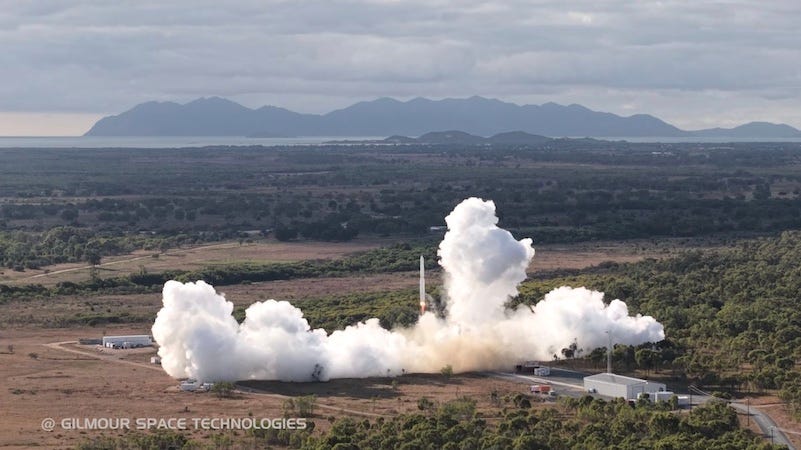
Gilmour Space Technologies has completed its investigation into the July 2025 in-flight failure of Eris TestFlight1, concluding that electrical and thermal faults in the oxidizer pump system of two first-stage motors caused the loss of Australia’s first homegrown orbital rocket.
“Analysis identified two independent failure modes originating from the oxidizer pump subsystem.”
Gilmour Space Statement
The Eris rocket lifted off from the Bowen Orbital Spaceport near Bowen, Queensland, on July 30, 2025, in what marked the nation’s first orbital launch attempt in more than 50 years. The vehicle climbed briefly before losing control and came down within the designated safety area approximately 14 seconds after liftoff.
According to the investigation findings, one of the four first-stage hybrid rocket motors experienced a loss of thrust about nine seconds after ignition. A second motor exhibited similar behavior at around 17 seconds, further reducing vehicle performance and ending the mission prematurely.
“Analysis identified two independent failure modes originating from the oxidiser pump subsystem,” Gilmour Space said in a statement. “Electrical and thermal faults were observed in the electric pump motors and associated inverters, including components sourced from an external supplier.”
The company said design, qualification, and process improvements are now being evaluated and implemented in response to the findings. Gilmour Space noted that the mission was designed from the outset to generate flight data and expose conditions not fully replicable during ground testing, and that data from the flight is already informing updates to vehicle design and operations.
A final report has been submitted to the Australian Space Agency in coordination with the Office of the Space Regulator.
The 25-meter (≈82-foot), roughly 30-metric ton Eris rocket is designed to deliver up to 215 kilograms (≈473 pounds) of payload to sun-synchronous orbit. TestFlight1 was the culmination of years of development at Gilmour Space’s Gold Coast headquarters, following multiple launch delays in early 2025 caused by Tropical Cyclone Alfred, a payload fairing anomaly linked to an electrical backfeed event, and persistent unfavorable weather at the Bowen launch site.
CEO and co-founder Adam Gilmour addressed the outcome at the International Astronautical Congress in Sydney in October 2025, stating the company intended to return to flight the following year. “We are going to be launching again next year,” Gilmour said. “We’re going to be doing more launch attempts, so we’re not going to give up.”
The company has since opened a representative office in South Australia and selected Transcelestial laser communications technology for future missions, signaling continued expansion even as it works toward a second launch attempt. Gilmour Space has said it plans to conduct additional missions later in 2026.