



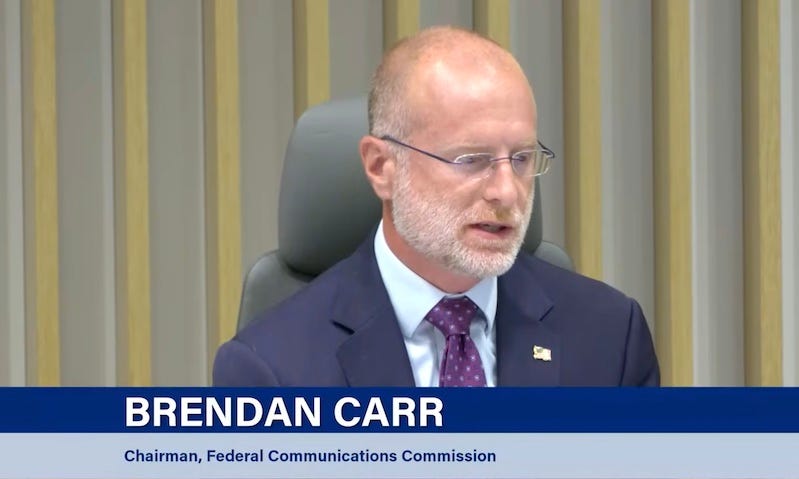
Federal Communications Commission Chairman Brendan Carr is taking aim at one of the least-talked-about chokepoints in the commercial space industry — spectrum.
On Wednesday, Carr shared a draft Notice of Proposed Rulemaking with his fellow commissioners. If it clears a full Commission vote at the agency’s March monthly meeting, the FCC would open a formal proceeding to address what it calls an acute spectrum shortage for emergent space operations — things like orbital laboratories, satellite repair missions, and private habitable spacecraft.
The issue comes down to telemetry, tracking, and command — the radio signals that let operators control spacecraft in orbit. Even satellites that don’t offer public communications services need reliable access to that spectrum. Right now, the FCC says American innovators are facing a crunch that could delay, or in some cases prevent, the growth of domestic space technologies.
The proposed rulemaking would move in two directions. First, the FCC wants to clarify its existing rules so that cutting-edge space operations have more predictable access to the spectrum they already use. Second, it wants to identify entirely new spectrum bands dedicated to these emerging use cases — giving companies a clear, reliable path to support the technologies they’re developing.
Carr called the proposal the first step toward the spectrum abundance needed to give American space activities a predictable operating environment. It’s worth noting the FCC has already been active on this front. Earlier this year, the Commission launched a separate proceeding to release up to 20,000 megahertz of spectrum for high-speed broadband services from low-Earth orbit constellations, and it has begun a comprehensive review of its overall space licensing framework.
The bottom line: spectrum may not be the flashiest topic in commercial space, but for the companies actually trying to operate there, it is foundational. Watch for the Commission vote later this month.
-0-
Voyager Technologies this week reported its financial results for the fourth quarter and full year 2025 — and paired that earnings release with a significant strategic investment that says a lot about where the company is heading.
On the financial side, Voyager delivered net sales of $46.7 million in the fourth quarter, a 24% increase year over year. For the full year, the company posted $166.4 million in net sales — up 15% from 2024. The standout number, though, is backlog. Voyager ended 2025 with total backlog of $265.6 million, a 33% increase over the prior year. That’s a record for the company, and it’s driving a bump in 2026 guidance — Voyager now expects full-year revenue between $225 million and $255 million, which would represent year-over-year growth of 35% to 53%.
The company’s Defense and National Security segment drove much of the momentum, with a 63% increase in fourth quarter sales to $35.7 million, led in part by progress on the Next Generation Interceptor program. The Space Solutions segment declined in the quarter, primarily because of the planned wind-down of a multi-year NASA services contract, which had been expected.
Voyager also completed five acquisitions during the year, including ExoTerra Resource and Estes Energetics in the fourth quarter, expanding its propulsion and energetics platform. The company’s Starlab commercial space station development achieved 10 NASA milestones in 2025, and received $56 million in NASA cash milestone proceeds during the year. Total liquidity ended 2025 at $704.7 million.
In an earnings call posted to the company website, CEO Dylan Taylor called 2025 a transformational year for the company, pointing to its completed IPO, record backlog, and what he described as accelerating demand across defense, national security, and space.
“Our defense and national security segment grew significantly, up 59% year over year, driven by execution on next generation interceptor and other classified programs. Our backlog increased 33% year over year, entering 2026 with $266 million to support our accelerating growth,” Taylor said. “During 2025, we raised over $1 billion, including and executing on a successful IPO and issuing a follow-on convertible note, all strengthening our liquidity to fund innovation and strategic growth initiatives. We completed and integrated several acquisitions, expanding our capabilities to meet growing customer demand, which we expect to remain strong in today’s geopolitical environment.”
Taylor was also bullish on the company’s Starlab private space station. “We anticipate NASA will soon release the RFP for the second phase of the Commercial LEO Development Program, or CLD, with a decision later in the year. We are highly confident in the modernized, cost-efficient, and commercially scalable solution that Starlab is delivering to NASA and other key stakeholders,” he said. “The architecture is designed to provide continuous U.S. presence in low-Earth orbit, while enabling a broader transition to commercially-led operations. As the program advances, we are expanding Starlab’s commercial ecosystem, building durable partnerships across mission logistics, life sciences, biopharma, advanced materials, and other high-growth verticals. The approach strengthens demand visibility and reinforces Starlab’s role as an ecosystem, not a single-use platform. “
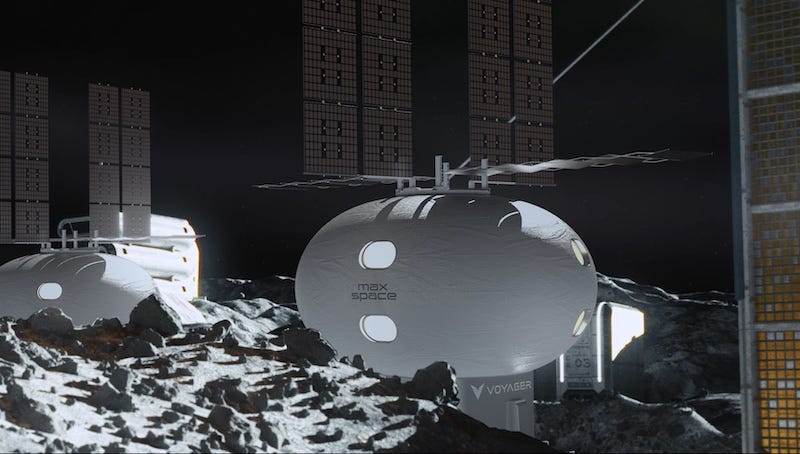
But Voyager’s big news this week wasn’t just about financial results — it was also about where that capital is being directed. Along with its Low Earth Orbit plans, the company announced a multi-million-dollar strategic investment in Max Space, a startup developing expandable habitat technology for the Moon.
Max Space’s approach is to build habitats that launch compactly — then expand up to 20 times their stowed volume once they reach their destination. That dramatically increases usable floor area per kilogram delivered, which matters enormously when every pound launched to the lunar surface carries a price tag. The flexible geometry of the design also allows the habitat to adapt as missions evolve, from early surface operations to long-duration habitation.
Voyager says the investment is directly tied to its broader lunar roadmap, which spans cislunar mission management, surface logistics, propulsion, and power systems. It also aligns with NASA Administrator Jared Isaacman’s stated goal of establishing a permanent human presence on the Moon by 2028.
-0-

Two companies from different sides of the Atlantic announced they are teaming up to explore satellite refueling — a technology that could fundamentally change the economics of operating spacecraft in orbit.
Orbit Fab and Airbus Defense and Space are working together under a project called RADICAL — part of the European Space Agency’s Advanced Research in Telecommunications Systems program, funded by the UK Space Agency. The goal is to assess whether Orbit Fab’s RAFTI refueling valve can be integrated into future Airbus geostationary satellites.
The business case for refueling is straightforward: satellites are expensive to build and launch, and propellant is typically the limiting factor in a spacecraft’s operational life. If you can top off a satellite in orbit, you extend its mission lifetime, reduce the cost of replacing it, and gain the flexibility to reposition it as market conditions change. For defense operators in particular, that ability to maneuver — and the resilience it provides — is becoming a strategic priority.
The RADICAL project is designed to work through the practical engineering required: what changes to mission operations, system design, and platform architecture are needed to make refueling possible for a production Airbus satellite? Orbit Fab brings the refueling technology. Airbus brings deep knowledge of geostationary satellite platforms and propulsion systems.
Jacob Geer, Orbit Fab’s managing director in Europe, framed the collaboration as essential to enhancing European competitiveness in the telecom satellite market. The UK Space Agency’s head of telecommunications, Henny Sands, called it a great example of how adaptive the UK industry is to changing global requirements.
Two companies have announced new capital raises.
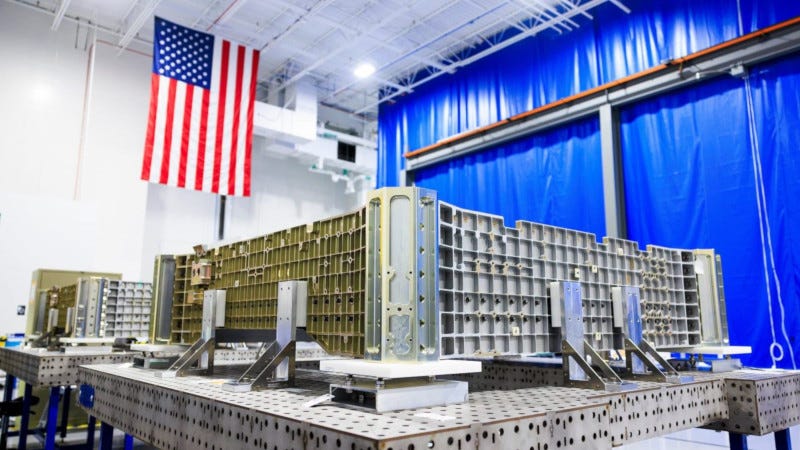
Sierra Space closed a $550 million Series C equity round led by LuminArx Capital Management. The financing values the company at $8 billion post-money and brings total capital investment in Sierra Space since 2021 to more than $2 billion. The company says the new funding will support expansion of production capacity and continued development of national security space solutions.
Sierra Space has been shifting its focus increasingly toward defense and intelligence customers. It holds contracts with essentially all eight space procurement agencies within the Department of Defense and the Intelligence Community, including a $450 million award to build satellites for a national security customer and an SDA Tranche 2 contract worth up to $740 million for missile warning and tracking satellites. The company also completed all manufacturing and assembly milestones for its Dream Chaser spaceplane last year, with a demonstration flight planned for late 2026.
-0-
Meanwhile, HawkEye 360 closed an additional Series E round, raising approximately $23 million in new capital. The round included new investors Ghisallo, Principia Growth, and Sixty Degree Capital, alongside continued participation from the Strategic Development Fund. HawkEye 360 provides radio frequency signals intelligence from orbit and is currently integrating its recently acquired Innovative Signal Analysis business. CEO John Serafini said the round reflects investor confidence in the company’s strategy and its progress scaling the business.
Two raises, two different chapters: Sierra Space is capitalizing for growth in the national security space; HawkEye 360 is strengthening its balance sheet as it integrates a new acquisition. Both are signals of continued private capital appetite for defense-adjacent space companies.
-0-
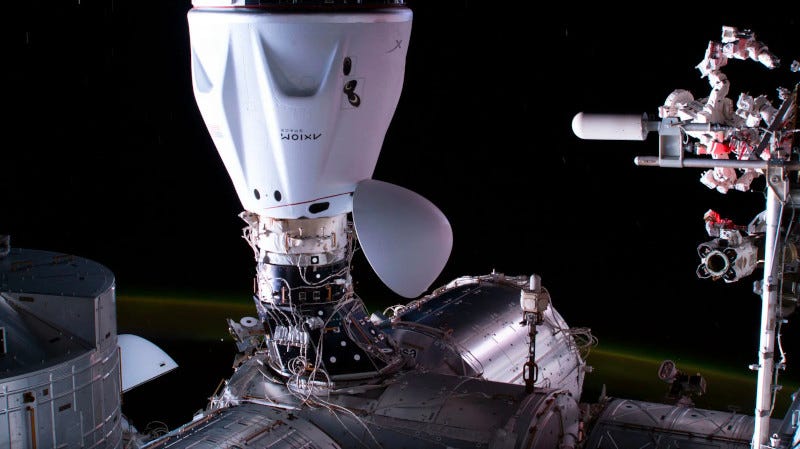
In Depth this week, NASA has expanded its Private Astronaut Mission pool from one company to two. (Paywall)
On Feb. 11, NASA awarded Vast Space its first Private Astronaut Mission to the International Space Station. Vast has never flown a station. Its Haven-1 module isn’t in orbit — it’s targeting a launch no earlier than early 2027. And yet NASA gave the company what had, until that moment, belonged exclusively to Axiom Space across five consecutive mission awards. (Paywall)
If you read the press release and moved on, you missed the story.
The Vast award is a procurement signal. Understanding what it means requires understanding what the Private Astronaut Mission program actually is — and what it isn’t.
A PAM award is not NASA buying a seat on a commercial flight. It is a bilateral services exchange executed through a Space Act Agreement — a non-traditional procurement vehicle authorized under the National Aeronautics and Space Act of 1958. Under that structure, the commercial operator purchases NASA-provided services: consumables, cargo storage, crew time, life support, and ISS access. In return, NASA purchases services from the operator — research capacity, payload integration, sample return, or crewed access to commercial facilities. Both parties are delivering value, and both parties are receiving it.
That structure carries fundamentally different legal, accounting, and intellectual property implications than a standard government contract. Companies that arrive at the proposal stage with a Federal Acquisition Regulation-based cost structure and traditional deliverable frameworks are not just underprepared — they’re speaking the wrong language.
The Axiom record demonstrates how this works in practice. Axiom Mission 1 launched in April 2022 as the first fully private astronaut mission to the ISS. Missions 2 and 3 followed at roughly annual cadence. Axiom Mission 4 launched in June 2025, carrying the first astronauts from India, Poland, and Hungary to orbit before splashing down off the California coast in July after 18 days aboard the station. By the time Axiom Mission 5 was signed in January 2026, Axiom had accumulated a track record spanning 14 private and government astronauts and more than 160 science and research activities.
NASA’s Commercial Low Earth Orbit Destinations Phase 2 program is where that track record pays off. CLD Phase 2 is structured as Funded Space Act Agreements with an estimated $1 billion to $1.5 billion award envelope and a minimum of two providers. Selection criteria explicitly reward operators who can demonstrate operational execution, attract non-NASA customers, and present a credible path to financial sustainability. The PAM program, run repeatedly, generates evidence for all three.
The capital markets understood this before most procurement professionals did. On the same day NASA awarded Vast its first PAM, Axiom closed a $350 million hybrid financing round co-led by Qatar Investment Authority and Type One Ventures. Hybrid equity-plus-debt with a sovereign wealth co-lead is how infrastructure companies raise capital. Axiom’s cumulative financing now sits at approximately $2.55 billion.
Vast is not Axiom. The company has committed more than $1 billion to Haven-1 ahead of any CLD Phase 2 award — a significant forward bet. The PAM-6 award begins to close the credentialing gap. It gives Vast a bilateral exchange to execute, and a mission record for CLD Phase 2 evaluators to assess.
The broader CLD Phase 2 field also includes Starlab and Blue Origin’s collaboration with Sierra Space. Starlab completed its Commercial Critical Design Review in February 2026. NASA’s decision to award new PAM missions to both Axiom and Vast in the same month is not coincidental — it is deliberate program expansion.
CLD Phase 2 is formally on hold as of Jan. 28, 2026. But the underlying competitive dynamics are set. The hold creates a window, not a reprieve.
The larger implication extends beyond low-Earth orbit. NASA’s long-term commercial framework is built on the principle that the government should be one customer among several in commercially operated destinations — not the owner and operator of the infrastructure itself. That principle does not stop at LEO. Artemis gateway logistics, lunar surface operations, and eventually Mars-architecture support will all face the same design question: should NASA own the asset, or buy bilateral services from a commercial operator under a Space Act Agreement framework?
The PAM program is the answer to that question, demonstrated in practice. Four missions completed, a fifth awarded, a second operator now credentialed, and a legislative framework hardening around the model. The exploration era is not waiting for a new contract vehicle. It is inheriting one that has already been field-tested.
Paid subscribers can read the full analysis on The Journal of Space Commerce under the In Depth tab. Other premium articles this week include How HawkEye 360 Cornered the RF-Intelligence Supply Chain, What Starlab’s Institutional Investor Moment Really Signals, and a the first installment of a new column by space marketing professional Mike Daily about the importance, and best practices, of branding for the space industry.
Worth a Second Look
SSTL Joins the Eric and Wendy Schmidt Observatory System’s Lazuli
Companies Reach Agreement to Collaborate on Lunar Construction Technology
Bankable, But Not Yet Backstopped (Paywall)


