

The Bilateral Deal
How NASA’s Private Astronaut Mission Template Is Becoming the Contract Structure for the Exploration Era

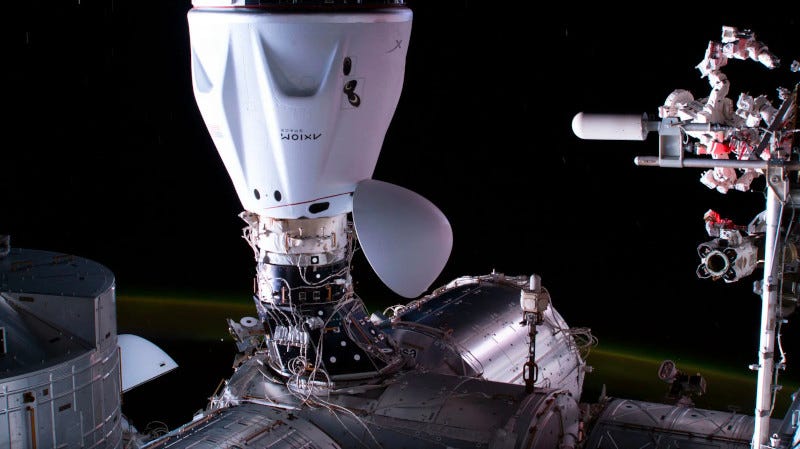
WHAT THIS MEANS: NASA’s Private Astronaut Mission program has institutionalized a bilateral services-exchange contract structure executed through a Space Act Agreement, not a standard procurement vehicle. The February 2026 award to Vast Space confirms the model is being actively replicated beyond Axiom. Companies pursuing NASA exploration-era contracts need to understand this architecture now, before CLD Phase 2 awards resume.
* * *
On February 11, 2026, NASA awarded Vast Space its first private astronaut mission to the International Space Station. Vast has never flown a station. Its Haven-1 module sits on a launch manifest targeting no earlier than early 2027, not in orbit. And yet NASA handed the company a seat at the table that, until that moment, had belonged exclusively to Axiom Space across five consecutive awards.
If you read the press release and moved on, you missed the story.
The Vast award is not a market-expansion headline. It is a procurement signal. NASA is not enlarging a customer list. It is replicating a contract architecture that has quietly become one of the most consequential deal structures in commercial space, and it is doing so with deliberate intent. The companies that understand what that architecture actually is, and what it requires from a proposal, are the ones who will be positioned when the next wave of exploration-era contracts opens. The ones who treat it as a seat-sale will find themselves structurally excluded before evaluation begins.
