

Record-Setting Test Fires Up Next-Gen Rocket Engine Technology
Astrobotic’s Chakram Engine Burns for 300 Seconds in Milestone Hot-Fire Campaign

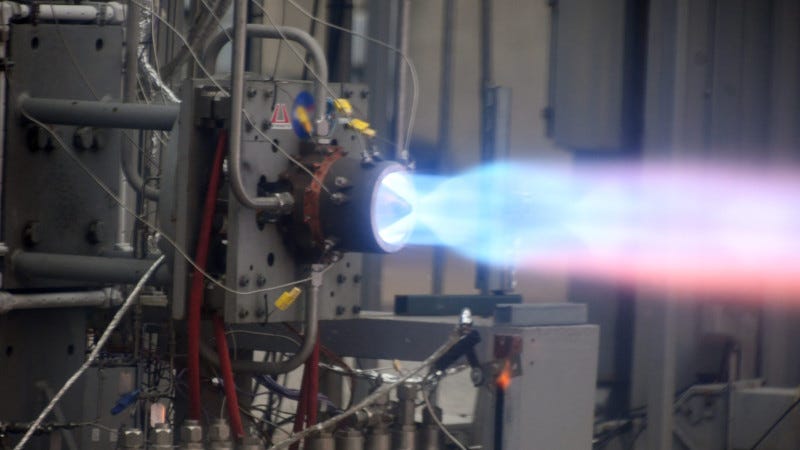
A Pittsburgh-based space robotics company has set what is believed to be a world record for the longest continuous hot-fire test of a rotating detonation rocket engine, a propulsion technology that could significantly improve spacecraft efficiency for future lunar and deep space missions.
“(T)he engine performed even better than expected. The 300-second burn was the cherry on top.”
Bryant Avalos, Astrobotic
Two prototypes of Astrobotic’s Chakram rotating detonation rocket engine (RDRE) completed eight successful hot-fire tests at NASA’s Marshall Space Flight Center in Huntsville, Alabama, accumulating more than 470 seconds of total run time with no discernible damage to either engine. The campaign’s centerpiece was a 300-second continuous burn — believed to be the longest duration hot firing of an RDRE ever achieved.
During testing, each Chakram engine prototype produced more than 4,000 pounds of thrust, placing it among the most powerful RDREs ever demonstrated. With the exception of two brief igniter tests, all hot fires in the campaign reached thermal steady state, demonstrating stable and sustained operation throughout.
“Chakram more than exceeded our expectations,” said Bryant Avalos, Astrobotic’s principal investigator for the Chakram program. “With any cutting-edge technology like an RDRE, moving from design into testing, you’re always worried about unknown factors that could be critical to performance. But the engine performed even better than expected. The 300-second burn was the cherry on top.”
Unlike conventional rocket engines, RDREs combust propellants using supersonic detonation waves that rotate around a ring-shaped outer body. The detonation process extracts more useful work from the same amount of fuel, offering potential gains of up to 15% in specific impulse — a measure of engine efficiency. The technology also promises improved thrust-to-weight ratios and a more compact engine footprint by reducing overall size and weight.
Astrobotic’s Chakram design incorporates the company’s patented PermiAM technology, a novel tunable-porosity metal additive manufacturing process co-developed with Elementum3D. PermiAM is applied to improve thermal management, combustion stability, and propulsion efficiency — areas that are critical to making RDREs viable for operational spacecraft.
The design, development, and testing effort was supported by two NASA Small Business Innovation Research (SBIR) contracts and a Space Act Agreement with NASA Marshall. The SBIR contracts focused on novel injector design and the application of PermiAM to RDRE development.
“This was pulled off by a small group working on a modest budget,” said Travis Vazansky, Astrobotic’s RDRE program manager. “Seeing the engine perform flawlessly on its first attempt is a testament to their acumen, ingenuity, and scrappiness.”
Astrobotic plans to incorporate Chakram into future vehicles, including Griffin-class lunar landers, Xodiac- and Xogdor-class reusable rockets, and an orbital transfer vehicle currently under development. The company describes these platforms as part of a broader effort to expand operations throughout cislunar space — the region between Earth and the Moon.
Future development efforts will focus on regenerative cooling, engine throttling, and mass reduction, which the company says will be critical to meeting mission requirements for spacecraft and landers.
“The data from these tests gives us a powerful foundation for the next phase of RDRE development and will help guide future engine designs,” said Monica Traupmann, co-investigator on the Chakram program. “I’m excited about where we can take this technology next.”