

ESA Advances Lunar Remote Camp Initiative With Award of Parallel Design Contracts
Copenhagen Design Firm to Head Three-Company Consortium for Deployable Surface Shelter Study

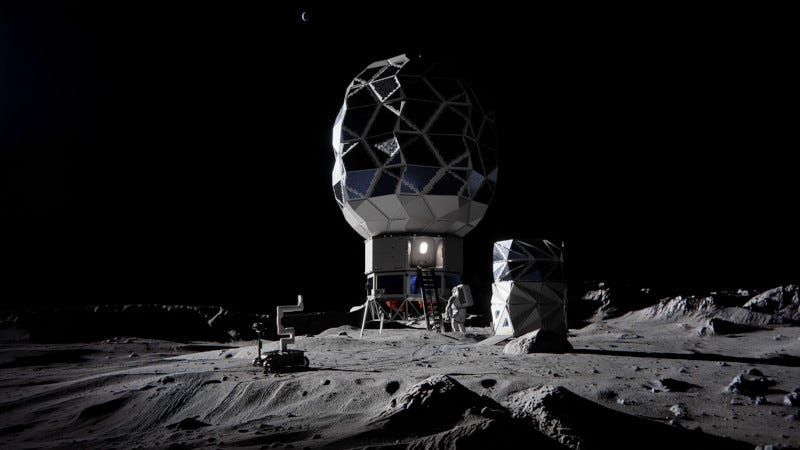
A three-company European consortium led by Copenhagen-based SAGA Space Architects has been selected by the European Space Agency to conduct one of two parallel studies aimed at developing a compact, deployable shelter for lunar surface operations.
SAGA announced its selection on Feb. 19, 2026. Alongside the Danish architecture firm, the consortium includes The Exploration Company, a Munich-based developer of cargo spacecraft for low Earth orbit, and Space Applications Services, a Belgian company specializing in space robotics and lunar rover systems. A second parallel study contract was awarded to a separate team.
The initiative is part of ESA’s Lunar Remote Camp program, which is focused on designing a deployable “protective unit” for the Moon’s surface. The compact shelter is conceived primarily to protect robotic equipment and scientific instruments from the Moon’s extreme operating environment — including sharp temperature swings, abrasive regolith dust, ionizing radiation, and micrometeorite impacts. In later phases, the same basic architecture could be adapted to support short-duration crewed missions as well.
Beyond environmental protection, the shelters are intended to supply power and communications services for robotic operations, providing functional nodes that extend the reach of larger surface installations planned as part of international lunar exploration programs. Both parallel study teams are expected to deliver their findings, including development roadmaps and demonstrator concepts, by the end of 2026.
SAGA brings a substantial track record in deployable lunar habitat design to the consortium. The company’s LUNARK project demonstrated a rigid carbon fiber structure built on an origami-inspired folding design capable of expanding its interior volume by 750% from its packed configuration. Co-founders Sebastian Aristotelis and Karl-Johan Sørensen conducted a three-month winter field expedition in Greenland to validate the design under polar conditions considered analogous to the lunar surface. Temperatures during the test dropped to -41°F (-41°C). The habitat was engineered to be fully assembled and disassembled while wearing a pressure suit — a critical operational requirement for any lunar surface system.
More recently, SAGA completed FLEXHab, a 28-square-meter (301-sq-ft) four-person lunar analog habitat built from a modified 40-ft high-cube shipping container, now installed at ESA’s LUNA analog facility in Cologne. Operational since early 2025, FLEXHab is used by astronaut crews preparing for Artemis surface missions in partnership with the European Astronaut Center and the German Aerospace Center. The structure incorporates circadian lighting, smart monitoring systems, high-performance textile interiors designed for crew well-being, and a 3D-printed glass-fiber exterior facade engineered to mimic the silhouette of a pressurized habitat on the lunar surface.
The Exploration Company is developing the Nyx cargo spacecraft for resupply missions to the International Space Station and other low Earth orbit destinations. Space Applications Services has built experience across multiple ESA-funded surface mobility programs, including lunar rover development initiatives such as the LUVMI-M lunar volatiles rover and the LPSR logistics rover demonstrator.
The Lunar Remote Camp concept addresses a practical shortfall in current lunar surface planning. Rather than requiring robots or future crew members to travel extended distances from a central installation for every task, deployable shelters positioned at remote work sites would provide protected workspaces, equipment storage, and communications relay capability across a wider area of the lunar surface — a capability that becomes more valuable as operational complexity increases during sustained human presence.
For SAGA, the ESA Lunar Remote Camp study represents a direct extension of its existing relationship with the agency. With FLEXHab already in use by ESA at the LUNA facility in Cologne, the company now moves from analog training hardware into early-stage design work on systems intended for actual lunar deployment.
ESA has yet to disclose the team selected for the second parallel study. Results from both consortia will inform ESA’s decisions on whether to advance the Lunar Remote Camp program into subsequent development phases.