


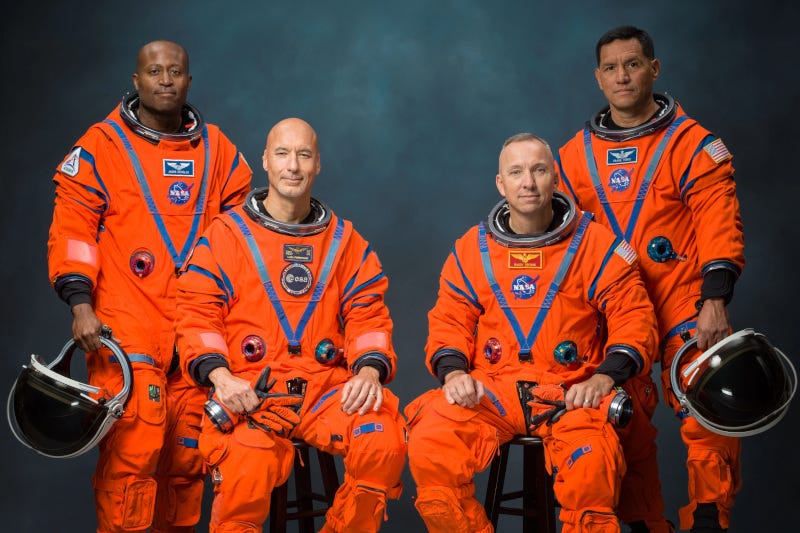
Four astronauts have been assigned to Artemis III, a two-week Earth orbit test mission scheduled for 2027 that will demonstrate rendezvous and docking operations with commercial lunar landers from Blue Origin and SpaceX.
The crew will include NASA astronaut Randy Bresnik as commander, ESA astronaut Luca Parmitano as pilot, and NASA astronauts Frank Rubio and Andre Douglas as mission specialists. NASA astronaut Bob Hines was named backup commander and will train alongside the prime crew.
The announcement came during a live event Tuesday at Johnson Space Center, identifying the mission as a critical step toward Artemis IV the first planned crewed landing at the lunar South Pole, targeted for 2028. The Artemis III crew will launch aboard NASA’s Space Launch System rocket from Kennedy Space Center in Florida.
NASA Administrator Jared Isaacman gave an overview of the mission.
Isaacman VSOT (See Transcript)
The crew will begin training immediately on Orion systems and will assist in development and operations of both the SpaceX and Blue Origin lander test articles.
-0-
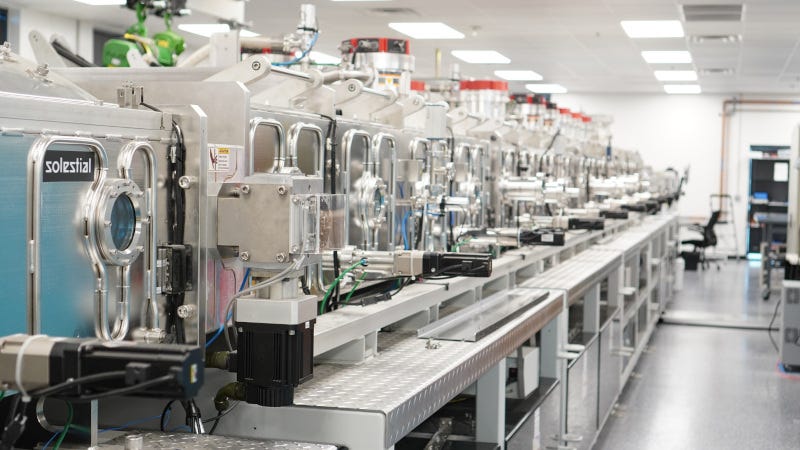
York Space Systems has closed its approximately $67 million cash and stock acquisition of Solestial ... a Tempe, Arizona-based manufacturer of silicon solar cells engineered for the space environment. The transaction closed June 4th. York paid using a negotiated share value of $34.00 per unit, issuing more than 1.7 million shares of its common stock to Solestial’s sellers.
The deal targets a supply chain vulnerability York says runs through the core of the satellite manufacturing industry. China controls 99% of the gallium and more than 60% of the germanium required for the legacy III-V solar cells used in most spacecraft today. It also produces 93% of the world’s polysilicon used in terrestrial solar panels. Approximately 95% of Solestial’s supply chain is already U.S.-based. Solestial will operate as a wholly owned subsidiary of York and will continue supplying solar technology to external customers outside York’s own portfolio.
-0-

The Federal Communications Commission’s Space Bureau has opened two new processing rounds. The rounds cover non-geostationary orbit satellite systems seeking authority to operate in Ku-, Ka-, and V-band frequencies with a July 6th, 2026 deadline for new applicants. The bureau released the public notice June 5th.
Three operators already hold conditional authorizations folded into these proceedings: SpaceX, Amazon Leo, and Logos Space Services. A fourth operator, SN Space Systems, has an application pending from the second V-band processing round that also requested Ku- and Ka-band authorization. The FCC has not set a deadline for acting on applications filed in the third processing rounds.
-0-
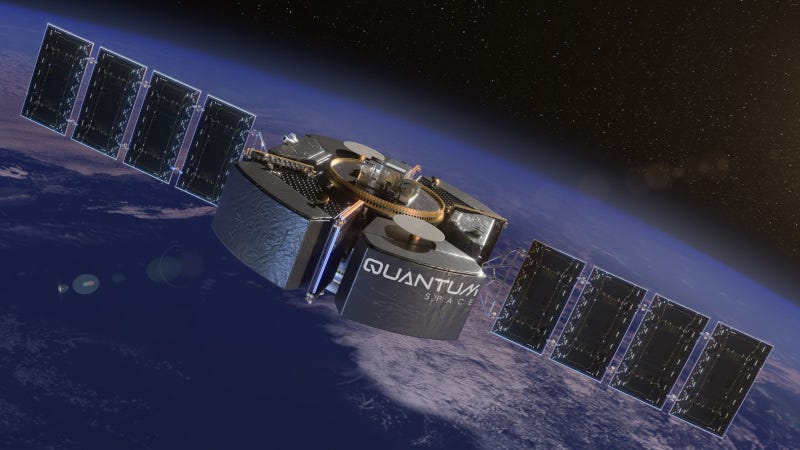
And are SPACs making a comeback? A merger agreement announced Monday values Rockville, Maryland-based spacecraft developer Quantum Space at $1.2 billion post-transaction. The company is set to go public through a combination with special purpose acquisition company Inflection Point Acquisition Corp.
The merged entity will operate under the Quantum Space name and is expected to list on Nasdaq under the ticker symbol “QSPC” pending shareholder approval and an anticipated close in the fourth quarter of 2026. Quantum Space has raised $57 million in equity funding to date, including a $40 million Series A extension closed in June of last year. The company’s Ranger 500 spacecraft completed a Manufacturing Readiness Review in late 2025.
-0-
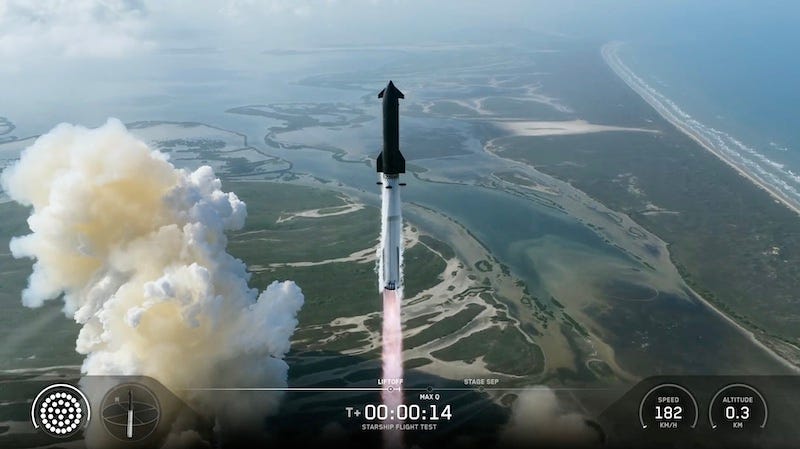
SpaceX flew Starship Version 3 for the first time last week, and the launch cost equation for commercial payload customers shifted with it. [Paywall]
The test flight, designated Flight 12, launched from a newly constructed second launch pad at SpaceX’s Starbase facility in southern Texas. It deployed 20 Starlink simulator satellites on a suborbital trajectory over approximately 10 minutes. SpaceX said ahead of the flight it did not anticipate a flawless test. Post-flight, the company confirmed the V3 ship stage completed its planned suborbital trajectory but the Super Heavy booster did not return to the launch site as planned.
The architecture behind V3 is a structural redesign. The booster now uses three larger grid fins, an integrated hot-staging design, and a new interstage configuration SpaceX calls its Block 3. The company states V3 is designed to carry approximately 200 metric tons to low Earth orbit in fully reusable configuration and roughly 400 metric tons in expendable configuration.
To put that in context: SpaceX’s original Starship required an expendable vehicle to reach 200 metric tons. The V3 reusable rating matches that number. That means a customer flying on a reused V3 vehicle accesses the same mass budget that early Starship variants could only achieve by expending the vehicle.
Third-party analytics group Payload Research estimated Starship’s internal cost per kilogram in an expendable V1 configuration at approximately $500. Under V3’s advertised capacity, that same analytical framework suggests the per-kilogram number could fall by roughly half. Those are third-party projections. SpaceX has not published a V3 commercial rate card.
The commercial payload certification timeline for V3 has not been announced. Neither has the timeline for non-Starlink, non-Starshield cargo access to the vehicle.
-0-
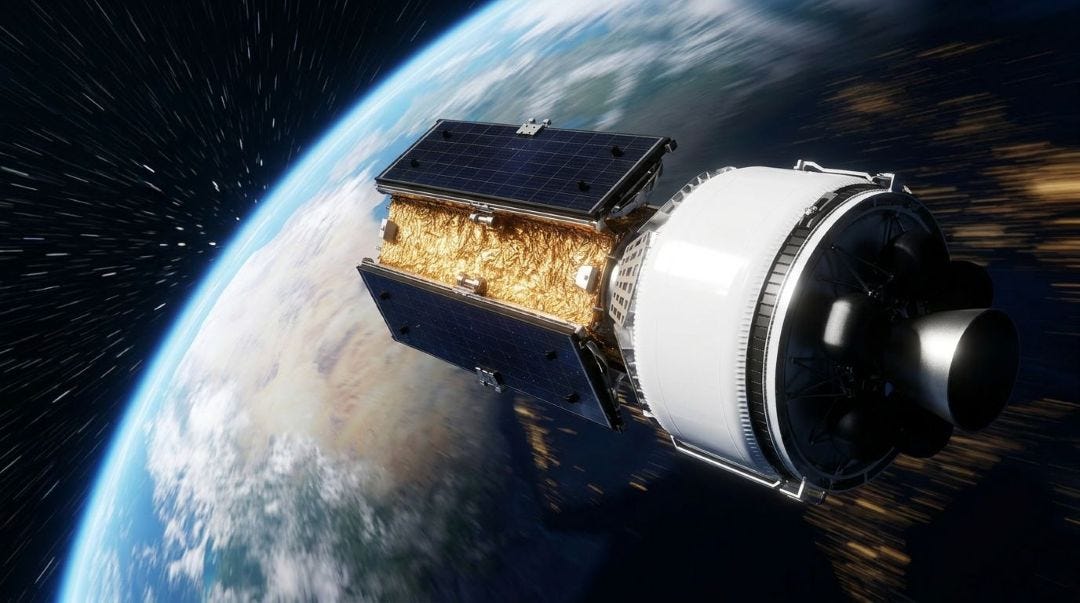
Impulse Space closed a $500 million Series D on June 2nd, bringing its total capital raised to more than $1 billion and the supply chain behind that ambition is still being built. [Paywall]
The round was co-led by 137 Ventures and BANNER VC, with participation from Founders Fund, Lux Capital, and Linse Capital. The funds are earmarked for vehicles, propulsion systems, and operational architecture, a broad mandate that signals Impulse is actively expanding its manufacturing and supply base.
Impulse operates two distinct vehicle programs. Mira, the company’s last-mile maneuvering spacecraft for low Earth orbit, has flown multiple operational missions, delivering satellites from rideshare drop points to their final orbital destinations. Its propulsion, avionics, and structural sub-tiers are either qualified or actively in qualification, indicating a supply chain in execution mode.
Helios is a different story. The Helios kick stage is designed for geosynchronous orbit rideshare and deep-space transfer requiring substantially higher-thrust chemical propulsion, larger propellant tanks, and thermal management hardware that Mira does not need. As of June 2026, Helios has not flown. Its sub-tier qualification chain remains open.
That opening is the primary supply chain opportunity this raise signals.
The Series D’s explicit call-out of propulsion systems as a fund deployment target confirms that Helios’s propulsion architecture is still being finalized and sourced. For suppliers of high-thrust bipropellant engines, composite overwrapped pressure vessels known as COPVs and GEO-class thermal management systems, this is a defined qualification window. Suppliers with existing COPV credentials, including Arde, a Moog subsidiary with flight-heritage high-pressure vessels, and Steelhead Composites, a Colorado-based manufacturer with LEO constellation heritage, represent the vendor class for which that window is most directly relevant.
There’s also a defense layer. Impulse is working as a subcontractor to Anduril Industries on the Space Force’s space-based interceptor prototype for Golden Dome, a team that also includes K2 Space, Inversion Space, Voyager Technologies, and Sandia National Labs. That relationship adds defense-grade guidance, navigation, and control requirements to Impulse’s avionics stack. Radiation-hardened flight computers are now part of the qualification picture.
And those parts face supply pressure across the entire defense space sector. Suppliers currently qualified on SpaceX, Rocket Lab, or Millennium Space Systems programs hold a meaningful head start. For others, early engagement with Impulse’s supply chain team should be considered a prerequisite.
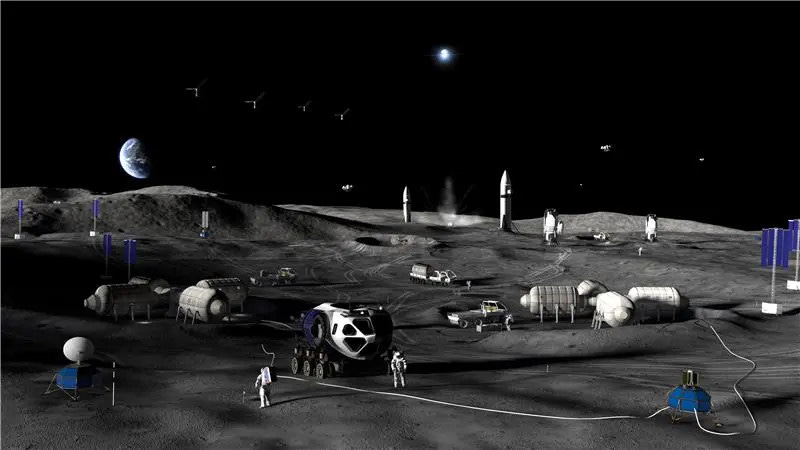
NASA awarded two Lunar Terrain Vehicle contracts on May 26th. The headline is which companies won. The story for supply chain leaders is the procurement architecture behind the awards. [Paywall]
Venturi Astrolab received a contract to produce its FLEX rover. Lunar Outpost received a contract for its MAPP rover. Both awards fall under NASA’s Artemis campaign. Combined, they represent approximately $440 million in potential contract value.
Neither award is a single-delivery purchase order. Both were structured as indefinite-delivery, indefinite-quantity contracts meaning NASA retains the right to issue task orders across a defined ordering period, with total contract value contingent on task order activity rather than fixed at award. That IDIQ structure signals NASA is building a recurring acquisition framework for sustained lunar surface capability, not issuing a one-time purchase.
The rover contracts are one procurement layer in a five-domain architecture. NASA currently has active procurement activity or announced intent across surface mobility, surface power, surface communications, in-situ resource utilization, and surface habitat. Of those five domains, only surface mobility has named prime awards fully in place as of June 2026.
The Fission Surface Power program co-developed with the Department of Energy is the most time-urgent open window. Phase 1 design contracts went to Battelle Energy Alliance, IX, a joint venture between X-energy and Intuitive Machines, and Lockheed Martin in June 2023. Phase 2 awards for flight hardware have not been announced. The sub-tier qualification window for flight-rated fission power components, shielding materials, and heat rejection systems is open now.
There is also a timing issue for the LTV program specifically. Venturi Astrolab and Lunar Outpost have each disclosed technical partnerships and supply relationships in filings dating 18 to 24 months before the May 26th announcement. The propulsion, power storage, mobility actuation, and avionics sub-tiers for those vehicles are substantially determined. New entrants positioning for the rover supply chain are not competing for the current award cycle. They are positioning for the next one and the procurement horizon for LTV-2 has not been publicly announced.
Supply chain leaders who treat the May 26th announcement as the signal to begin qualification are, by definition, already behind.
-0-

Defense buyers are no longer writing Earth observation contracts around best-efforts delivery. Guaranteed cadence is now a contract requirement, and that shift carries direct consequences for every tier of the EO supply chain. [Paywall]
On May 26th, Satellogic announced an $18 million contract with an international defense customer for persistent, high-frequency Earth observation monitoring. The contract runs one year. The meaningful detail isn’t the dollar value. It’s what the customer required: a collection frequency obligation written directly into the contract. Satellogic’s constellation architecture, downlink infrastructure, and processing throughput are now contractual commitments.
And that award isn’t an outlier. In February, the National Reconnaissance Office confirmed the first tranche of contracts under its Strategic Commercial Enhancements Commercial Solutions Opening program, selecting HEO, SatVu, and Sierra Nevada Corporation to supply non-Earth-imaging, medium-wave infrared, and radio frequency sensing capabilities. In May, the NRO added ICEYE US to that panel under a subsequent award, expanding qualified suppliers to include synthetic aperture radar imaging.
Together, those awards establish something more significant than individual contract values: defense buyers are broadening the phenomenology set they procure commercially. A persistent intelligence delivery contract now routinely bundles optical, infrared, RF, and SAR sensing into a single program architecture. The prime contractor that wins such a contract needs a credible subcontract structure behind it for every sensor type.
That sub-tier architecture is where the current sourcing whitespace lives.
The ground segment is the layer that is neither disqualified nor confirmed across any of these award structures. Downlink throughput, antenna access schedules, and processing pipeline capacity are structural requirements in a persistent delivery contract. Providers including Leaf Space, Atlas Space Operations, and Amazon Web Services Ground Station, represent the mapped starting point for ground-segment dependencies. But contractors building teams for persistent EO awards who have not pre-qualified a ground-segment partner are building an incomplete proposal.
The NRO has indicated additional 2026 award tranches are anticipated. The window to build the program office relationships that convert a panel qualification into delivery orders closes before a solicitation is formally posted.
Worth a Second Look
Goodyear to Supply Tires for NASA’s Artemis Lunar Terrain Vehicle
First Wild Strawberries to Be Grown in Orbit Under ISS Agriculture Contract
Satellite Flood Intelligence Tapped for Florida Hurricane Preparedness
Vertical Integration as Brand Strategy [Paywall]
Europe Charts Road Map for Domestic Plutonium-238 Production [Paywall]


