

Starship V3’s First Flight Rewrites the Commercial Launch Cost Equation
Every Assumption Commercial Payload Customers Made About Per-Kilogram Pricing Is Now Under Review

What This Means
Starship V3’s first flight is not a test program milestone. It is a cost-structure reset. SpaceX’s Version 3 vehicle carries approximately 200 metric tons to low Earth orbit in reusable configuration — matching what the original Starship required an expendable vehicle to achieve — and third-party analysts estimate that cost floor, per kilogram, falls by roughly half under V3’s advertised expendable capacity. Investors pricing the SpaceX initial public offering (IPO), payload customers building 2027 and 2028 manifest assumptions, and program managers writing Golden Dome subcontract specifications have days, not months, to revise their models around what V3 changes.
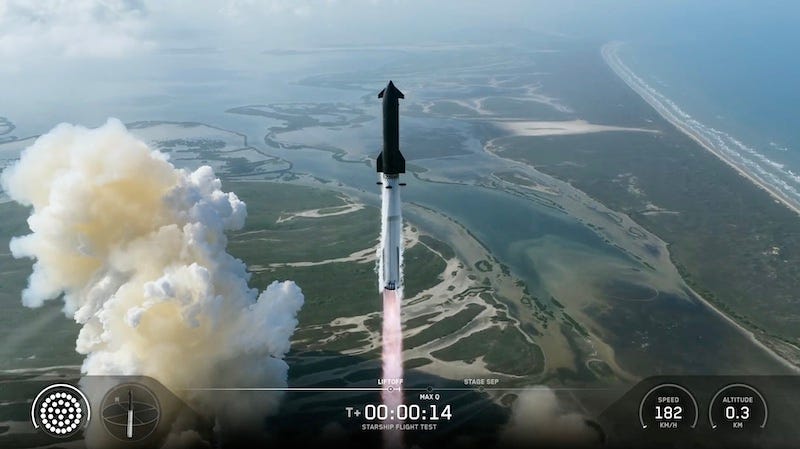
SpaceX launched its Starship Version 3 (V3) rocket for the first time on a suborbital test flight, unveiling a full suite of structural and propulsion upgrades that the company says will push reusable payload capacity to approximately 200 metric tons to low Earth orbit (LEO) and expendable capacity to roughly 400 metric tons. For commercial payload customers building manifest assumptions around current-generation vehicle performance, the architecture shift carries direct consequences for what they can fly, when they can fly it, and how much per-kilogram pricing will look when V3 enters routine service.
The test flight, designated Flight 12, launched from Launch Pad 2 at SpaceX’s Starbase facility in southern Texas and deployed 20 Starlink simulator satellites on a suborbital trajectory over approximately ten minutes. It was the first Starship flight in several months and the first to use SpaceX’s newly constructed second launch pad at the site. SpaceX said ahead of the flight it did not anticipate a flawless test. SpaceX comfirmed post-flight that the V3 Ship stage performed its planned suborbital trajectory but the Super Heavy booster did not complete its planned return to the launch site.
What V3 Actually Changes
The V3 architecture goes well beyond being a few tweaks to an existing vehicle. It’s essentially a structural redesign. The booster configuration now includes three larger grid fins rather than the prior multi-fin arrangement, with an integrated hot-staging design that removes the interstage ring used in earlier vehicles. The ship stage carries corresponding upgrades. SpaceX has described the vehicle collectively as its Block 3 configuration.
The performance gap between V2 and V3 is not marginal. SpaceX has stated publicly that V3 is designed to carry approximately 200 metric tons to LEO in fully reusable configuration and approximately 400 metric tons in expendable configuration. V1, which flew on Flight 3, was rated at 200 metric tons expendable. The V3 reusable rating matches V1’s expendable rating. That means a customer flying on a reused V3 vehicle accesses the same mass budget a customer on an early expendable Starship once required the vehicle to be thrown away to achieve.
The analytics group Payload Research estimated Starship’s internal cost per kilogram to orbit in an expendable V1 configuration at approximately $500, which was a third-party analytical figure and not a published SpaceX pricing commitment. Under V3’s advertised expendable capability, that same analytical framework implies the internal number would fall by roughly half. NextBigFuture, citing SpaceX’s internal roadmap analysis, reported that SpaceX projects Starship can reduce launch costs toward approximately $100 per kilogram as the vehicle scales toward 70 or more flights, again, a third-party projection that SpaceX has not formally confirmed in a published rate card. The downstream effect on list pricing has not been announced. But the directional cost-structure math does not require an official rate card to be useful to a capital allocator or a payload customer building a business case.
How This Lands on the Commercial Manifest
The practical consequence for commercial customers is not just price. It’s mass fraction and scheduling.
Heavier payloads that previously required dedicated launch vehicles or multi-launch assembly sequences are now single-manifest candidates. A 150-metric-ton payload, impossible on any prior commercial launcher without a multi-launch architecture, becomes a feasible single-flight proposition on a fully reusable V3, assuming SpaceX certifies the configuration for non-Starlink commercial cargo. That certification path has not been announced. The timeline for commercial payload certification on V3 is not public.
The Starlink and Starshield manifests are a different matter. SpaceX controls both the vehicle and those programs. V3’s payload capacity means SpaceX can deploy more Starlink satellites per flight or fly larger Starlink satellites per mission, compressing constellation buildout timelines and reducing flight frequency for a given orbital shell. That has downstream consequences for SpaceX’s own launch-frequency projections embedded in the S-1 prospectus and the Starlink capacity assumptions used by third-party analysts modeling Starlink unit economics.
For Starshield, the defense-facing constellation program, V3’s expanded capability adds mass margin for more capable sensor payloads — a factor the United States Space Force (USSF) will note as it structures remaining Golden Dome sensing and imaging subcontracts. The USSF awarded SpaceX a $2.29 billion fixed-price contract for the Space Data Network Backbone in the period leading up to the V3 test, with a fully operational prototype required by end of 2027. A V3 vehicle that can fly heavier Starshield payloads in fewer missions changes the program’s logistics geometry.
V3’s mass capacity is the headline. Paid subscribers get the frequency analysis, the IPO gap assessment, and what this means for your Golden Dome subcontract window — closing this summer.
