



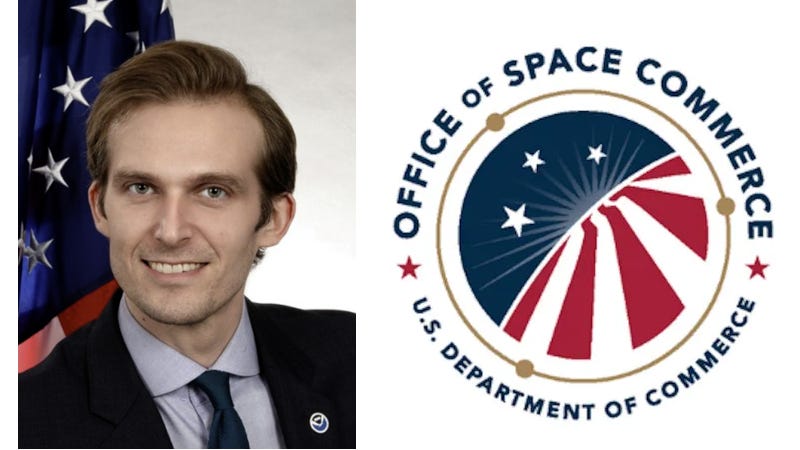
U.S. Secretary of Commerce Howard Lutnick has announced the appointment of Taylor Jordan as Director of the Office of Space Commerce (OSC), underscoring the Trump Administration’s commitment to strengthening U.S. leadership in space commerce. Mr. Jordan will continue to serve concurrently as assistant secretary of commerce for environmental observation and prediction at NOAA.
Jordan brings more than 15 years of space policy and operational experience to the role. He previously served nearly a decade on the staff of the House Committee on Science, Space, and Technology as the committee’s subject-matter expert on NOAA, environmental satellites, and civil space programs. In that capacity, he was the lead author of the Weather Research and Forecasting Innovation Act of 2017.
During President Trump’s first term, Mr. Jordan served as a senior policy advisor at NOAA, where he supported the agency’s satellite programs and provided strategic oversight of major space-system acquisitions. Most recently, he was a principal at Innovative Federal Strategies, advising commercial space and technology companies on legislative and executive-branch engagement.
-0-
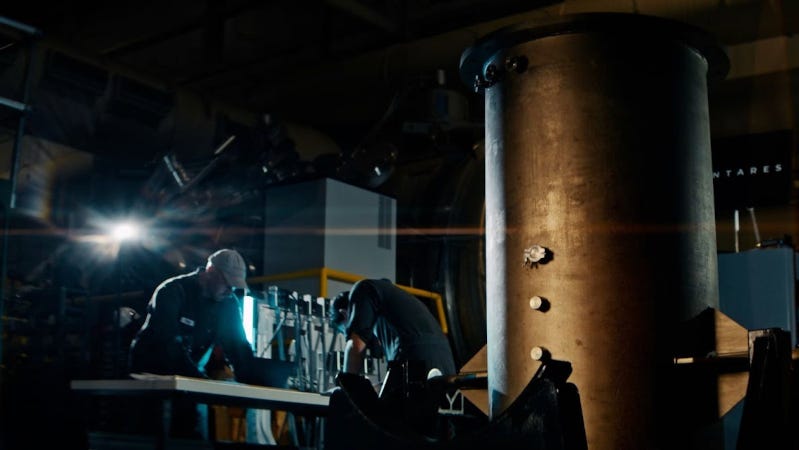
Advanced nuclear energy startup Antares has closed a $96 million Series B funding round. The round was led by Shine Capital, with participation from Alt Capital, Caffeinated, FiftyThree Stations, Industrious, and other investors. The round consists of $71 million in new equity capital and $25 million in debt for equipment, factory build-out, and uranium procurement.
Founded just over two years ago, Antares has made rapid progress in technology maturation. The company has raised over $130 million in funding to date and put those resources to work building out a 145,000-square-foot facility in Torrance, California, capable of producing 10 units per year. Antares has also secured contracts with the United States Air Force, Space Force, Defense Innovation Unit (DIU), and NASA to advance its technology.
Antares CEO Jordan Bramble said the new capital will fuel the company’s mission to deliver safe, reliable, and scalable nuclear power solutions. Over the summer, the company conducted an electrically-heated demonstration of its reactor in partnership with NASA at their Marshall Space Flight Center in Huntsville, Alabama. Antares plans to propose on NASA’s Fission Surface Power program, which aims to deliver 100 kWe of nuclear power on the lunar surface by 2030.
-0-

Funding has been secured by ICEYE to accelerate the company’s delivery of sovereign satellite systems and data intelligence services. The new financing, led by General Catalyst, has broad pan-European participation.
ICEYE has secured the equivalent of some $174 million in new funding, as well as a secondary placement of about $58 million, valuing the company at $2.8 billion. The Series E round was led by General Catalyst, with strong pan-European participation.
The new capital builds on ICEYE’s strong momentum, powering the continued growth of its SAR constellation and the accelerated deployment of sovereign satellite systems, advanced sensing capabilities, and data intelligence services.
SAR uses radar pulses that pierce clouds, smoke, and darkness, providing a continuous view of the Earth that supports rapid response for defense and intelligence, security, disaster response and recovery, insurance, maritime monitoring, and finance.
ICEYE is accelerating the shift to software-defined satellites with its fourth-generation platform, which delivers the world’s highest-fidelity commercial SAR imagery of up to 16 cm. With 62 satellites successfully launched to date, the company plans to scale up to an average production rate of one satellite per week starting next year, deploying sovereign space capability for allied nations at unprecedented speed and scale.

Under the leadership of High-Tech Gründerfonds, Marble has successfully closed its oversubscribed $6.2 million seed round, exceeding initial funding targets. The funding supports Marble in scaling operations, accelerating product and technological developments for its upcoming satellite constellation. The first Marble satellite is scheduled for a 2026 launch.
This marks another major milestone for the company founded in August 2023, following more than $11.6 million in non-dilutive funding and the signing of Marble’s first anchor contract with ESA valued at about $3.5 million.
Marble momentum is also reflected in the latest outcomes of last week’s ESA Ministerial Council 2025 in Bremen. Member states of the European Space Agency committed to a total budget of $25.67 billion for the next three years – the highest funding level in ESA’s history. Particularly encouraging is Germany’s decision to increase its contribution to nearly $6 billion, making it the largest contributor.
High-Tech Gründerfonds is one of the leading and most active early-stage investors in Germany and Europe. Its fund investors include numerous corporations and family offices, as well as the German Federal Ministry for Economic Affairs and Energy and KfW Capital. In addition, Marble has attracted a strong group of further investors who share the mission.
The investment will enable Marble to significantly scale its development team and accelerate completion of its intelligence, maritime, and trafficability tools – solutions that already serve early customers and are now being prepared for broad commercial rollout. It will also support the build-out of Marble’s end-to-end data-processing chain and customer data portal.
-0-

In brief, the Commercial Space Federation (CSF) has announced its four newest members to its Space Supply Chain Council (S2C2): McCollister’s, MERC Aerospace, Space Markets, and Vivace. Together, these small and medium-sized space businesses represent a diverse cross-section of the commercial space industrial base, from logistics and innovative engineering to marketplace infrastructure and next-generation space technologies.
-0-
This week’s company spotlight features D-Oribt (paywall), which has established itself as Europe’s leading space logistics company by delivering over 200 payloads to orbit through 21 commercial missions of its proprietary ION Satellite Carrier platform. Founded in 2011 and headquartered in Milan, Italy, the company has evolved from a New Space startup into a critical infrastructure provider for the rapidly expanding satellite industry.
D-Orbit operates at the intersection of space transportation and logistics, providing what it describes as “last-mile delivery” services for satellites launched on rideshare missions. The company’s core offering centers on the ION Satellite Carrier, a configurable orbital transfer vehicle that transports satellites from their initial deployment orbit to precise operational slots, dramatically reducing the time and cost for satellite operators to begin revenue-generating operations. Unlike traditional rideshare launches that deploy all payloads into a single orbit, D-Orbit’s ION platform uses electric propulsion to maneuver between orbital altitudes and inclinations, delivering each customer’s satellite to its specific destination.
The company’s business model encompasses four primary revenue streams: precision deployment services for satellites requiring customized orbits, in-orbit demonstration (IOD) services for technology testing, hosted payload services for customers who need orbital access without building complete spacecraft, and mission control as a service.
The ION Satellite Carrier represents D-Orbit’s core technological asset—a satellite platform with a configurable payload bay that can accommodate various combinations of launch dispensers, CubeSat-sized payloads, microsatellites, and instruments for in-orbit testing. The platform employs electric propulsion systems that enable precise orbital maneuvers while maintaining fuel efficiency for extended mission durations. ION’s modular architecture allows D-Orbit to customize each vehicle for specific mission requirements, whether deploying a constellation of small satellites or hosting technology demonstration payloads.
The orbital transfer vehicle market is experiencing rapid growth driven by the proliferation of satellite constellations and increasing demand for on-orbit services. Market research firm GM Insights estimates the OTV market was valued at $1.70 billion in 2024 and is projected to reach $3.98 billion by 2030, representing a compound annual growth rate of 15.2%. This expansion reflects fundamental changes in satellite deployment economics, where rideshare launches have reduced launch costs but created new demand for precise orbital delivery services.
D-Orbit competes in this market against both established aerospace primes and emerging New Space companies. Primary competitors include Impulse Space, founded by SpaceX’s first employee Tom Mueller and recently securing $300 million in funding for high-energy orbital transfer capabilities, Momentus Inc., which has faced operational and regulatory challenges, Rocket Lab USA, leveraging its Photon spacecraft platform for OTV missions, and Starfish Space, focusing on satellite servicing and life extension. Traditional aerospace companies including Sierra Space, ArianeGroup, and Mitsubishi Heavy Industries are also developing OTV capabilities.
D-Orbit’s competitive advantage rests on its operational track record—21 completed commercial missions and over 200 payloads successfully deployed represent more flight heritage than most competitors have achieved.
D-Orbit’s growth trajectory depends on several converging market trends and company-specific execution factors. The overall orbital transfer vehicle market’s projected growth from $1.70 billion in 2024 to $3.98 billion by 2030 provides substantial total addressable market expansion. Increasing regulatory requirements for debris mitigation and end-of-life disposal create demand for D-Orbit’s deorbiting capabilities. The company’s operational track record, strategic partnerships, and positioning within European space programs provide advantages as the space logistics market matures from experimental to essential infrastructure.
Paid subscribers can read the full article on The Journal of Space Commerce under the “Capital and Investment” tab.
Theme Stock Music Provided by Pond 5
Worth a Second Look
Lunar Outpost Joins Artemis IV Mission Team
HAKUTO-R Lunar Exploration Program Sunsets
Shield AI Expands into Space Domain


