



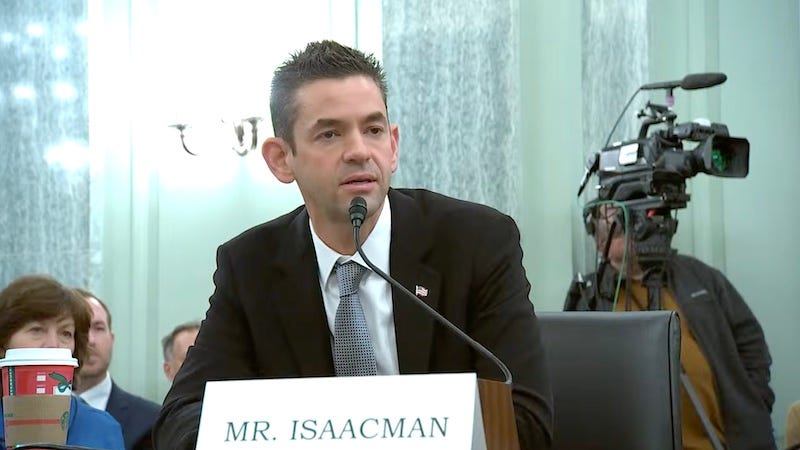
It wasn’t exactly the hot seat, but Jarad Isaacman was back in front of the United States Senate Commerce Committee to answer questions about his qualifications to be the next administrator of NASA.
Isaacman had been tapped by President Donald Trump in December, 2024 for the post during the transition period, and Isaacman appeared to be headed for easy confirmation with bipartisan support. But his nomination was abruptly withdrawn by Trump in May, who said Isaacman was a “true blue Democrat” who did not support the America First agenda. He later said that Isaacman was a good friend of Elon Musk, with whom Trump had had a political falling out.
Such is politics in the 21st century.
The renomination came in November, and the first confirmation hearing was held Wednesday morning.
Isaacman has had strong bipartisan support throughout the process, and that support did not appear to be wavering. Committee Chairman Senator Ted Cruz, a Texas Republican, was effusive in his praise for the entrepreneur-turned-astronaut.
“Mr. Isaacman, I know you are as committed to American supremacy in the final frontier as is this committee and the entire Senate,” Cruz said during his opening remarks. “The United States must remain the unquestioned leader in space exploration. And this imperative is why we need to confirm your nomination as expeditiously as possible. My hope is that you’ll be confirmed and in this role before the end of this year”
Isaacman’s answers to Senators’ questions were very similar to those he gave the first time around. He reiterated his belief that private industry will be an essential partner for NASA in what is widely seen as the new space race with China, as has always been the case with the agency.
“A lot of people do believe generally these are, these are new developments. But in reality, going back to the 1960s in the space race, NASA worked alongside some of our great aerospace companies. I mean, whether it was Boeing or McDonnell Douglas and Northrop, for sure, sir. So a lot of those names are still very relevant within the space program today,” Isaacman said. “And then there’s also a lot of new names that is, referred to sometimes as new space or commercial space. I think it’s going to take, you know, the contributions of the many to do the near impossible. Now, where NASA can play a role is consistent in the past, which is sharing its expertise and talent to help these new companies. When NASA does tend to figure out the near impossible, and it’s mature enough technology to hand it off to industry where innovation can improve upon the capability and lower cost, that’s a great outcome.”
No date has been set for either a full committee vote or a vote by the full Senate, but given the tone of Senator Cruz’ remarks, we will likely see a decision on Isaacman’s nomination before the holidays.
-0-
Following the release of the draft EU Space Act and the accompanying Vision for a European Space Economy, the Office of Space Commerce, in coordination with the Department of State, solicited feedback and comments from US Government agencies and commercial stakeholders on the legislation’s potential impact on the United States. This consultation included input from U.S. trade associations representing a broad cross-section of the U.S. commercial space industry, as well as over 70 responding companies that have active or potential future commercial interests in the EU market.
In its comments, the OCS said that “As a general matter, the United States expresses deep concern regarding measures in the proposed Act that would impose unacceptable regulatory burdens on U.S. providers of space services to European customers. As close partners in civil, commercial, and security aspects of space cooperation for decades, the EU should proceed cautiously when developing and refining the proposed EU Space Act to ensure it provides a permissive and adaptable framework that promotes innovation, investment, and fair competition for the U.S., EU, and EU member states commercial sectors, while respecting each other’s sovereignty. Otherwise, the ability of the United States, the EU, and EU members to maintain government-to-government burden-sharing partnerships could be threatened.”
The letter went onto say that “the current draft EU Space Act contradicts the spirit of the comments made in August on the U.S.-EU Framework Agreement on Reciprocal, Fair and Balanced Trade to “resolve trade imbalances, improve market access, increase our trade and investment relationship, and reduce or eliminate non-tariff barriers.”
The U.S. requested several changes in the draft EU Space Act, including alignment with existing international and industry guidelines, standards, and rules for space systems and operations that have been developed by international consensus. The comments also requested a significant increase in the information and clarity in the text of the EU Space Act itself, rather than waiting for subsequent implementing acts. That would mean that stakeholders and EU member states themselves are fully aware of implications ahead of its adoption, rather than assigning oversight functions to Commission officials in Brussels.
-0-

Space traffic management (STM) functions aboard the Pathfinder A 16U pilot satellite for ESA’s upcoming Celeste In-Orbit Demonstration constellation will be provided by Neuraspace under a contract with CubeSat manufacturer German Orbital Systems. The mission is designed to demonstrate Low Earth Orbit Positioning, Navigation and Timing, or PNT capabilities.
As part of this STM service package, Neuraspace will provide real-time automated solutions for conjunction screening, analysis, and classification, as well as maneuver planning and optimization. In addition, the launch and early operations phase (LEOP) will be supported with GNSS data processing and dedicated tracking using the company’s optical telescopes.
These services by Neuraspace will also contribute towards compliance to ESA’s space debris requirements, with the intention to control collision risk and prevent space debris release and proliferation.
Scheduled to be launched in the first quarter of 2026, the satellite will fly in LEO to demonstrate how PNT signals can ultimately provide guaranteed location accuracy, better signal robustness, increased resistance as well as faster signal acquisition.
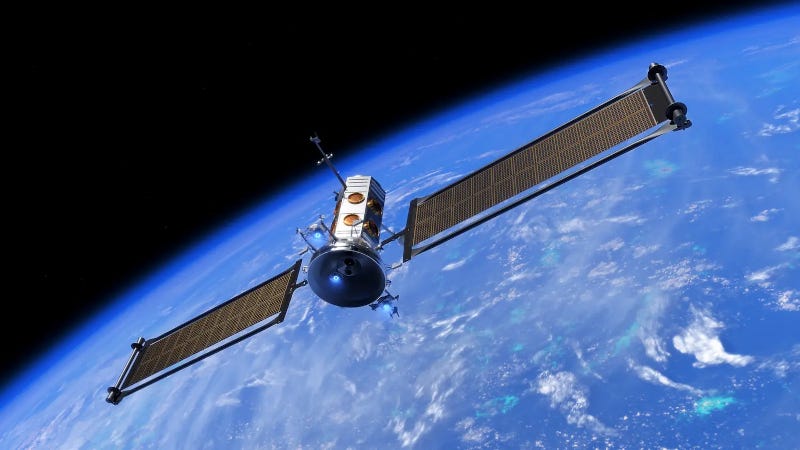
An agreement has been reached between Optimum Technologies and Blue Origin to integrate the OpTech next-generation Caracal optical payload onboard the first mission of Blue Ring. Blue Ring’s first mission is expected to launch in 2026 with initial injection into Geostationary Transfer Orbit (GTO) and additional services performed in Geostationary Orbit (GEO).
The Blue Ring vehicle will demonstrate its ability to simultaneously support the GEO tracking and custody mission as well as space object characterization, leveraging dynamic maneuverability to support high-resolution characterization.
The Caracal sensor is designed to provide actionable insights on resident space objects and orbital activity and includes onboard image storage, object detection algorithms, and passive thermal control. The payload is designed to operate flexibly across dynamic orbits over a year-long mission profile. Caracal will fly with Scout Space’s Owl sensor, along with internally developed payloads, all demonstrating Blue Ring as a platform for supporting future GEO space domain awareness missions.
-0-
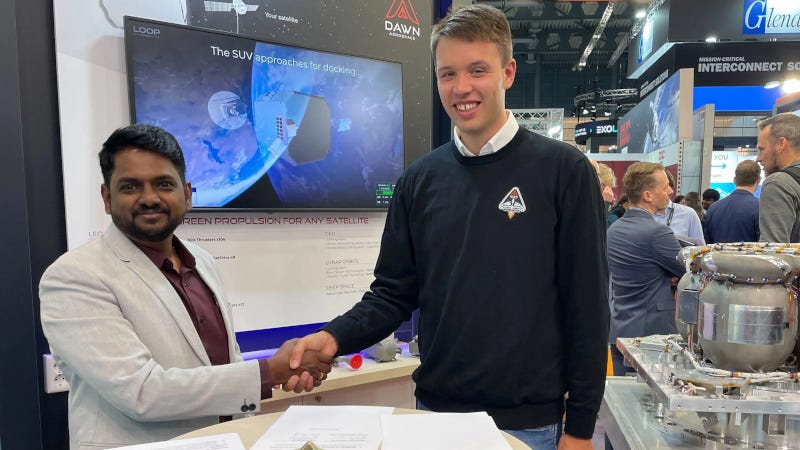
A pair of agreements with Cosmoserve and the Royal Netherlands Air and Space Force will help solidify Dawn Aerospace’s position in the orbital refueling space.
A Memorandum of Understanding was signed between Dawn and Cosmoserve at Space Tech Expo in Bremen, Germany to partner on enabling sustainable and scalable in-space servicing through refueling and debris removal technologies. The strategic MoU expresses both parties’ intent to explore future collaboration on integrating Dawn’s refuelable propulsion systems and in-space refueling service ‘Loop’ with Cosmoserve’s debris capture and removal missions.
By combining Dawn Aerospace’s refueling and propulsion capabilities with Cosmoserve’s debris-removal platforms, the partnership aims to enhance mission endurance and reduce the environmental impact of space activity.
A separate agreement between Dawn and the Royal Netherlands Air and Space Force will see Dawn provide its SatDrive propulsion system for the flagship PAMI-1 mission. Critically, the propulsion system will be equipped with Dawn’s Docking and Fluid Transfer (DFT) port, providing the Netherlands with its first sovereign satellite capable of being serviced and refueled in orbit.
The PAMI-1 mission is the first of six satellites that form a constellation in Low Earth Orbit, with plans for further expansion.
-0-
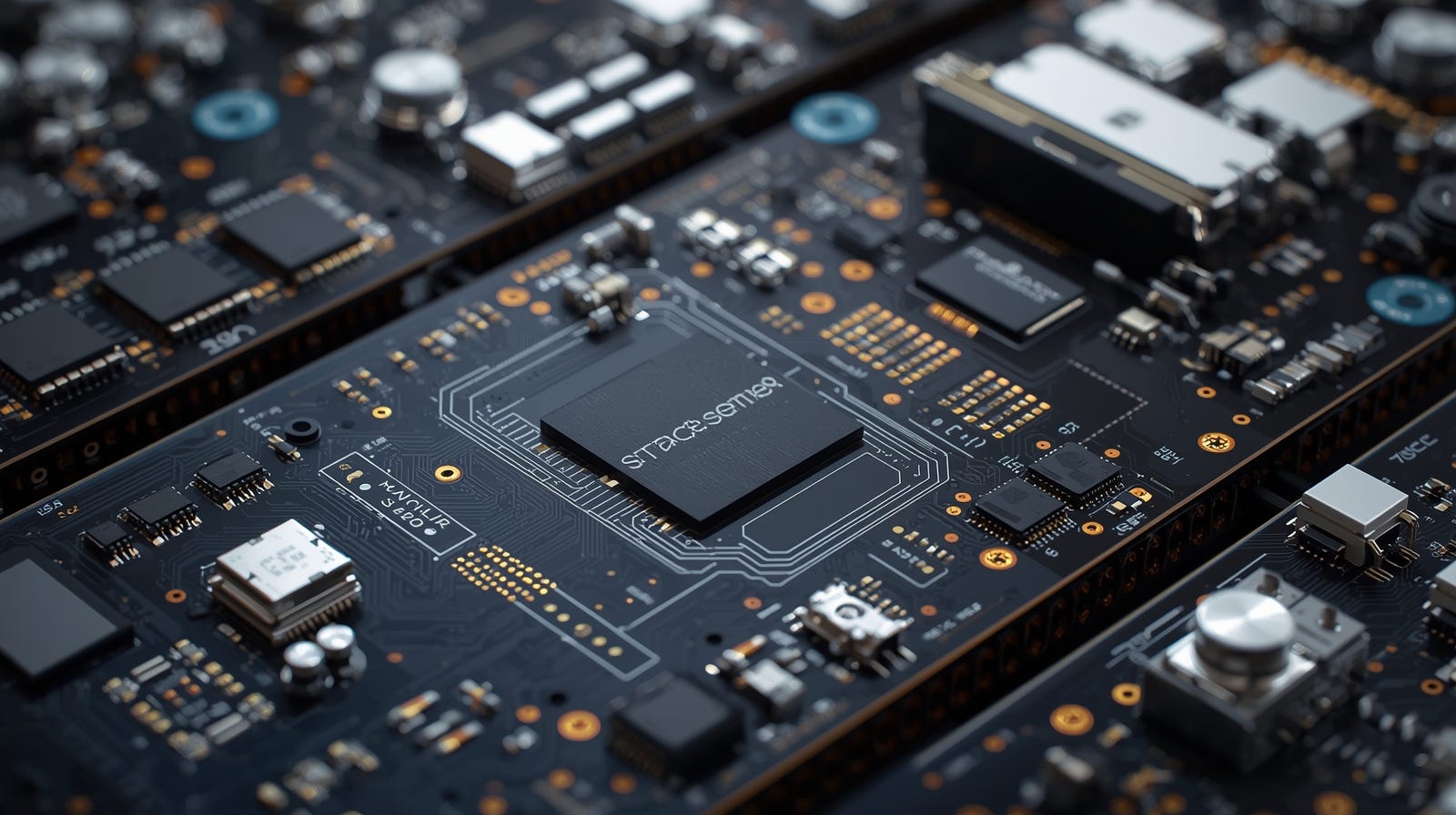
In depth this week we took a look at the supply chain for spacecraft optics and sensors. The global market for optics and sensors represents a critical bottleneck in space commerce, valued at $7.44 billion in 2024 and projected to reach just over $13 billion by 2032, growing at a compound annual growth rate of 5.4 percent.
This Tier 2 component and subsystem segment produces specialized optical instruments and detection systems essential to all space missions, from satellite positioning and Earth observation to scientific research and communication. The supply chain exhibits significant geographic concentration, single-source dependencies for critical materials like germanium, and extended lead times that create strategic vulnerabilities for satellite manufacturers and constellation operators.
Optics and sensors are precision-engineered subsystems that integrate into complete satellites and space vehicles produced by prime contractors. North America dominates the space sensors market with a market share of just over 40 percent in 2024, driven by expanding satellite constellations and U.S. government investments in space domain awareness capabilities. The commercial segment demonstrates the highest growth trajectory through 2032, fueled by rising demand for space tourism, telecommunications, and data transmission services from government and private space agencies.
But digging a little deeper into the supply chain, germanium and silicon represent critical materials for infrared optics and sensors used in satellite payloads and thermal imaging systems. The germanium supply chain exhibits extreme concentration, with China accounting for more than 98 percent of global production and recent export restrictions creating significant disruptions for Western defense manufacturers.
Product categories within the optics and sensors segment include imaging systems for Earth observation, scientific instruments for space exploration, navigation star trackers, communication optical terminals, and thermal infrared sensors. Lead times for custom-designed optical systems typically range from 18 to 36 months from initial design through space qualification, with procurement of base materials extending an additional 12 to 18 months. Batch sizes remain typically small to medium in volume.
Going forward, design standardization across satellite constellation programs could reduce custom manufacturing requirements and improve supplier economies of scale. Vertical integration of germanium production and optical coating capabilities by satellite integrators could secure supply chains and reduce dependency on specialized suppliers. And, material efficiency improvements through precision manufacturing and additive manufacturing for component housings could reduce waste by 15 to 25 percent.
The full report is available for paid subscribers on The Journal of Space Commerce under the In-Depth tab. And while you’re there, check out our investor spotlight on NorthStar Earth & Space, a Montreal-based company backed by $35 million in private equity funding.


