


The global space economy grew 12% last year, reaching $686 billion, according to a new report from Space Foundation.
That’s the second double-digit gain of the decade, though it trails 2021’s 15.5% post-pandemic surge. It’s the fourth-highest growth rate Space Foundation has recorded since it began tracking the industry in 2006. The five-year compound annual growth rate now stands at 9.8%, up more than two percentage points from the prior five-year stretch.
Commercial activity drove most of the increase, accounting for $544.3 billion — 79% of the total — up from $481.5 billion in 2024. U.S. government spending came in at $78.3 billion, or 57% of all government space spending worldwide, though that increase was among the smallest of any leading spacefaring nation.
Two sectors led commercial revenue: positioning, navigation and timing, and ground stations and equipment, combining for $419.8 billion. Newer categories grew faster in percentage terms — in-space servicing, assembly and manufacturing rose 23%, while lunar activity, tracked for the first time this year, jumped 43%.
Space Foundation board members Kevin O’Connell of Space Economy Rising and Carissa Christensen of BryceTech both pointed to the same trend in their comments: government funding and private capital are increasingly moving together, and that combination, they said, is reshaping how the industry thinks about activity beyond low Earth orbit — particularly around the moon.
Government space spending rose 7.4% worldwide, to nearly $141 billion, as 53 national space budgets added nearly $10 billion in 2025, with defense budgets accounting for a growing share of that total.
-0-

A space propulsion, power and electronics business once part of L3Harris Technologies has spun off into its own company. The $845 million deal closed Monday, seven months after it was first announced, with AE Industrial Partners taking majority ownership and L3Harris retaining roughly a 40% stake as what the companies call a strategic partner. The new company revives a familiar name in the industry: Rocketdyne.
AE Industrial Partners, a Boca Raton, Florida-based private investment firm, completed its purchase of a majority stake in the units from L3Harris. The RS-25 rocket engine program was excluded from the sale, and remains under L3Harris.
Kristin Houston, who previously led L3Harris’ Space Propulsion and Power Systems sector and spent 16 years at Boeing before that, becomes Rocketdyne’s chief executive. In comments accompanying the announcement, she said the standalone structure gives the company more room to invest in its people and pursue new work in a fast-growing industry.
AE Industrial’s Jon Lusczakoski (luss-a-KOW-ski) and Kirk Konert both framed the deal as a chance to scale Rocketdyne’s core business lines. Lusczakoski, who was the lead partner on the transaction, told Ex Terra media that the deal was fairly straightforward.
“Given the structure of the deal and it being a carve-out, this is really typical for a transaction like this. We had some standard government approvals and customer approvals that we had to walk through, but we hit our original timeline that we communicated to the market, you know, back in the beginning of this year when we announced the deal,” he said. “You know, we said it would be second half and ended up closing the deal right in Q3. So from us, it was a great success.”
Even with L3Harris staying on as what the companies call a strategic partner, Lusczakoski said that Rocketdyne will be a fully independent company.
“We do have a transition service agreement and a lot of carve-out work that the company will have to get done, you know, over the coming months. But from an operational perspective, governance perspective, they’re now fully independent, which is fantastic. L3 will have some board representation that comes along with their, you know, minority ownership,” Lusczakoski said. “And with that representation on the board, you know, we think they’ll be able to help us on the board and help the company, you know, with insights from their previous ownership of owning Rocketdyne, as well as, you know, insights that they gained from the market with all the exposure and the experience that they have in space and other markets that are relevant here.”
AE Industrial Partners has laid out plans to continue with the RL10 engine, expand thruster production, and push into nuclear power for space applications, and Lusczakoski said all of those will be priorities for the company.
“As we plan to increase investment in higher, you know, exceptional talent across all of our different sites around the country. You know, difficult to put a dollar on it or a head count on it, but definitely plan to be making investments where needed and doing what’s required to, you know, help the customer. For the RL10, you know, we won’t be upgrading the engine. The plan is to, you know, continue to modernize the manufacturing process and increase production of the engine,” he said. “For in-space thruster production, you know, we’re seeing a significant demand from our customer. So it’s really investing into the production line supply chain to really be able to answer that demand. And for nuclear, you know, NASA, the Pentagon Department of Energy established a new initiative back in April to fast track space fission reactors for lunar surface power and nuclear electric propulsion. You know, today Rocketdyne is a leader in both those areas. So we plan to invest further into those to really help support that initiative with those entities.
AE Industrial’s other space holdings include Firefly Aerospace, Redwire Space and York Space Systems.
-0-

The FAA proposed a rule late last month that would let the agency waive parts of 13 federal laws — including environmental and historic preservation statutes — when reviewing certain commercial space launch and reentry license applications.
The proposal comes from the U.S. Department of Transportation, which oversees the FAA, and was announced by Transportation Secretary Sean Duffy. It builds on President Trump’s August 2025 executive order on commercial space competition, along with an existing congressional mandate directing regulators to speed up launch licensing.
This is a proposal, not a final rule. The FAA has opened a 30-day public comment period and says it will review that input before deciding on a final version. Requirements tied to public health and safety, property, national security or foreign policy would not be affected.
The laws in question include the National Environmental Policy Act, the Endangered Species Act, portions of the Clean Water Act and Clean Air Act, and the National Historic Preservation Act, among others.
FAA Administrator Bryan Bedford said the pace of commercial launch activity is outrunning the agency’s current review process and that the FAA needs to streamline and modernize its approach to keep up.
The agency authorized a record 204 commercial space operations in fiscal year 2025, and says it has cleared more launches in the past five years than in the previous three decades combined.
The rule cites a unanimous 2025 U.S. Supreme Court ruling that found the National Environmental Policy Act had turned into what the court called a blunt tool used by project opponents. The FAA did not cite specifi c past licensing cases.
The next step is the close of the comment period, after which the FAA will decide whether to move to a final rule.
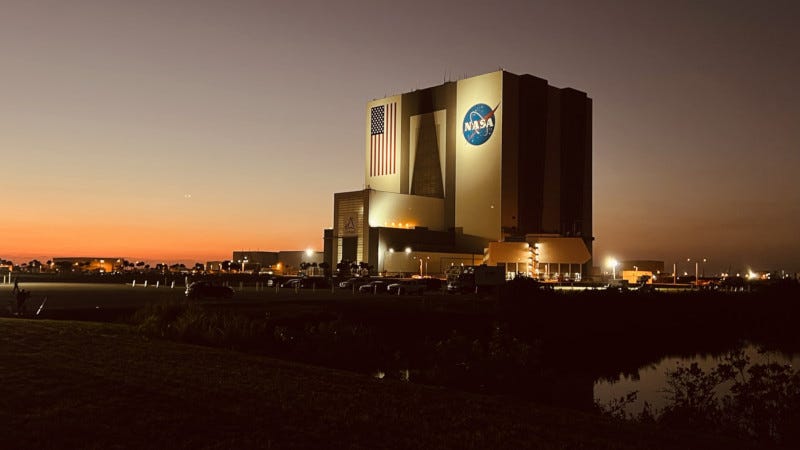
Companion bills in the House and Senate would authorize NASA to accept voluntary private contributions to modernize shared infrastructure at its centers, including Kennedy Space Center.
Florida Republican representative Mike Haridopolos introduced H.R. 9651 on July 13; it’s now with the House Science, Space and Technology Committee. Florida Republican Senator Ashley Moody introduced the companion measure, S. 4905, on June 24; it’s in the Senate Commerce Committee. Both carry the same name, the Space Ready 2.0 Act, and neither has so far picked up a cosponsor.
The bills aren’t identical. Both would create a pilot program letting public and private investment go toward “common use infrastructure” — projects like roadways and pipelines that benefit NASA and outside users jointly, not infrastructure that benefits NASA alone. Where they diverge is on collection: the House version blocks NASA from collecting or accepting contributions, or executing an agreement to do so, unless an appropriations act allows it in advance. The Senate version doesn’t include that restriction; it applies a more standard appropriations condition only to a related repair account.
Senator Moody said that it was also important to point out what the legislation does NOT do.
“In no way does this bill mean that there is new spending programs or a new treasury fund or it doesn’t authorize new federal spending,” Moody said. “This is a legal mechanism to facilitate voluntary contributions into our aging infrastructure. It is important to me, as someone that takes very seriously our use of taxpayer dollars, that we are thinking outside the box and making sure we are using innovative programs to fund some of this demand.
Haridopolos and Moody both framed the bills as necessary to keep pace with growth on Florida’s Space Coast. Space Florida president and CEO Rob Long echoed that message, calling the legislation a step toward modernizing Cape Canaveral.
The bills follow a June NASA Inspector General report finding that Kennedy Space Center still relies on launch-support infrastructure — roads, power systems, pipelines — dating to the Apollo program. The report put the needed upgrade cost at approximately $1 billion to keep pace with Artemis. Moody’s office says Space Coast launch activity has climbed more than 500% since 2016.
Participation is voluntary, unspent funds would be refunded or redirected after 90 days, and completed improvements would generally become U.S. government property. The authority to collect contributions would expire Dec. 31, 2031.
Both bills remain in committee, and no hearing dates have been set.
-0-
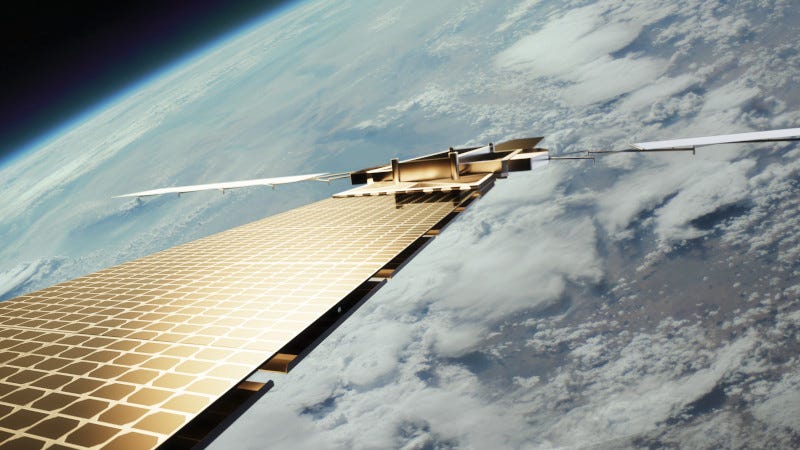
The U.S. Patent and Trademark Office has issued a patent covering the design of computer data centers built to run in Earth orbit, jointly owned by Sophia Space and the California Institute of Technology.
Patent number 12,679,564, titled “Space-Based Data Centers,” was filed in October 2024 and issued July 14. Sophia Space, based in Pasadena, California, and backed by Mandala Space Ventures, traces the invention to research inside NASA’s Jet Propulsion Laboratory, which Caltech manages. Seven inventors are named on the patent, drawn from JPL, Caltech and Sophia Space.
The design draws power from sunlight to run onboard computing and storage, then sheds heat by radiating it directly into space rather than relying on a mechanical cooling system. Sophia Space founder Dr. Leon Alkalai (al-kah-lie), a former JPL fellow, said cooling in orbit required an entirely different approach than cooling on the ground, since radiating heat into space is the only option available. He calls the resulting modular unit TILE — Thermal Integrated LEO Edge — designed to be assembled into a larger, continuously powered orbital data center.
The work builds on Caltech’s Space Solar Power Project, funded by the Donald and Brigitte Bren Foundation since 2013, which demonstrated wireless power transmission from space to Earth for the first time in 2023. JPL researcher Dr. John Brophy, one of the named inventors, described the patent as an example of moving federally funded research into commercial use.
Alongside the patent, Sophia Space signed a new sponsored research agreement with Caltech under which Professor Sergio Pellegrino’s team will develop lightweight deployable structures and thermal management techniques for future orbital data centers.
Sophia Space has raised $22 million to date and is targeting a 2027 in-space demonstration of the TILE technology aboard an Apex Nova satellite bus.
-0-
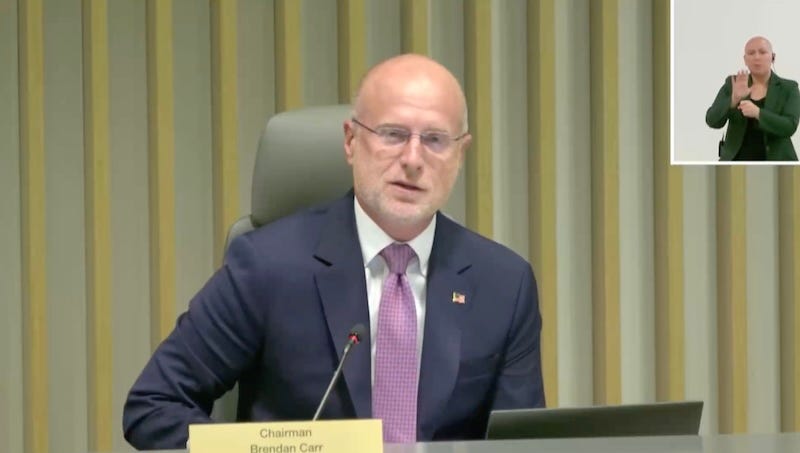
The Federal Communications Commission voted unanimously Thursday to adopt a Notice of Proposed Rulemaking (NPRM) that would let satellites communicate directly with smartphones, laptops and other consumer devices using spectrum currently reserved for unlicensed uses such as Wi-Fi and Bluetooth.
The notice, adopted at the Commission’s August open meeting, targets three frequency bands governed by the agency’s Part 15 unlicensed-device rules. Certified devices could transmit to FCC-authorized satellites at up to four watts equivalent isotropically radiated power — the same limit that applies to their terrestrial use today.
The measure responds to more than $40 billion that has moved through the direct-to-device satellite sector over 18 months, including SpaceX’s $19.6 billion spectrum acquisition from EchoStar and separate deals involving AST SpaceMobile, Amazon and Rocket Lab.
Most of the notice raises questions rather than settling rules. FCC Chairman Brendan Carr said that the NPRM is moving spectrum allocation into “uncharted frontiers.”
“For the first time, we are exploring whether D2D services are technically possible in more than 200 megahertz of unlicensed spectrum bands,” Carr said. “These frequencies could yield more capacity to complement D2D services and encourage experimentation. Unlicensed spectrum already powers a range of household devices and important innovations and our inquiry today asks a lot of questions that are designed to ensure that these bands remain an American success story for existing and future services of all types. We are excited to see where the answers to this inquiry lead us.”
The Commission has proposed allowing device-to-satellite transmission in all three bands, but has not yet proposed a matching path for satellites to transmit back down to devices, and it’s asking for public input on interference protections, device authorization, and potential impacts on radio astronomy.
The vote starts the rulemaking process rather than ending it. The public will have 30 days to comment once the notice is published in the Federal Register, and 60 days to file replies.
You Might Also Like
FCC Clears Full Deployment of Private Navigation Satellite Network
Long-Missing Transmitter Found, Freeing Up NOAA Weather Satellite Uplink Slot
Wind Tunnel Tests Wrap For Redesigned Moon Rocket Booster
Earth-Observation Satellite Reaches Orbit, Completing Constellation’s Commercial Threshold
Eighteen Missile-Tracking Satellites To Carry Flight-Proven Infrared Sensors


