


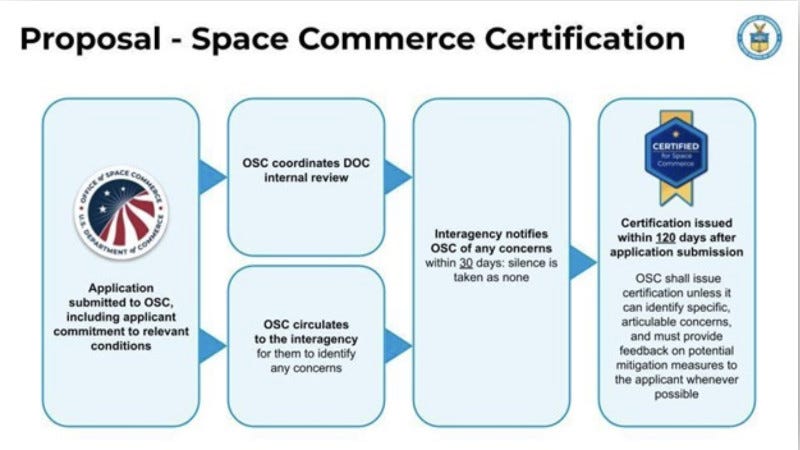
The Office of Space Commerce says it will publish a Federal Register notice within weeks seeking the first applications for its proposed space licensing certification.
The notice would invite companies to apply under the “Space Commerce Certification,” a voluntary process OSC proposed in March to consolidate licensing for commercial space activities not clearly covered under existing FAA, FCC or OSC remote-sensing rules. The office says it plans to begin certifying missions within months of the notice’s publication.
OSC posted a video with the announcement. Commerce Secretary Howard Lutnick framed the certification as central to the department’s ambitions in space.
“It’s going to be a multi-trillion dollar industry, and the Department of Commerce is going to lead the way.” he said, adding that the certification carries what he called a presumption of approval. “Which means we’re looking to help you get in business, to get in space, to launch your satellites, and to create the amazing opportunity that’s going to be space.”
The announcement comes eight days after OSC Director Taylor Jordan testified before the House Science, Space, and Technology Committee’s Space and Aeronautics Subcommittee. Lawmakers there questioned whether the office has the money to run the process it’s now moving to launch. The Trump administration’s fiscal 2027 budget request seeks $11 million for OSC, down from an enacted 52-and-a-half million this year. Jordan told the subcommittee the office hasn’t built additional staffing into its budget for the certification work.
The FAA, FCC, and OSC’s own remote sensing division have not said whether they’ll accept the certification in place of their existing requirements. That means companies who apply before that question is settled may not know yet how much regulatory relief the certification will actually deliver.
OSC has not said which category of activity — satellite servicing, in-space manufacturing, or lunar operations — will be first in line once the Federal Register notice publishes.
-0-

The FCC has approved a framework to free up 160 megahertz of Upper C-band spectrum for wireless use across the country.
The Commission adopted the order Wednesday under two dockets, combining freshly cleared spectrum between 3.98 and 4.14 gigahertz — plus a 20 megahertz guard band — with previously auctioned Lower C-band frequencies. Together, that creates a contiguous 440 megahertz band for next-generation wireless service. The move satisfies a requirement in the One Big Beautiful Bill Act that the commission auction at least 100 megahertz of the band by July 4, 2027.
Three satellite operators will split $6.3 billion in incentive payments for clearing the spectrum: SES gets a touch over $5.6 billion, Eutelsat gets $504 million, and Telesat gets $189 million. The payments come in two installments — $4.914 billion tied to a primary deadline, followed by $1.386 billion before a second deadline. Operators who fall more than 180 days behind schedule forfeit the payment entirely.
New Upper C-band license holders will also have to reimburse the operators’ transition costs, which the commission estimates at $4 to $5 billion.
Commissioner Anna Gomez approved the order in part but dissented on one point — she wanted a Tribal Licensing Window added for the Navajo Nation, the Shoshone-Bannock Tribes and other tribal governments.
“As part of the federal government, the FCC has a trust responsibility to tribal nations. The United States trust responsibility to tribes is a legal obligation established by the Constitution, treaties, and over a hundred years of Supreme Court precedent. Under this obligation, we engage with tribal nations on a government to government basis and are charged with carrying out the law in a manner that supports their sovereignty,” Gomez said.
“The unique legal framework and relationship between the federal government and tribal nations requires us to ensure that they have a fair and meaningful opportunity to secure spectrum that is essential to their economic development, public safety, and cultural preservation.”
Chairman Brendan Carr agreed to take further comment on that idea, but it’s not in this order.
Executives at SES and Eutelsat both welcomed the payments, calling them recognition of the role their companies will play in the transition.
Eligible operators have to file transition plans with the FCC by Nov. 5. A clearinghouse selection committee has 60 days from the order’s publication to convene and name a candidate by Dec. 15.
-0-
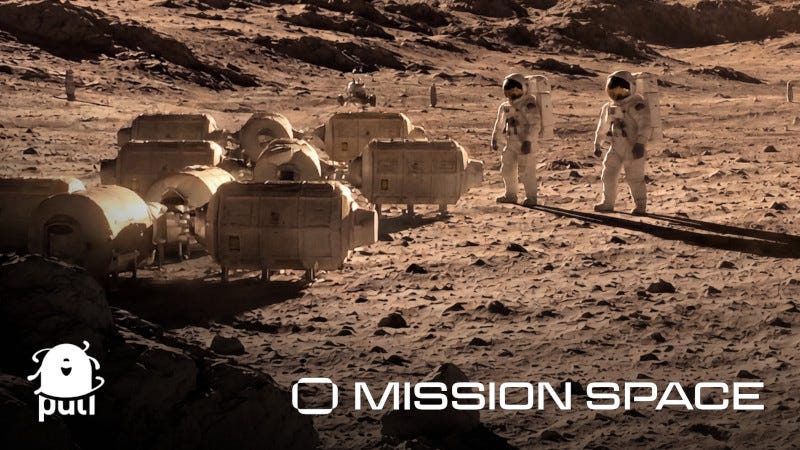
A Budapest-based rover developer and a Miami-based space-data company are exploring a joint mission to put environmental sensors on the lunar surface.
Puli Space Technologies and Mission Space have signed a memorandum of understanding to evaluate pairing Puli’s rover platform with Mission Space instruments that measure radiation, charged particles, dust behavior and surface charging on the moon. The agreement is nonbinding — it commits the companies only to studying the concept, with no disclosed timeline, funding source or target launch date.
The deal follows Mission Space’s selection by NASA to develop a lunar dust and surface-charging instrument with the agency’s Goddard Space Flight Center. NASA is separately funding a similar effort of its own: DUSTER, a University of Colorado/Boulder-led instrument suite being developed under a $24.8 million contract for the Artemis IV mission.
Both efforts fall under NASA’s broader “Ignition” initiative that includes a Moon Base program aimed at a permanent lunar outpost by 2030.
Under the concept, Puli’s rover would handle mobility and terrain access while Mission Space instruments collect measurements along the way. Executives from both companies say the collaboration builds on Puli’s Water Snooper instrument, which already returned data from the lunar south pole under a European Space Agency contract.
The companies are also looking at a joint commercial data product, combining the rover’s positioning data with Mission Space’s environmental readings.

The Office of Space Commerce and the Aerospace Industries Association will host a forum on the commercial space supply chain Aug. 18 in Arlington, Virginia.
The Commercial Space Supply Chain Forum runs from 8 a.m. to 5 p.m. at AIA headquarters — the second event in OSC’s forum series on Commercial Space Competitiveness, which connects industry with federal agencies.
Organizers say growth in the commercial space industry is straining the industrial base that supports it, pointing to challenges around demand visibility, manufacturing capacity, component availability, testing and qualification, capital access and regulatory compliance.
Sessions will cover eight topics, including domestic manufacturing capacity, constraints among tier 2 and tier 3 suppliers, supply chain dependencies, capital access, testing capacity, regulatory pressures, export considerations and barriers to adopting emerging technology. The forum will mix panel discussions with what organizers call hands-on working sessions.
The goal, according to the announcement, is to identify policy priorities that could strengthen the resilience of the U.S. commercial space industrial base.
Space is limited, and no agenda, panelist list or registration deadline has been published yet. Those interested can reach the Office of Space Commerce at Space.Commerce@noaa.gov.
-0-
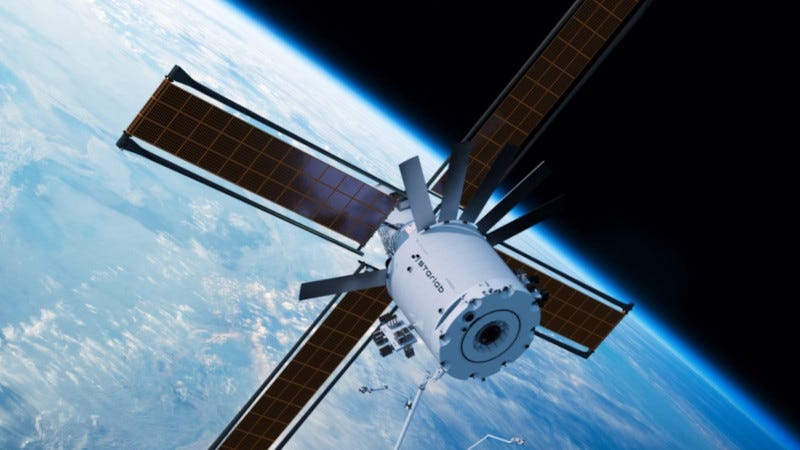
Starlab has picked SES Space & Defense to handle continuous satellite relay communications for its commercial space station.
The companies announced the arrangement Monday. Starlab is under development through NASA’s Commercial Low Earth Orbit Development program, meant to succeed the International Space Station. SES Space & Defense, a subsidiary of SES S.A., has provided communications to the U.S. government and allied defense agencies for nearly six decades.
Neither company said whether the arrangement is a signed contract, a memorandum of understanding or a letter of intent. Contract terms and a target launch date for the station weren’t disclosed.
Under the deal, SES Space & Defense will route Starlab’s data through its O3b mPOWER satellite network in medium Earth orbit, relaying information to ground networks with minimal delay instead of relying on direct contact windows.
Executives at both companies described the setup as central to keeping the station connected around the clock, with SES Space & Defense saying the service will expand as Starlab’s operations grow.
-0-
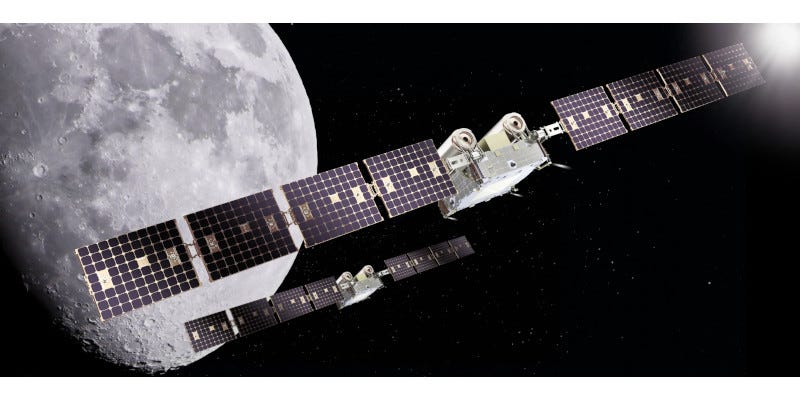
NASA has ordered a second CAPSTONE mission that will send two small spacecraft into lunar orbit to practice rendezvous and docking ahead of future crewed Moon landings.
The agency awarded the contract to Advanced Space. CAPSTONE 02 is targeted for launch in 2027, building on the original CAPSTONE mission, which NASA calls the first U.S. commercial mission to the moon and the first spacecraft to fly in a near rectilinear halo orbit.
Where the first mission tested navigation and communications, CAPSTONE 02 moves into active demonstrations. The two spacecraft, each about 882 pounds, or 400 kilograms, and built by Terran Orbital Systems, will practice rendezvous, proximity operations and formation flying to study how trajectories behave under the combined gravitational pull of Earth and the moon.
Each spacecraft can switch between chaser and target roles, testing scenarios NASA says can’t be fully replicated on Earth. The techniques mirror the navigation approach planned for Orion’s rendezvous with a lunar lander.
The mission will also test three NASA-developed navigation software suites and carry an optical imaging payload from Lawrence Livermore National Laboratory. NASA officials say the work builds toward the lasting capabilities needed for a permanent presence at the moon, supporting Artemis, Moon Base and future deep-space missions.
The mission is funded by NASA’s Human Spaceflight Mission Directorate and managed by the Small Spacecraft & Distributed Systems office at NASA’s Ames Research Center in California.
Worth a Second Look
Florida, South Australia Agency Sign Deal to Link Spaceport Development
Space Development Agency Commits $1.75 Billion to Golden Dome Tracking Satellites
Space Force Awards $69.2 Million Contract for AI-Powered Mission Training
Rovers Bound for the Moon Will Get NVIDIA-Powered Onboard Computing
The True Competitive Frontier [Paywall]


