

Rovers Bound for the Moon Will Get NVIDIA-Powered Onboard Computing
Company Says Partnership Will Support Navigation and Mapping, Starting With a Late-2026 Launch

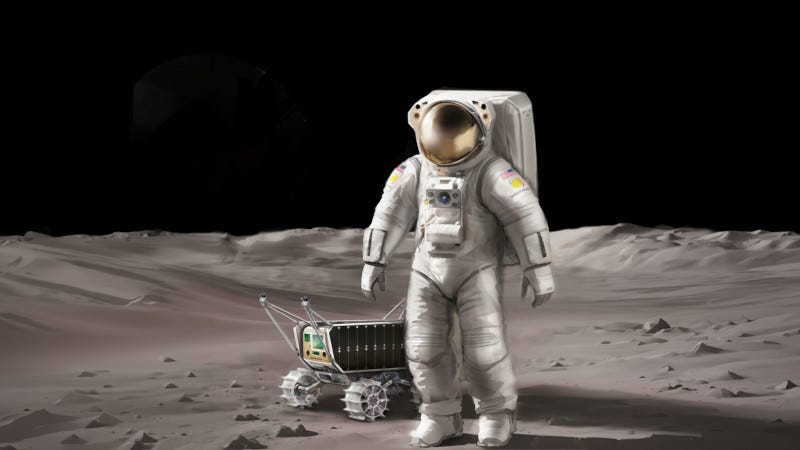
A Golden, Colorado-based rover manufacturer will use NVIDIA’s computing hardware to run navigation, mapping and data-processing systems on its upcoming lunar missions, the companies said in a news release Thursday.
“We are actively deploying the technologies that enable people to work, live, and build in space.”
Justin Cyrus, Lunar Outpost
Lunar Outpost announced the collaboration with NVIDIA on July 23. The agreement calls for the company’s rovers to run on NVIDIA’s Jetson platform and CUDA-X software libraries for onboard data processing beginning with its next mission.
The first mission to use the hardware will be Lunar Voyage 2, which Lunar Outpost said is targeted to launch later this year to explore the Reiner Gamma region of the Moon. According to the release, NVIDIA Jetson modules will command and control the rover’s LiDAR system, handle post-processing of sensor data, and compress large files for transmission back to Earth.
“Returning to the Moon is more than just landing rovers,” Justin Cyrus, founder and CEO of Lunar Outpost, said. “We are actively deploying the technologies that enable people to work, live, and build in space.”
Two later missions, Lunar Voyage 3 and Lunar Voyage 5, may incorporate a newer NVIDIA processor, the space-qualified Space-1 Vera Rubin Module, the release said — though the company described that use as a future possibility rather than a confirmed configuration. Lunar Outpost said Lunar Voyage 5 is intended to support the first human-robot interaction on another celestial body; no date for that mission was given in the release.
“Lunar missions require intelligent systems that can process data and make decisions in real time,” said Chen Su, head of edge AI product marketing at NVIDIA. “Lunar Outpost is using NVIDIA Jetson and CUDA-X libraries to give its rovers the onboard AI computing needed for terrain mapping, autonomous navigation, mission data processing and scientific discovery.”
Lunar Outpost is one of several companies NASA has contracted to build lunar terrain vehicles for Artemis missions, alongside Astrolab and Intuitive Machines, according to NASA. Lunar Outpost said it is a member of NVIDIA’s Inception Program, which provides hardware access and technical support to startups, and that it counts Nokia, the Massachusetts Institute of Technology and Castrol among its other collaborators. The company said it has 10 lunar and cislunar missions under contract for launch before 2030, including a role delivering a crewed rover under NASA’s Lunar Terrain Vehicle Services contract.
Lunar Voyage 2 remains the next scheduled test of the arrangement, with Lunar Outpost targeting a launch later this year.