

NASA Could Accept Private Funds Under New Space Infrastructure Bills
House and Senate Versions Diverge on When NASA Could Actually Collect the Money

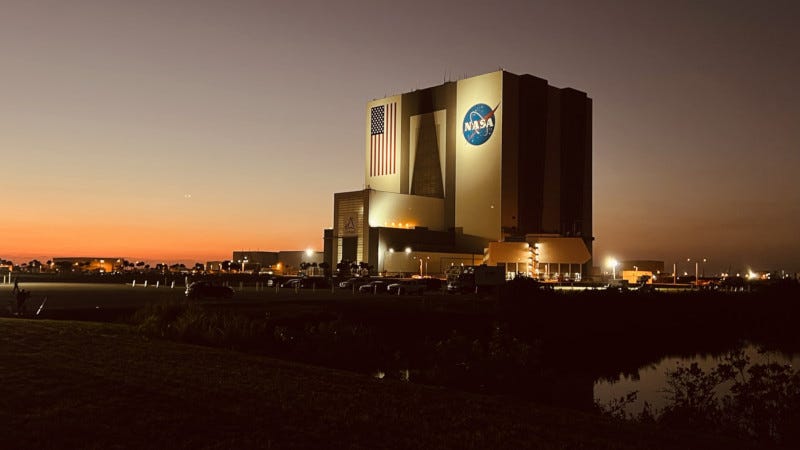
Companion bills introduced in the House and Senate would authorize NASA to accept voluntary private contributions to modernize shared infrastructure at its centers, including Kennedy Space Center.
“As more missions launch from Florida, we must ensure NASA has the infrastructure needed to support the next generation of exploration and keep America leading the world in space.”
Mike Haridopolos (R-FL)
Rep. Mike Haridopolos, R-FL, chairman of the House Subcommittee on Space and Aeronautics, introduced H.R. 9651 in the House on July 13; it was referred to the Committee on Science, Space, and Technology. Sen. Ashley Moody, R-FL, introduced a companion measure, S. 4905, in the Senate on June 24; it was referred to the Committee on Commerce, Science, and Transportation. Both bear the same title, the Space Ready 2.0 Act, and neither has attracted a cosponsor.
The two bills are not identical. Both would let the NASA administrator run a pilot program allowing public and private investment in infrastructure projects at one or more NASA centers, and both define eligible work narrowly: “common use infrastructure” that benefits NASA and outside users jointly, such as roadways and commodities pipelines, but not infrastructure that solely benefits NASA. Where the bills differ is on when the government could actually take the money. The House bill states that no voluntary contribution “may be collected or accepted,” and no agreement authorizing collection “may be executed,” except to the extent provided in advance in an appropriations act. The Senate bill, as introduced, does not include that restriction on collection itself; it instead applies a more standard appropriations condition only to NASA’s use of a related repair account.
“We can’t be number one on Earth if we’re number two in space,” said Haridopolos. “The Space Coast has always been at the heart of America’s space program. As more missions launch from Florida, we must ensure NASA has the infrastructure needed to support the next generation of exploration and keep America leading the world in space.”
“Florida is leading America’s next great chapter of space exploration, but if we want to remain the world’s leader in space, our infrastructure must keep pace with the incredible growth we’re seeing on the Space Coast,” said Moody. “The Space Ready 2.0 Act is a commonsense solution that empowers NASA and its commercial partners to modernize aging facilities without creating new spending programs, ensuring we remain competitive and mission ready. I’ll continue fighting to strengthen our nation’s space capabilities and keep the Sunshine State the launchpad for American innovation and exploration.”
Rob Long, Col. USSF (Ret.), president and CEO of Space Florida, also weighed in. “We’re grateful to Senator Moody for her leadership and putting into action real solutions for the space industry,” Long said. “The Space Ready 2.0 Act takes the space infrastructure challenges head-on, bringing everyone together to modernize the Cape. Florida built the model for a thriving commercial space industry, and with leaders like Senator Moody, we’ll keep Florida and our nation first in the space economy.”
The legislation follows a June report from the NASA Office of Inspector General that found Kennedy Space Center relies on launch-support infrastructure — including roads, power systems and pipelines — dating to the Apollo program of the 1960s. The report estimated NASA needs approximately $1 billion in upgrades to keep pace with the Artemis lunar program. Moody’s office said launch activity on Florida’s Space Coast has increased more than 500 percent since 2016.
Under both bills, NASA could accept the contributions without creating a new federal spending program or a new Treasury fund, drawing instead on the agency’s existing Construction and Environmental Compliance and Restoration account. Participation would be voluntary; the agency could not withhold an agreement or deny a commercial lease over a dispute on contribution terms. Contributed funds not spent within 90 days of a project becoming operational would, at the contributing company’s choice, be refunded or redirected to another eligible project. Improvements built with the money would generally become U.S. government property unless the administrator determines otherwise. NASA would have to report to Congress on expenditures within 180 days of enactment, then annually, with milestone updates at least every two years. The authority to collect contributions would expire Dec. 31, 2031, though existing agreements would remain unaffected.
Both bills remain in committee. No hearing date has been set for either.