

Global Space Economy Grows 12% to $686 Billion in 2025: Space Foundation
Commercial Revenue and Government Funding Both Climb, but Growth Rate Trails 2021’S Post-Pandemic Surge

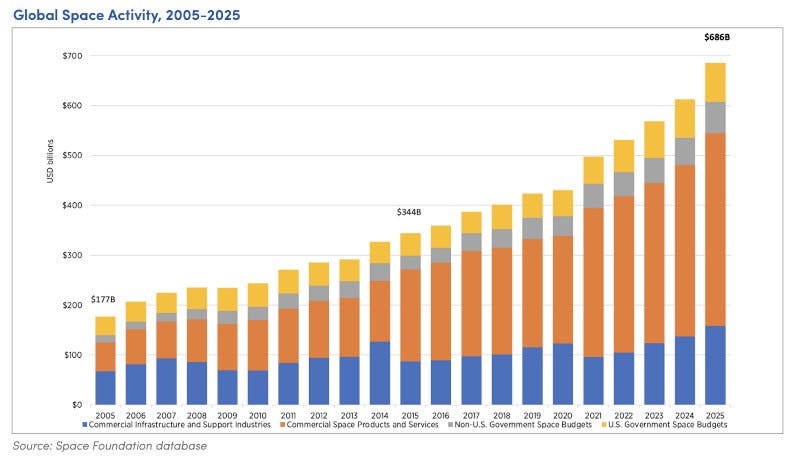
The global space economy grew 12% in 2025, reaching $686 billion, driven by commercial revenue growth and rising government spending on civil and defense programs, according to a new report from Space Foundation.
“We recognize there’s enormous economic and social value that will be created by leveraging space.”
Kevin O’Connell, Space Economy Rising
The increase marks the second double-digit annual gain of the decade. It trails 2021, when the economy grew 15.5% during the post-pandemic recovery, and ranks as the fourth-highest growth rate since the Space Foundation began its annual analysis in 2006. The five-year compound annual growth rate reached 9.8%, up more than 2 percentage points from the prior five-year period.
Commercial activity accounted for $544.3 billion of the total, or 79% of the global space economy, up 13% from a revised $481.5 billion in 2024. U.S. government spending totaled $78.3 billion, or 57% of all government space spending worldwide, though the increase was among the smallest of any leading spacefaring nation.
Kevin O’Connell, CEO and founder of Space Economy Rising and a former director of the Office of Space Commerce, said the pairing of federal funding and private capital has historically accelerated the pace of new capabilities reaching the market. “We recognize there’s enormous economic and social value that will be created by leveraging space,” O’Connell, who also sits on the Space Foundation’s board, said. “I think that’s critical at this particular point in time, the combination of government funding and strategy and (really) private capital fueling innovation in the market.”
Two sectors — positioning, navigation and timing, and ground stations and equipment — generated a combined $419.8 billion, the largest share of commercial revenue. Newer categories showed sharper percentage gains: in-space servicing, assembly and manufacturing rose 23%, and lunar activities, added to the analysis for the first time this year, grew 43%.
Carissa Christensen, CEO of BryceTech and a Space Foundation board member, said the pace of lunar-related investment marks a shift in how the industry views activity beyond low Earth orbit. “We’re in an extraordinary time in thinking about the cislunar economy right now,” Christensen said. “We have governments around the world spending money to develop missions and support activities on the Moon. That increase in activity and those plans with international partners are really going to reshape how we think of the cislunar economy.”
Government spending also climbed. Fifty-three national space budgets added nearly $10 billion in 2025, pushing global government spending up 7.4% to close to $141 billion. Of the 43 fiscal 2026 budgets available for comparison, spending rose 11.8%. Peter Beshar, a former general counsel to the Air Force and Space Force and a Space Foundation board member, pointed to defense budgets as a growing share of that total. “Around the world, defense budgets have increased significantly,” Beshar said. “And space has become an ever larger, and prominent, component of those expanding military budgets.”
Space Foundation’s report includes separate sections on commercial revenue by sector, military space spending, government budgets by nation, emerging technologies and midyear launch activity.