


Eight early-stage companies have been selected for the second year of a national accelerator program that pairs access to the International Space Station with private investment capital.
The International Space Station National Laboratory named the group as the 2026 cohort of its Orbital Edge Accelerator. The Center for the Advancement of Science in Space, or CASIS, runs the program under agreement with NASA. Selected companies will receive $500,000 to $750,000 in private capital along with access to low Earth orbit for research and development.
The cohort splits into two tracks. The Sentinel Track includes four companies working on dual-use space technologies: Aspect Aerospace, Mithril Space, Polaris Semiconductor and Vaxon Space. The Disrupt Track includes four companies focused on in-space manufacturing and space biology: Astrileux, Aura Life Science, Micro-gRx and Tensr.
Investment partners backing this year’s cohort include Cook Inlet Region, E2MC, Stellar Ventures, Context Ventures, Draper Associates and Draper University. The companies are also eligible for a Boeing-funded prize offering up to $100,000 in non-dilutive funding.
CASIS Chief Executive Officer Ray Lugo says startups that have completed spaceflight projects through the ISS National Lab have raised nearly $3 billion in venture capital and non-NASA grant funding since the program began.
The eight companies will travel to events in Anchorage, Houston, Washington and Boston before a Demo Day in San Francisco in December, where each will present its planned spaceflight project.
-0-
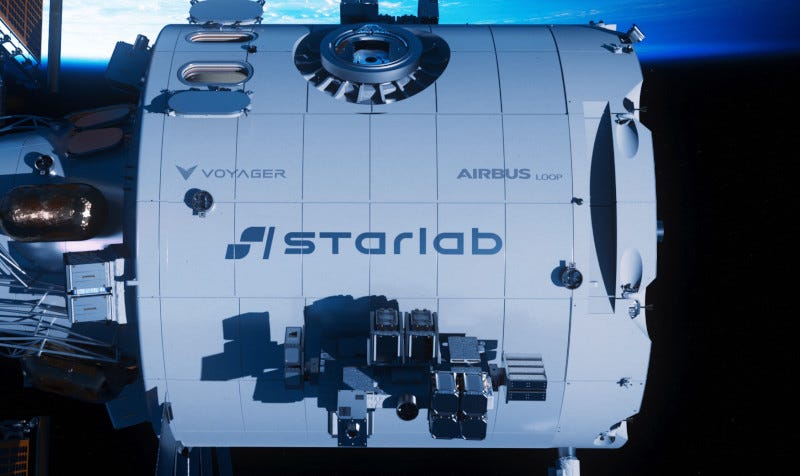
A venture capital firm has taken an undisclosed stake in Starlab Space, a company developing one of the commercial space station concepts competing to succeed the International Space Station.
Starlab Space and Global Venture Management announced the investment Wednesday. Neither company disclosed the size of the stake, the form the investment took or what percentage of the venture Global Venture Management now holds.
Starlab is a joint venture led by Voyager Technologies. Airbus, Mitsubishi Corp., MDA Space, Palantir Technologies and Space Applications Services round out the venture, with Hilton, Journey, Northrop Grumman and Ohio State University listed as strategic partners. Global Venture Management, based in San Juan, Puerto Rico, describes itself as a venture capital and private equity firm that gives accredited investors access to pre-IPO companies.
Voyager President Matt Kuta says the country needs a continuous human presence in low Earth orbit once the space station retires, and calls Starlab the program built to meet that need.
Wednesday’s announcement follows a similar strategic investment Starlab disclosed in May from 1789 Capital.
-0-
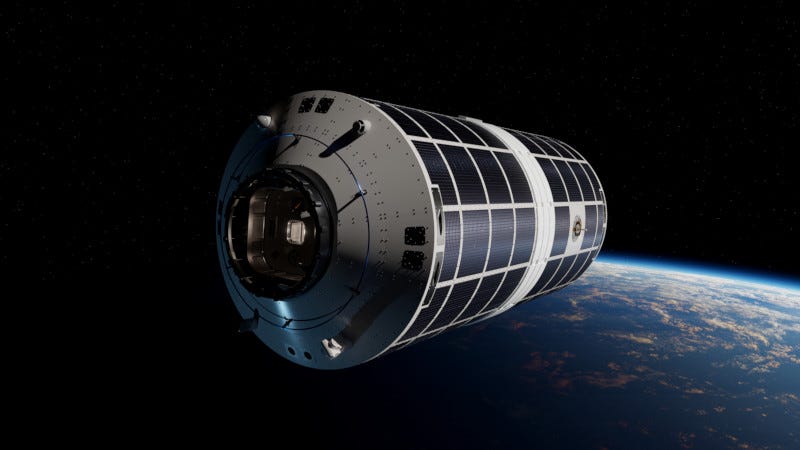
NASA has selected Gravitics for a six-month study of a hangar system designed to return cargo from low Earth orbit on a more regular schedule.
The Seattle-based orbital infrastructure company will use the Small Business Innovation Research Phase I award to evaluate the Multiple-Downmass Hangar, a platform designed to hold several return vehicles at once so customers don’t have to wait on a dedicated flight. NASA announced its 2026 SBIR Phase I selections Aug. 6. The agency did not specify a dollar figure for the award, and the deal is subject to contract negotiation through NASA’s Shared Services Center.
Gravitics Chief Executive Officer Colin Doughan says the company remains focused on cargo logistics for low Earth orbit, and calls the return capability a natural extension of its existing cargo-delivery work.
Material return has been a persistent constraint for companies conducting research or manufacturing on orbit. Gravitics is currently executing a STRATFI contract with the U.S. Space Force and says it’s developing its first commercial cargo-delivery partnerships to low Earth orbit destinations.
The next step is contract negotiation between Gravitics and NASA’s Shared Services Center.

An artificial intelligence system detected and canceled satellite signal interference up to 10 times more effectively than conventional methods in early testing, according to results announced by Gilat Satellite Networks.
Gilat, based in Petach Tikva, Israel, says the patent-pending system runs AI-based signal processing on standard edge neural processing hardware. Gilat tested the system against interference and jamming patterns that were neither fixed nor predictable — the kind of signal that’s harder for older mitigation tools to track.
The results are preliminary and come from Gilat’s own testing rather than an independent evaluation. The company says the target signal showed only negligible quality loss after the interference was canceled, but the system still needs to be demonstrated on dedicated AI accelerator hardware before it could be built into operational satellite terminals.
Gilat Chief Research and Development Officer Aharon Mullokandov says the technology opens opportunities in an environment where spectrum has become a critical resource for both defense and commercial users.
Gilat plans to move the system onto dedicated AI accelerator hardware next, a step the company says would allow a lower-power version suitable for terminals already fielded in commercial and defense satellite networks. The company gave no timetable for reaching commercial terminals.
-0-
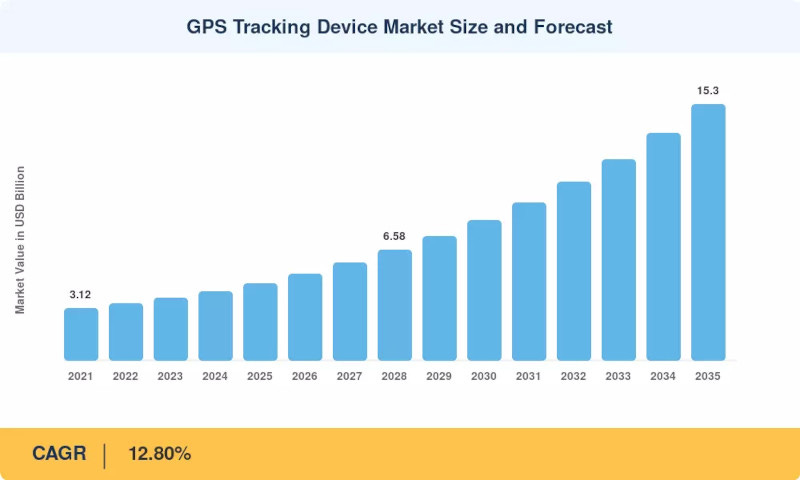
The global market for GPS tracking devices is projected to grow from an estimated $4.58 billion this year to $15.3 billion by 2035, according to a new report from Market Research Future, a New York-based market research firm.
The report projects a compound annual growth rate of 12.8% over the decade, driven by two forces: expanding fleet telematics mandates across North America, Europe and Asia-Pacific, and the growth of last-mile logistics tied to e-commerce fulfillment. Global logistics spending is expected to exceed $2.1 trillion annually by 2030, the report states, adding pressure on fleet operators to adopt connected tracking systems.
On the hardware side, the report points to multi-constellation satellite receivers — combining the U.S. GPS system with Russia’s GLONASS, Europe’s Galileo and China’s BeiDou constellations — as a factor pushing sub-meter positioning accuracy in both urban and rural settings.
Regionally, North America holds about 36% of the global market, the report states, followed by Europe at about 28%. Asia-Pacific is forecast to be the fastest-growing major region, while the Middle East and Africa is projected to post the highest regional growth rate, at about 9.1% annually through 2035.
-0-
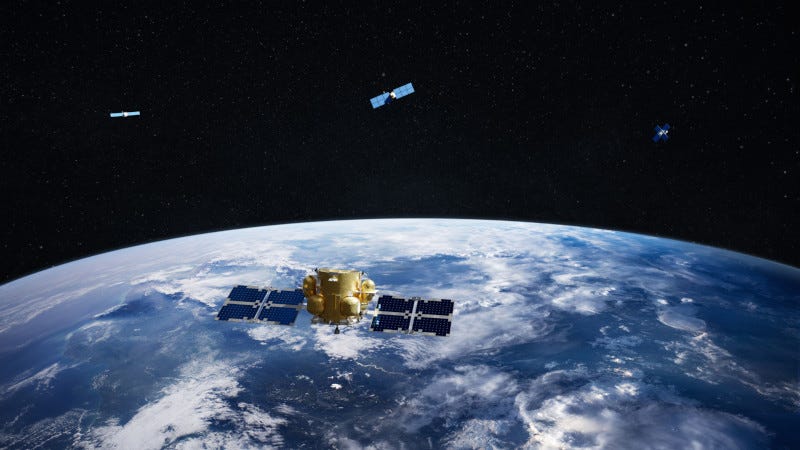
The Defense Innovation Unit and the Space Development Agency have awarded Firefly Aerospace a contract for a preliminary design review of a spacecraft mission to deorbit satellites nearing the end of their working life.
The mission would use Firefly’s Elytra spacecraft. Completing the design review doesn’t guarantee Firefly the full mission; the Cedar Park, Texas-based company says it will be eligible to compete for the next phase, covering launch and spacecraft operations, only after the review wraps up.
Firefly Chief Executive Officer Jason Kim says the design aligns with a White House order to prioritize orbital debris mitigation, and describes the system as capable of deorbiting satellites of different sizes and configurations.
Under the mission design, Elytra would launch into low Earth orbit, maneuver to the target satellite, carry out rendezvous and proximity operations, survey the object, then perform the deorbit service. Firefly says the system is designed to work in low, medium and geostationary Earth orbit.
The award is separate from an existing Defense Innovation Unit contract under which Firefly is building an Elytra spacecraft for a space domain awareness mission, targeted no earlier than 2027; the company says the core flight structures for that vehicle are complete and it has entered integration and testing.
Firefly has not disclosed the value of the design review contract.
You Might have Missed:
Startup Taps Satellite Maker for First Air-Breathing Propulsion Flight
Solar Array Design Clears Key Technical Review for Undisclosed Defense Satellite Program
Satellite-Servicing Spacecraft Completes Second Life-Extension Mission
Bipartisan Bill Seeks to Expand Space Force Wargaming and Training
Satellite Launch Advances Globalstar Network Replenishment


