


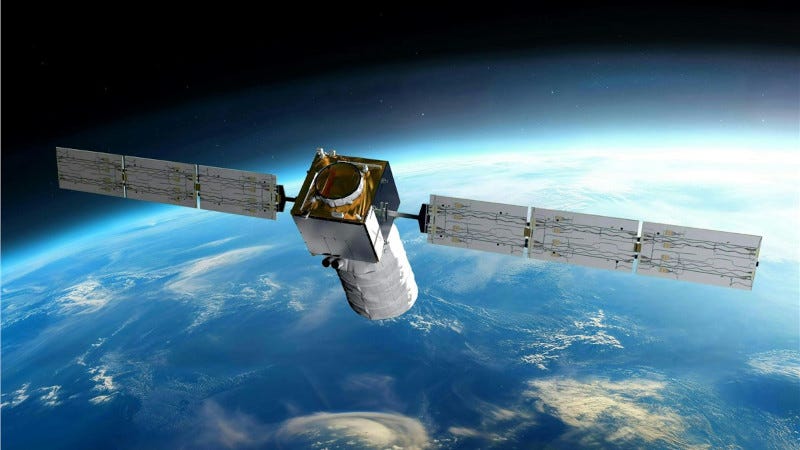
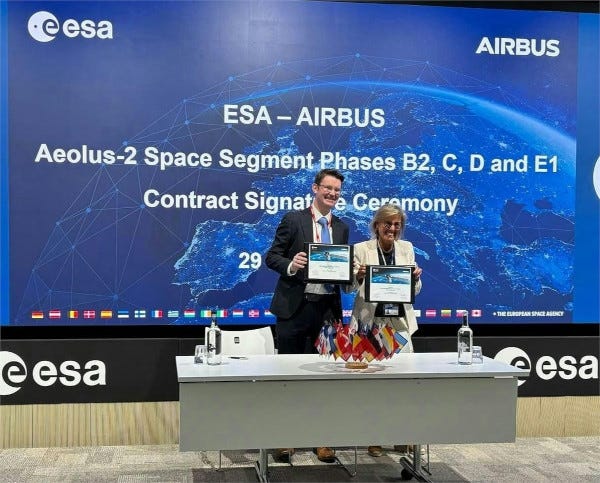
A contract to design and build the Aeolus-2 wind sensing satellite has been signed by the European Space Agency (ESA) and Airbus Defense and Space, advancing a next-generation mission intended to refine global weather forecasting models. The initial agreement, announced July 2 at ESA’s European Center for Space Applications and Telecommunications (ECSAT) in Harwell in the United Kingdom, authorizes Airbus to proceed with spacecraft design and development for the follow-on to the original Aeolus satellite launched in 2018.
“Aeolus exceeded expectations and demonstrated the transformative impact that space-based wind observations can have on weather forecasting.”
Simonetta Cheli, ESA
The first mission delivered what ESA describes as the first high-resolution vertical wind profiles from space, contributing to an estimated 4% improvement in numerical weather prediction. Aeolus-2 is being developed by ESA in partnership with EUMETSAT, the European Organization for the Exploitation of Meteorological Satellites, and is expected to serve major weather centers including the UK Met Office and the European Center for Medium-Range Weather Forecasts. ESA Director of Earth Observation Programs Simonetta Cheli said the second mission moves the capability from pioneering research toward an operational data service.
“Aeolus exceeded expectations and demonstrated the transformative impact that space-based wind observations can have on weather forecasting,” Cheli said in the announcement. “Aeolus-2 represents the natural evolution of that achievement – from pioneering research to an operational service that will benefit citizens and businesses worldwide.”
“Aeolus-2 will deliver real benefits for people across the UK, from more accurate weather forecasts that protect lives and communities, to the highly skilled jobs that come from being a key partner in Europe’s most ambitious space science programs,” said UK Space Minister Liz Lloyd. Kata Escott, managing director of Airbus Defense and Space in the UK, said the mission is also a workforce play, calling Aeolus-2 “more than a scientific mission” and “a major investment in British talent.”
The first Aeolus satellite, which flew until 2023, gathered data used to improve understanding of atmospheric circulation and long-term climate trends, according to ESA. It also supported analysis of hurricanes and volcanic ash transport in the upper atmosphere, while improving data availability at both the poles and the equator and reducing mean error between forecasts and observations by more than 4%.
Aeolus-2 will carry a Doppler wind lidar with ultraviolet lasers similar to the instrument aboard the original spacecraft. The lidar system is designed to scan from the ground to roughly 19 miles in altitude, taking measurements every 0.01 seconds and building a full-Earth data set approximately every seven days. Airbus and ESA say the follow-on satellite will also add an extra detector to track aerosols in the atmosphere.
The instrument works by firing laser pulses that scatter off particles such as dust, ice and water droplets. Light reflected back to the satellite is measured for Doppler shift, which reveals wind speed and direction along the line of sight.
Aeolus-2 is planned to operate in a low Earth orbit at about 280 miles altitude and circle the planet roughly 15 times per day. Mission planners expect to deliver data products to users within about two hours of the oldest measurement in each orbit, supporting near-real-time ingest by operational weather centers. ESA and Airbus project a mission lifetime of approximately five and a half years for the new satellite and did not disclose contract value in the announcement.