

Why Surface Treatment Vendors Are the Hidden Choke Point in Every Space Hardware Program
An Invisible Bottleneck

What This Means.
Space hardware programs obsess over propulsion, avionics, and structural components, yet consistently underestimate the supplier concentration risk hiding in post-processing. Based on publicly available National Aerospace and Defense Contractors Accreditation Program (NADCAP) accreditation records and trade reporting, the number of qualified vendors in some process categories appears to be fewer than five with active aerospace certifications, readers should verify this against their own approved vendor lists, as the public database does not disaggregate by specific program approval status. These vendors control the surface treatments, coatings, and corrosion-resistance steps that every structural part must pass through before integration. When one of those vendors pauses operations, changes its chemical process, or loses a key certification, a satellite or launch vehicle program does not get a warning call; it discovers the problem when parts come back out of spec. Supply-chain leaders and program managers building or re-evaluating their hardware sourcing strategies should audit their post-processing dependencies before the current surge in Golden Dome and commercial constellation orders fills the remaining capacity.
The Signal
In early 2025, the Aerospace Industries Association (AIA) and PricewaterhouseCoopers (PwC) published a study identifying nine categories of highly specialized components where the space manufacturing supply chain faces a serious production capacity deficit. The list drew predictable attention to the headline items: rocket motor nozzles, optical intersatellite link (OISL) hardware, and radiation-hardened chips. What received far less notice was the finding that the constraint is not always in the component itself. For several of the nine categories, the bottleneck sits one step downstream, in the finishing and certification processes that determine whether a fabricated part is qualified to fly.
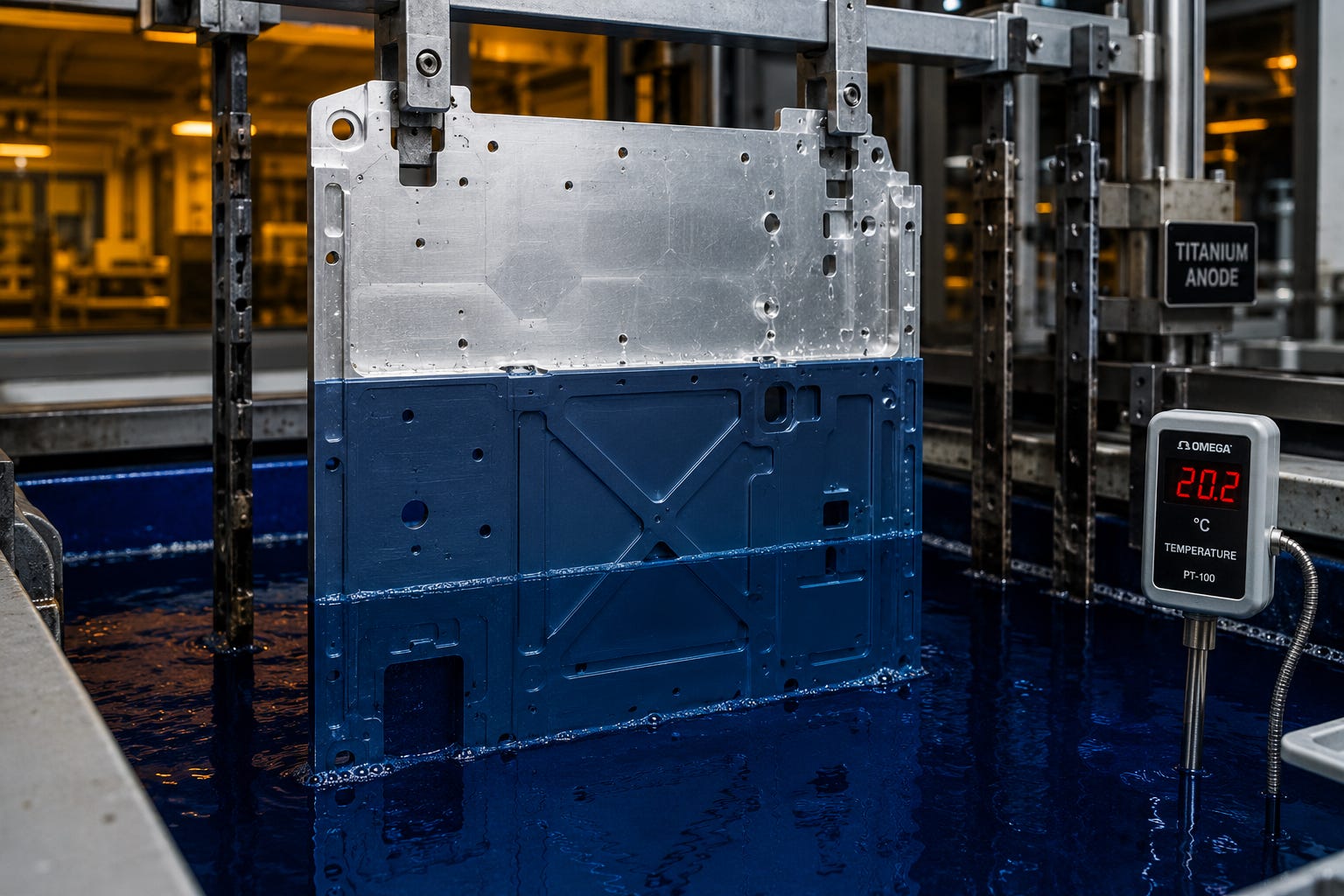
Post-processing is the unglamorous final mile of space hardware manufacturing. It includes chemical conversion coatings, anodizing, physical vapor deposition (PVD) and chemical vapor deposition (CVD) hard coatings, electroless nickel plating, passivation of stainless-steel and titanium alloys, thermal spray processes, and specialized paint and adhesive systems qualified for vacuum outgassing. None of these processes are exotic in industrial terms. What makes them rare in the space context is the certification overhead: every process that touches flight hardware must be traceable to a qualified process specification, the facility must maintain an active approval from the relevant government or prime customer, and the process chemistry must be controlled to tolerances that ordinary commercial processors do not maintain.
The result is a supplier landscape where the fabrication work is often widely distributed but the post-processing work flows through a very small number of certified facilities, many of them running at or near capacity, and almost none of them visible in standard program risk reviews.
The Supply Chain Map
Certification Regimes That Create the Bottleneck
The core mechanism producing supplier concentration in space post-processing is the certification regime, not the technology itself. Three overlapping qualification frameworks govern most of the work:
Military specifications and standards. The Department of Defense (DoD) maintains process specifications under the military specification (MIL-SPEC) family that govern surface treatments on flight hardware. MIL-DTL-5541 governs chemical conversion coatings on aluminum, the most common structural metal in satellite and launch vehicle structures. MIL-A-8625 governs anodizing. MIL-DTL-23053 and related documents govern heat-shrink and insulation materials. Maintaining active qualification to these documents requires documented process control, periodic re-qualification testing, and acceptance by the prime or government customer. A commercial metal-finishing shop can perform chromate conversion coatings, but unless it has maintained its DoD-qualified process status and can provide traceable documentation, its work is not accepted on defense or National Aeronautics and Space Administration (NASA) programs.
NASA process specifications. NASA maintains its own process specification library through the NASA Technical Standards Program. Documents such as MSFC-SPEC-522 (welding), NASA-STD-6001 (flammability, offgassing, and compatibility), and process approvals flowing through prime contractors add a parallel set of qualification requirements. NASA-STD-6001 outgassing requirements alone eliminate most commercial coating vendors, because the test protocol requires process-specific data, not just generic material data, and the test is not trivial to run or maintain.
AS9100 and NADCAP. NADCAP provides third-party audit accreditation for special processes used in aerospace and defense. NADCAP accreditation in chemical processing, coatings, and heat treating is considered table stakes for most prime contractors when sourcing post-processing. Achieving and maintaining NADCAP accreditation requires dedicated quality management resources, controlled process chemistry, and recurring third-party audits. The program has merit: it has standardized process quality across the industry. It has also raised the bar for entry to a point where, based on industry trade reporting, many regional metal-finishing shops that could technically perform the work have declined to pursue accreditation because the administrative burden does not pencil out at the volumes they handle.
The combination of MIL-SPEC qualification, NASA process approvals, and NADCAP accreditation means that a vendor serving space programs must maintain three overlapping compliance frameworks simultaneously, and must do so continuously, because a lapse in any of them can trigger a re-qualification process that takes months and effectively sidelines the vendor for new program work during that period.
"The next section maps the actual vendor landscape by process category, including the sub-categories where program managers report the qualified vendor list narrows to one or two names when all qualification requirements are applied simultaneously. It also covers the regulatory attrition mechanism shrinking the available base, the capacity compression argument tied to Golden Dome and commercial constellation demand, and five specific action steps structured for supply-chain leaders and program managers to execute this quarter. Paid subscribers receive the full supply chain map, risk and opportunity analysis, and decision questions with direct relevance to current programs."
