

When (And Why) NASA Partners Instead of Buys
How Space Act Agreements Are Reshaping Space Contracting

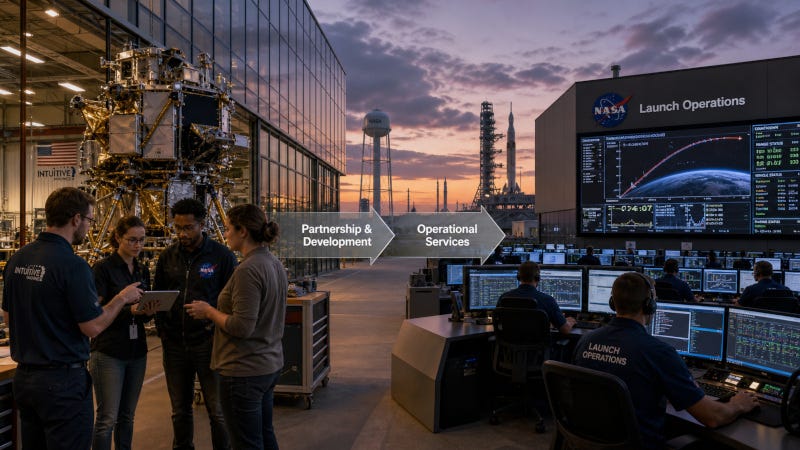
Space Act Agreements (SAAs) are now one of NASA’s most important tools for working with companies, universities, non‑profits, and foreign partners. They sit alongside—but separate from—traditional Federal Acquisition Regulation (FAR) contracts and help explain why so much commercial space activity involves “partnering with NASA” rather than NASA simply buying a service.
Legal foundation and basic concept
Congress gave the National Aeronautics and Space Administration (NASA) broad authority in the National Aeronautics and Space Act, now codified in title 51 of the U.S. Code. Under 51 U.S.C. 20113, NASA may enter into contracts, leases, cooperative agreements, and “other transactions” as needed to carry out its functions. SAAs are the flavor of “other transaction” NASA uses for partnerships that advance agency missions but do not fit the mold of a standard procurement or grant.
An SAA is a binding agreement that defines a shared activity, roles, and resource commitments, but NASA is not acting as a conventional buyer; instead, both NASA and the partner gain something they need—data, facilities, technical capability, or operations experience.
Main types of Space Act Agreements
NASA policy divides SAAs largely by how money and benefits flow.
Nonreimbursable SAAs: NASA and the partner collaborate on a mutually beneficial activity; each pays its own costs and no funds are exchanged. Typical uses include joint research, data sharing, and technology demonstrations.
Reimbursable SAAs: NASA provides unique goods, services, or facility access that primarily benefit the partner, and the partner reimburses NASA’s costs according to agency financial policy. Examples include wind‑tunnel campaigns, specialized test facilities, or mission simulations.
Funded SAAs: NASA transfers appropriated funds to a domestic partner when the activity serves an agency objective, provides no direct benefit back to NASA, and cannot be effectively done via a standard contract, grant, or cooperative agreement. These are tightly controlled and relatively rare.
International SAAs: Any of the above when a foreign space agency, government, or organization is involved, triggering additional coordination and export‑control reviews.
All types are governed by NASA policy and internal guidance such as the NASA Partnerships Guide, which constrain how “flexible” these agreements really are.
Why NASA is using more SAAs
Several trends explain why SAAs are more visible in NASA’s portfolio.
Strategic shift to commercial partnership: NASA’s statute and recent policy direction emphasize “the fullest commercial use of space” and encourage the agency to act more as an anchor customer and technical partner than as sole owner and operator of infrastructure. SAAs fit this role because they support co‑development, early demonstrations, and shared use of assets without locking NASA into large, long‑term service purchases too early.
Flexibility compared with FAR contracts: SAAs are not governed by the FAR. They are structured under the Space Act and NASA’s own agreements policy, giving more room to tailor milestones, cost‑sharing, and intellectual‑property terms to each project. NASA’s Inspector General has noted that SAAs can be faster to put in place and adjust than traditional procurements, which matters in emerging technology fields where requirements and players evolve quickly.
Growth of the commercial space sector: As commercial launch, data, in‑space services, and infrastructure markets have expanded, there are more prospective partners whose work overlaps NASA’s objectives but is not purely built‑to‑spec for the agency. SAAs let NASA influence and leverage this ecosystem—helping shape standards, test capabilities, and share risks—without owning every system.
Policy pressure for collaboration and asset use: Congress and the executive branch have encouraged NASA to enable use of the International Space Station and other facilities by other agencies, academia, and industry. SAAs are the main mechanism for such non‑traditional users to access NASA facilities when a straight procurement is not appropriate.
Normalization through oversight and reporting: A 2014 NASA Office of Inspector General audit critiqued aspects of SAA management but recommended strengthening policy and oversight, not abandoning the mechanism. NASA subsequently expanded internal guidance and created public reporting of SAAs, including periodic lists of active agreements by center and partner. That transparency has helped embed SAAs as a standard tool rather than a one‑off exception.
Programs like Commercial Orbital Transportation Services (COTS) and early Commercial Crew phases illustrate these dynamics: NASA used SAAs to structure milestone‑based development and shared testing, then moved to FAR contracts for operational cargo and crew services once capabilities matured.
How SAAs compare with FAR contracts
NASA still relies heavily on FAR‑based contracts for defined systems and services, but the two tools serve different purposes.
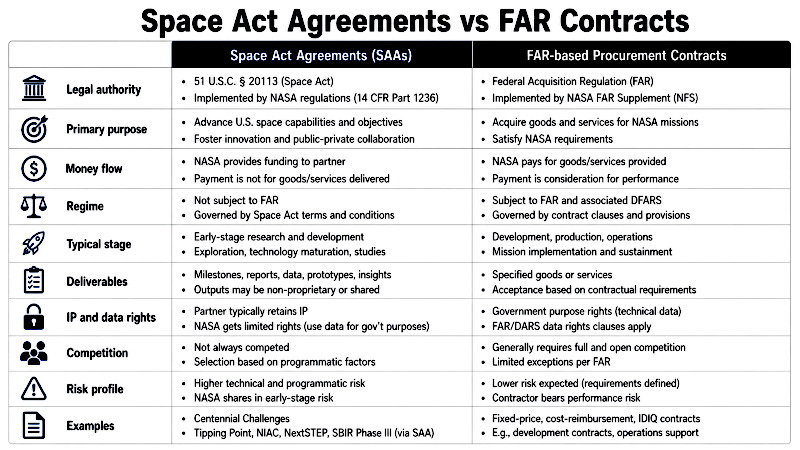
A practical rule of thumb: when you see an SAA, think “NASA is partnering to shape or prove something”; when you see a FAR contract, think “NASA is buying something to use.”
What SAAs mean for companies and investors
For companies, an SAA is usually a validation and an enabler, not a guaranteed revenue stream. It can provide:
Access to NASA facilities and expertise
Data and credibility that help attract private capital
A path to later competitions for operational contracts if the technology proves out
But SAAs often require the partner to bring its own funding and accept shared risk. Revenue forecasts should not treat an SAA like a multi‑year service contract unless there is a companion FAR award.
For investors and analysts, a portfolio heavy on SAAs suggests a company is deeply networked with NASA and positioned for future procurements, but still exposed to execution and market risk. The critical questions become: Are SAA‑backed efforts converting into actual service contracts? Are partners building sustainable commercial markets beyond NASA?
Key takeaway for decision‑makers
SAAs are NASA’s preferred tool when partnership and shared development, not straightforward purchasing, best serve the mission. FAR contracts still dominate for mature systems and operations, but SAAs increasingly shape who gets to that stage and on what terms.
Limitations and caveats
This article relies only on Tier 1 sources such as U.S. statutes, Congressional and Congressional Research Service materials, NASA policy documents, NASA Inspector General reports, and official NASA program and partnership guidance. It does not constitute legal advice or interpret any specific agreement; organizations should consult counsel and the relevant NASA center for transaction‑specific issues.
Disclosures
This article is based on public U.S. government information, which is generally not subject to copyright, and respects intellectual property by paraphrasing rather than reproducing source language.