

What the ISS Supply Chain Knows That Your CLD Proposal Doesn’t
Maps, Gaps and Risks for Commercial Low-Earth Orbit Destination Developers

WHAT THIS MEANS
NASA’s CLD Phase 2 awards are formally on hold as of January 28, 2026 — but that is not a reason to pause supply chain preparation. It is additional runway. The four critical subsystem categories that kept astronauts alive on the ISS — ECLSS, power and thermal control, propulsion, and pressurized structures — have known vendor maps, documented single-source risks, and open qualification gaps that no CLD developer has publicly closed. Axiom Space is the one exception: it has already awarded Redwire a contract for ROSA solar array wings for its first station module, using the same flight-proven technology now powering ISS. Every other CLD developer has not named a power vendor publicly. That asymmetry is the kind of detail that shows up in a cost-realism assessment. The propulsion reboost category has no qualified commercial incumbent at all. That is not a risk statement. It is an open slot.
The ISS Accumulated What Commercial Stations Must Deliberately Build
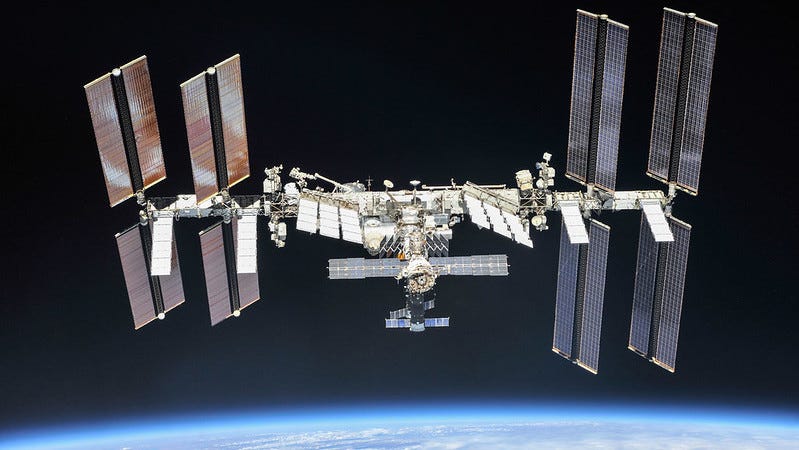
The International Space Station’s supply chain wasn’t designed. It accumulated. Over 13 years of on-orbit assembly, 15 nations, and hundreds of contractors, NASA and its partners built a web of vendors, qualification records, and hard-won redundancy that kept humans alive in one of the most hostile environments in the universe. The bill was roughly $150 billion. The timeline was measured in decades.
Commercial station developers have roughly 36 months after Phase 2 awards to demonstrate they can replicate the parts that matter — on a budget that would not have covered ISS’s first module — and they must do it within the performance period of a funded Space Act Agreement. The supply chain leaders and BD executives who have done the sub-tier homework will shape the competitive landscape. Those who have not will find the critical vendor slots already spoken for.
This is not a history lesson. It is a gap map.
The Signal That Changed the Calculus
NASA’s August 4, 2025 CLD directive restructured the entire Phase 2 acquisition framework. The original plan was a firm fixed-price FAR-based contract — the kind of vehicle that demands near-complete supply chain certainty before signing. NASA pulled back from that approach, citing a $4 billion budget shortfall and the risk of a capability gap between ISS deorbit in 2030 and a functional commercial replacement. What replaced it was a funded Space Act Agreement framework with a three-to-five-year base period, milestone-based payments, and a minimum of two — preferably three or more — awards.
Then, on January 28, 2026, NASA’s JSC procurement office issued a formal notice: Phase 2 is on hold while the agency works to align acquisition timelines with updated program requirements. No AFP has been released as of March 2026. The award window originally targeted for April 2026 has no confirmed replacement date.
For supply chain leaders, the hold is not a pause on preparation. It is additional runway — and the most valuable business development window this supply chain will see. The vendor qualification work completed during this hold period is work a competitor cannot undo after awards resume.
One requirement from the August directive did not soften with the hold: Phase 2 SAA recipients must provide cost-realism assessments, affordability strategies, and co-investment plans. That means NASA’s evaluators will ask whether the vendors named in a proposal can actually deliver what was proposed, on the timeline proposed, for the price proposed. A supply chain plan that defaults to ISS-era single-source vendors without dual-source strategies is not a cost-realism plan. It is a wish list.
Compounding this is a compliance requirement that few CLD proposals have fully reckoned with. NASA’s Supply Chain Visibility Reporting rule, effective June 28, 2024, requires prime contractors on covered programs to report sub-tier supplier data directly to NASA. This is not a disclosure formality. It means NASA will have direct visibility into the actual vendor depth behind every CLD proposal. The gap between what a developer claims and what their tier-2 and tier-3 supply chains can support will surface in evaluation. There is no longer anywhere to hide a thin vendor map.
