

Weather Satellites To Gain Higher-Precision Navigation For 2032 GeoXO Missions
GeoXO Constellation To Rely On New GNSS Receivers For Improved Forecast Data

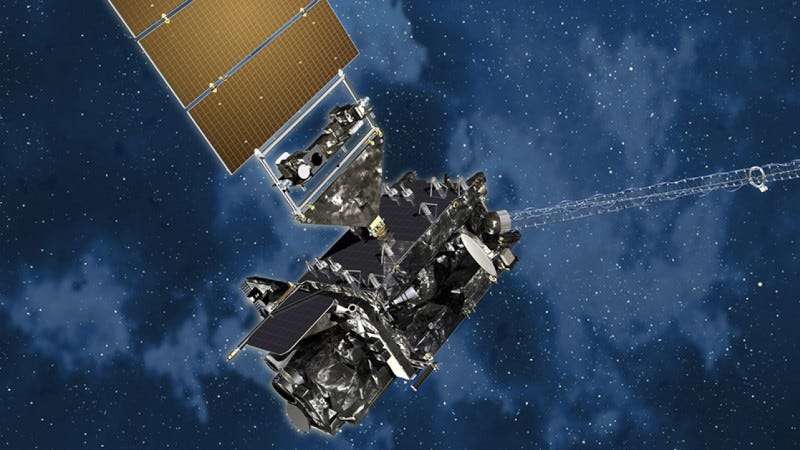
Launching in 2032, a new generation of U.S. geostationary weather satellites will carry navigation receivers designed to sharpen the accuracy of weather and environmental data for forecasters through the middle of the century.
“The more accurately the position of the satellite is determined by our receiver, the more accurate the weather and environmental data will be.”
Kurt Kober, Beyond Gravity
The Geostationary Extended Observations (GeoXO) constellation, a joint program of the National Oceanic and Atmospheric Administration and NASA, will replace the current GOES-R series as those spacecraft near the end of their service lives. Two operational GeoXO satellites, positioned in geostationary orbit over the Western Hemisphere, are expected to maintain and advance NOAA’s geostationary observations through about 2055.
Lockheed Martin will build the GeoXO spacecraft under a contract with NASA on behalf of NOAA, and has selected Beyond Gravity to supply navigation receivers for at least two of the satellites. Beyond Gravity, an international space supplier headquartered in Zurich, will provide its GEORIX navigation units for the first time to Lockheed Martin under the agreement.
“For our first contract with Lockheed Martin, we will supply navigation receivers for two NOAA weather satellites,” said Kurt Kober, vice president electronic solutions at Beyond Gravity. “The more accurately the position of the satellite is determined by our receiver, the more accurate the weather and environmental data will be.”
The GeoXO satellites will operate in geostationary orbit at an altitude of about 22,236 miles above Earth’s equator, matching the planet’s rotation so that each spacecraft remains fixed over a given region. From that vantage point, GeoXO will provide advanced imagery and atmospheric measurements, real-time lightning mapping and continuous monitoring of Earth’s atmosphere, land and oceans to support short-term forecasts and warnings of extreme weather and environmental hazards.
Beyond Gravity’s GEORIX receivers are designed specifically for geostationary missions and are intended to deliver in-orbit positioning accuracy of better than 65 feet at geostationary altitude. The company describes that performance as a new benchmark for on-board, real-time navigation in GEO.
The high-performance, multi-constellation GNSS receivers are developed and produced at Beyond Gravity’s Vienna, Austria, facility. The first GEORIX receiver launched in 2023 on NASA’s TEMPO climate mission, where it supports positioning of the instrument as it measures atmospheric gases and aerosols over North America.
Beyond Gravity says about 30 satellites now use its navigation receivers to determine their positions, on missions ranging from low Earth orbit, roughly 620 miles above Earth, to geostationary orbit.
The GEORIX design incorporates an antenna optimized for geostationary orbit, detached low-noise amplifiers, and an orbit propagator based on an accurate force model coupled with state-of-the-art Kalman filtering. The receiver can acquire and track up to 12 satellites on a single frequency and is described as highly configurable, with a parameter interface that supports changes in both standby and operational modes.
NOAA has operated geostationary weather satellites since 1975, using the Geostationary Operational Environmental Satellites series to provide continuous imagery and data on atmospheric conditions and solar activity. The GOES satellites also orbit at about 22,236 miles above the equator, providing fixed coverage of specific regions for long-term monitoring and forecasting.
GeoXO is planned to take over from the GOES-R series starting with its first launch in 2032. The new constellation is expected to extend NOAA’s geostationary weather and environmental data record through at least 2055, with the aim of improving short-term forecasting and warning of severe weather and other hazards across the Western Hemisphere.