

W-6 Reentry Capsule Validates Autonomous Navigation and Thermal Protection Technology
Air Force, NASA, Sandia Lab Payloads Gather Hypersonic Data During Australian Landing

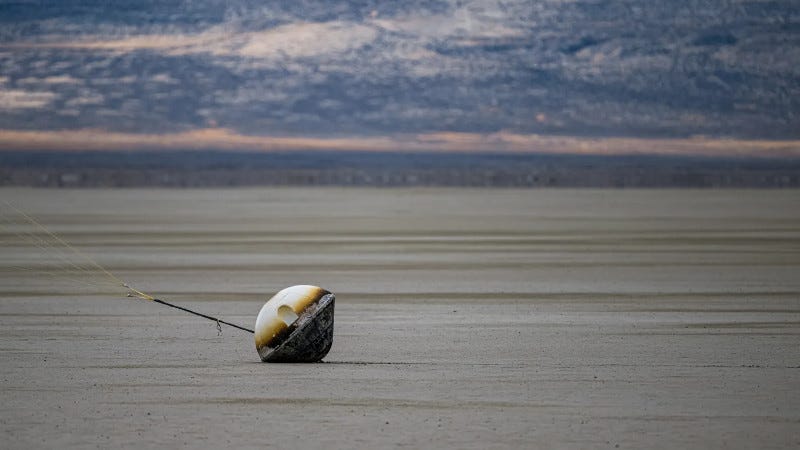
A reentry capsule carrying payloads for the Air Force Research Laboratory, NASA and Sandia National Laboratory touched down safely at the Koonibba Test Range in South Australia, delivering flight data on autonomous hypersonic navigation and next-generation thermal protection systems that researchers say could not have been collected any other way.
“Every reentry builds on the last. W-6 is another demonstration that frequent, low-cost, reliable return is easily accessible.”
Dave McFarland, Varda
The W-6 capsule — built and operated by El Segundo, California-based Varda Space Industries — landed within the designated recovery zone at the range, operated by Southern Launch. The mission marks Varda’s second successful reentry of 2026.
“Every reentry builds on the last. W-6 is another demonstration that frequent, low-cost, reliable return is easily accessible,” said Dave McFarland, VP of Hypersonic Test and Targets at Varda. “The data our partners are taking home from this mission would have taken years to collect through traditional testing methods.”
The mission was funded through the Prometheus program, a partnership between the Air Force Research Laboratory (AFRL) and commercial space entities. The program is designed to accelerate science and technology experiments in the hypersonic reentry environment through a low-cost, high-cadence commercial flight testbed — similar to the framework that supported previous Varda missions carrying Department of War payloads.
Autonomous Navigation in a Hypersonic Environment
One of the W-6 mission’s primary objectives was the demonstration of an autonomous navigation payload during hypersonic reentry. The system used imagery of resident space objects — including stars and low Earth orbit satellites — to determine the vehicle’s position while traveling at hypersonic speeds. Autonomous navigation at those velocities represents a growing capability requirement for both commercial spaceflight and national security missions.
Thermal Protection Data from Sandia and NASA
The W-6 heatshield carried two categories of instrumented tiles designed to gather performance data that cannot be replicated in ground-based facilities.
A nose tile developed by Sandia National Laboratory was embedded with small sensors that recorded temperatures throughout the reentry environment. Researchers will use the real-world data to compare against high-fidelity computer model predictions, allowing them to refine the models used to design heatshields for future hypersonic platforms.
Two instrumented shoulder tiles on the heatshield were supplied by researchers at NASA’s Ames Research Center in California’s Silicon Valley. The tiles were produced using an alternative manufacturing technique, and the flight test is intended to provide NASA with a new dataset to guide the development of future thermal protection systems.
Like all W-series capsules, the W-6 heatshield was manufactured at Varda’s El Segundo headquarters using C-PICA — Conformal Phenolic Impregnated Carbon Ablator — an ablative material originally developed at NASA’s Ames Research Center and later commercialized with support from NASA’s Tipping Point program.
Building Mission Cadence in 2026
The W-6 mission continues a pattern of increasing flight frequency for Varda’s reentry vehicle program. The company is scaling both vehicle production and flight-testing operations to serve a broader range of commercial and government customers as mission cadence rises through 2026 and beyond.