

Vertical Integration Powers Rocket Lab’s $90M Space Force GEO Satellite Award
Supply Chain Strategy Drives First Geostationary Production Program for Long Beach Satellite Maker

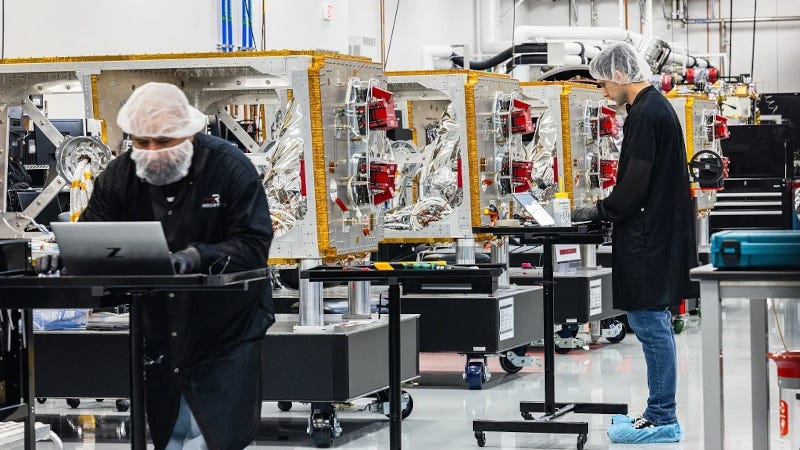
A $90 million contract awarded by the U.S. Space Force’s Space Systems Command (SSC) will have Rocket Lab Corporation designing, manufacturing, integrating, and operating two geostationary (GEO) satellites hosting a space domain awareness (SDA) sensor — the company’s first satellite production program for geostationary orbit.
The award underscores the competitive advantage of Rocket Lab’s vertically integrated supply chain, which allows the Long Beach, California-based company to deliver a complete space mission — from bus manufacturing and optical payload production through launch integration and on-orbit operations — without depending on outside vendors for critical components.
Rocket Lab will serve as prime contractor and end-to-end mission provider. Responsibilities include spacecraft design and manufacture, integration of the Heimdall optical payload produced internally by Rocket Lab Optical Systems, launch integration onto a government-furnished launch vehicle, and on-orbit satellite operations for up to five years following commissioning.
The Heimdall payload is a small, low-cost electro-optical sensor designed to operate from geosynchronous orbit, augmenting the Space Force’s ability to maintain custody of objects in the GEO belt. Its production sits entirely within Rocket Lab’s own walls. Rocket Lab Optical Systems — the internal payload division formed after Rocket Lab acquired optics specialist GEOST in 2025 — will deliver the Heimdall sensors to the spacecraft production line. That acquisition closed a critical gap in Rocket Lab’s supply chain, integrating advanced optical payload design and manufacturing with the satellite buses that carry them.
The two satellites will be built on Rocket Lab’s Lightning bus, adapted to meet the thermal, radiation, propulsion, and station-keeping demands specific to GEO. Lightning is currently in production across multiple national security programs, including the Space Development Agency’s Tranche 2 Transport Layer-Beta (T2TL-Beta) and Tranche 3 Tracking Layer (T3TRK), as well as commercial constellation customers. Extending the Lightning platform into geostationary orbit allows Rocket Lab to carry forward its existing production heritage and preserve the manufacturing efficiencies and supply chain advantages that architecture has already established.
The new award is a direct outgrowth of an earlier Space Systems Command program. That effort, originally awarded to GEOST before Rocket Lab’s acquisition, funded the prototype development of two Heimdall payloads. With the prototype phase complete, the $90 million contract transitions the program from payload development to full operational space vehicle delivery — a step that places the entire production chain, from sensor fabrication to spacecraft integration to mission operations, inside Rocket Lab’s own facilities.
Spacecraft assembly, integration, and test will be performed at Rocket Lab’s Spacecraft Production Complex in Long Beach. Payload delivery will come from Rocket Lab Optical Systems, and mission operations following launch will be conducted from Rocket Lab facilities — keeping every phase of the mission lifecycle under a single operational roof.
The contract extends what Rocket Lab describes as its “vertically integrated mission model” into a new orbital regime, adding GEO to a national security space portfolio that has been built largely on the strength of that same in-house supply chain.