

Vast Space at $5.5 Billion
What the a16z Thesis Actually Signals for Commercial LEO Destinations Investors

What This Means.
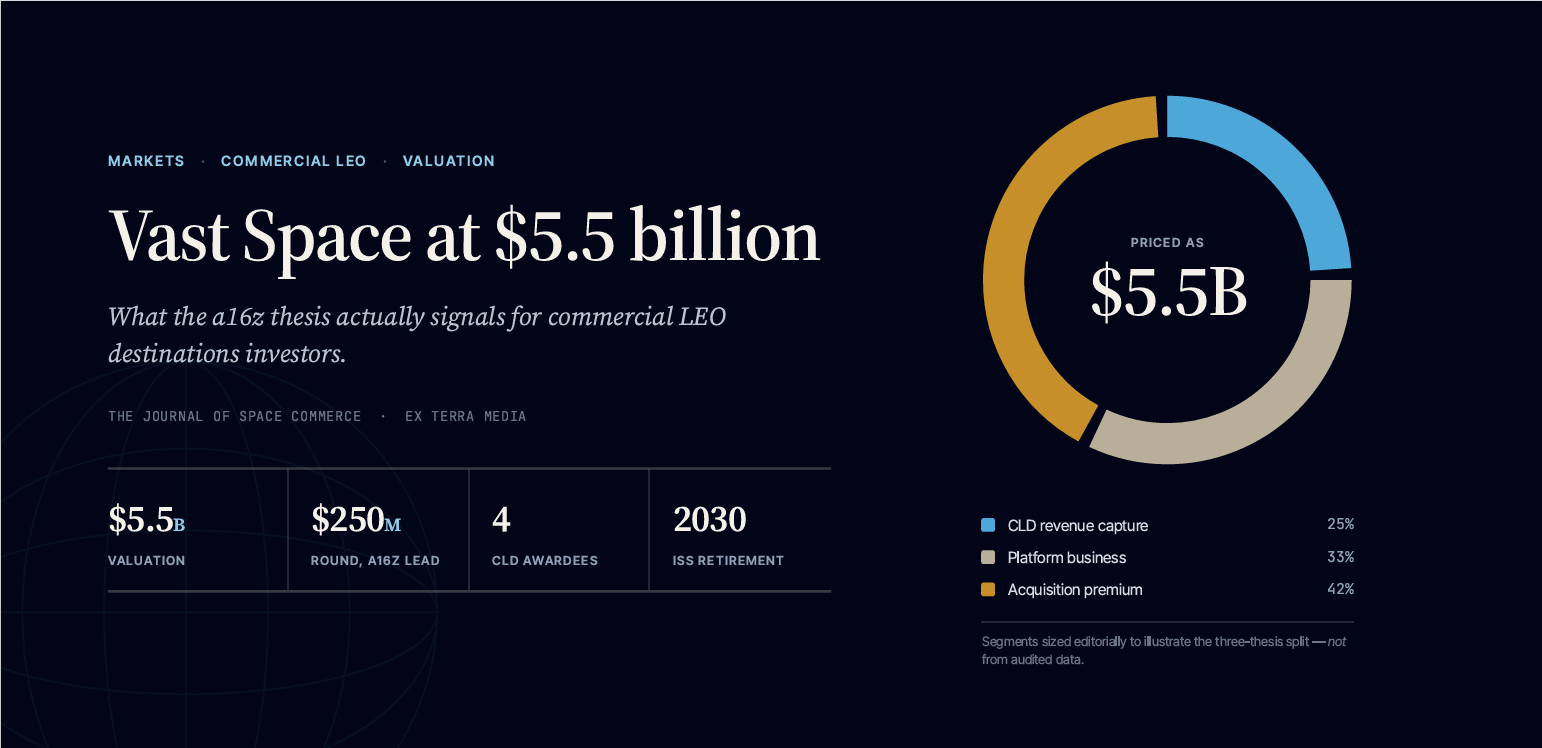
Andreessen Horowitz’s (a16z) lead on a $250 million funding round valuing Vast Space at $5.5 billion is not simply a vote for commercial space stations. It is a structured bet on who captures recurring revenue when the International Space Station (ISS) retires, and it arrives at the precise moment National Aeronautics and Space Administration (NASA)’s Commercial Low Earth Orbit Destinations (CLD) program faces its deepest budget uncertainty. Investors tracking the commercial LEO destinations sector need to determine whether this valuation is anchored in near-term contract certainty or in a longer-horizon acquisition thesis that depends on conditions outside Vast’s control. The answer reshapes how you size a position, choose a comparable, and set a time horizon.
On its face, a $5.5 billion valuation for a company that has not yet launched a crewed station is aggressive relative to confirmed revenue milestones. Vast Space has one confirmed operational milestone: Haven-1, its single-module commercial station, launched aboard a SpaceX Falcon 9 rocket in May 2025 and currently hosts a crew of four NASA-sponsored astronauts on what the company describes as its first commercial mission. The larger Haven-2 multi-module station, which represents the actual revenue architecture behind any serious valuation model, remains in development. NASA awarded Vast a CLD contract in 2023, but that contract is a funded Space Act Agreement, not a cost-plus delivery contract, and NASA’s ability to fund follow-on work depends on annual appropriations that have grown increasingly uncertain.
So what exactly did a16z price at $5.5 billion?
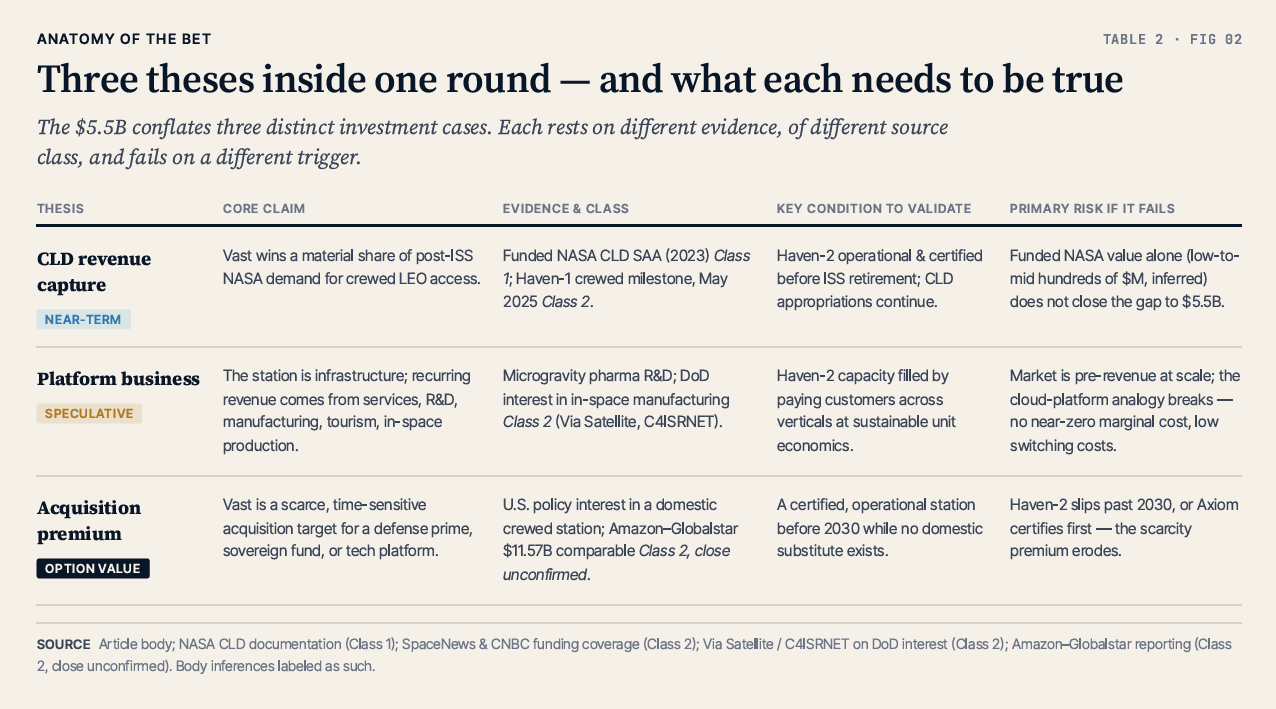
The answer requires separating three distinct investment theses that the round conflates, and understanding which one actually drives the valuation multiple.
The Data Foundation
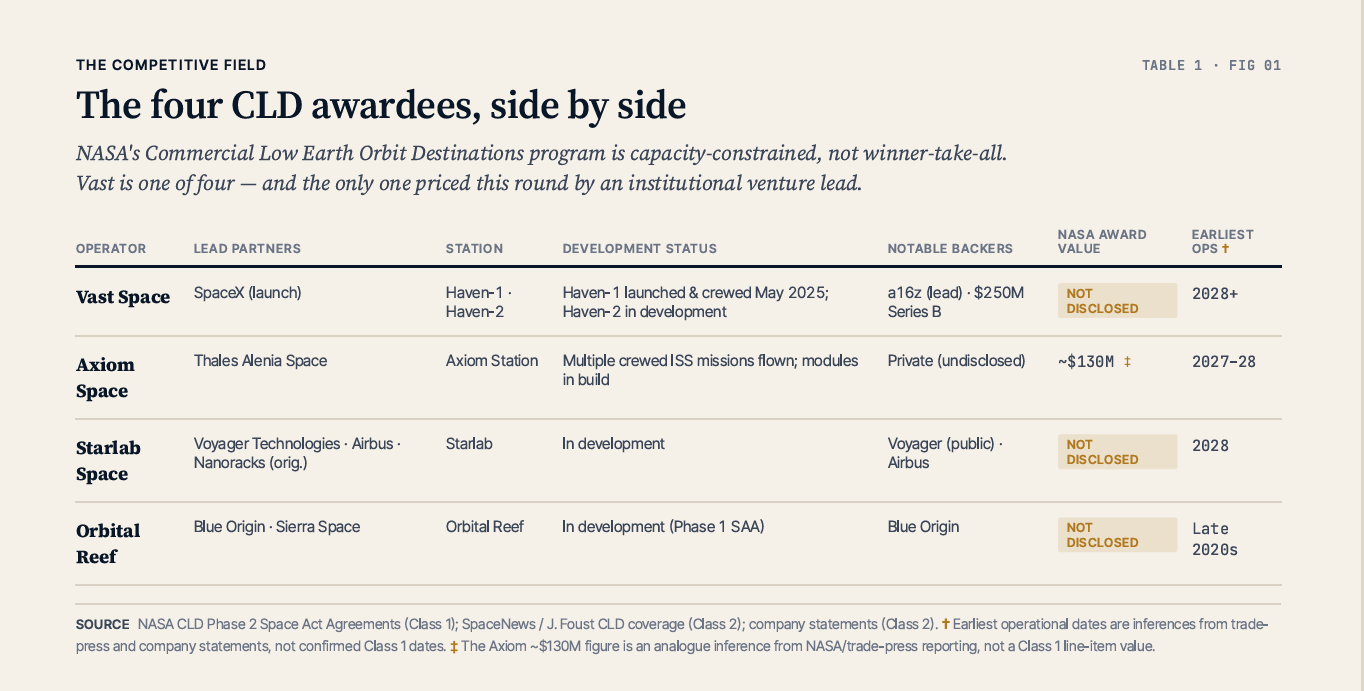
Before unpacking the thesis, the evidentiary floor matters. The $250 million round and the $5.5 billion valuation figure were reported by multiple Class 2 sources including SpaceNews and Bloomberg in May 2026, citing the company’s announcement directly. Vast Space has not filed with the Securities and Exchange Commission (SEC) as a public company, so no audited financials are publicly available. All financial characterizations below rely on company statements, NASA Space Act Agreement disclosures, and analyst reporting, and should be treated as the best available public data rather than audited figures. Where claims extend beyond confirmed data, they are explicitly labeled as inferences.
NASA’s CLD program awarded Vast a funded agreement in June 2023 under the second phase of its CLD solicitation. That agreement is a Class 1 source anchor: the NASA CLD award is documented in NASA’s official communications and was worth an undisclosed amount in the initial phase, with options tied to milestones. The Haven-1 launch and crew mission represent completion of early milestones. The funded value of Vast’s NASA CLD agreement has not been publicly disclosed at the line-item level, which creates a meaningful Class 1 gap in any attempt to model the NASA revenue contribution to the $5.5 billion valuation. That gap is noted explicitly in the Limitations and Gaps section.
Three Theses Inside One Round
Thesis One: The CLD Revenue Capture Bet
The most straightforward read of the a16z investment is that Vast wins a material share of the post-ISS demand stack. The ISS is currently funded through 2030, with NASA planning for retirement and de-orbit. If no commercial LEO destination is operational and certified by 2030, NASA faces a gap in human low Earth orbit (LEO) access that would be enormously costly both politically and programmatically. That gap creates leverage for any company that can demonstrate a functioning, crewed-capable station before the retirement date.
The next section completes the three-thesis breakdown, identifies which thesis is carrying the weight at $5.5 billion, and maps the specific risk vectors, competitive dynamics, and sub-tier supply chain opportunities that the a16z entry creates for investors in the commercial LEO destinations sector. Paid subscribers also receive five concrete decision actions with a NASA appropriations stress-test framework and a SpaceX IPO recalibration guide."Haven-1’s successful crew hosting is a genuine de-risking event for this thesis. It demonstrates life-support, docking, and operational capability at an early level. Haven-2 is the bet that actually generates the sustained revenue, and it remains several years from deployment. The question for investors is how much of the $5.5 billion represents probability-weighted NASA revenue versus speculative premium.
