


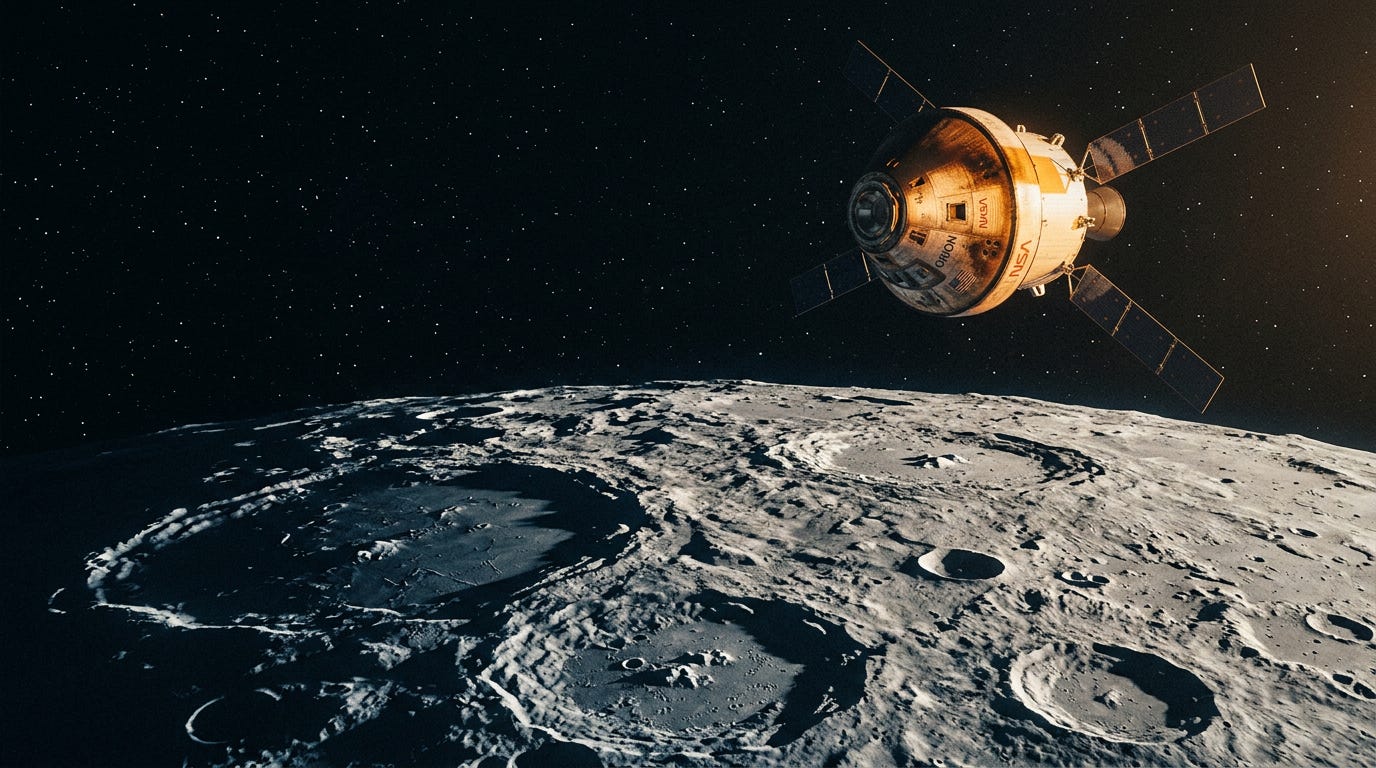
Signal Summary:
Artemis II did not just send four astronauts around the Moon. It validated the Space Launch System (SLS)/Orion stack as a functioning crewed system — removing the single largest programmatic uncertainty hanging over NASA’s Artemis IV contracting cycle. For investors and C-suite executives watching the commercial lunar economy, the mission’s splashdown on April 10, 2026 was less a human interest story and more a data point with measurable downstream effects on capital allocation decisions in Q2 2026. The question is not whether the mission succeeded. It did. The question is what “success” unlocks — and where the money moves next.
The Validation That Wasn’t Guaranteed
When Artemis I flew in 2022, it validated the SLS/Orion hardware in an uncrewed configuration. That cleared the aerodynamic and thermal envelope but left the most critical commercial unknown untouched: whether the stack could keep humans alive in deep space transit. That uncertainty had real dollar consequences — every prime and sub-tier contractor building for Artemis IV was pricing a program that had never demonstrated it could fly its crew.
Artemis II changed that. Launching April 1 with Commander Reid Wiseman, Pilot Victor Glover, Mission Specialist Christina Koch, and Canadian Space Agency Mission Specialist Jeremy Hansen, the mission executed a translunar injection burn, completed the lunar flyby, and returned to Earth splashdown on April 10. The mission ran approximately ten days, and the spacecraft performed within expected parameters across all major subsystems. For an Artemis IV program office trying to justify multibillion-dollar expenditures in a constrained NASA budget environment, that operational data is not ceremonial — it is contractually relevant.
What the Supply Chain Actually Looks Like
Artemis II drew on more than 2,700 suppliers across the United States and allied nations, a network coordinated through what NASA describes as a “digital thread,” a continuous record linking design, engineering, manufacturing, testing, and integration so that every component carries a documented history and every change is tracked. That supplier architecture spans a much wider industrial base than most investors model. The Defense Logistics Agency (DLA) Energy alone provided more than 21,000 pounds of highly specialized propellants for the Orion spacecraft, a logistics chain that sits almost entirely outside the commercial space investment narrative. California alone contributed over 500 companies and 16,000 workers to the effort.
This matters for C-suite and investor decisions because the 2,700-supplier network is not an inert background condition — it is a live capacity signal. Many of these suppliers were structured around low-volume, high-cost government programs with long development timelines, and the current market is demanding faster production at much higher output. As NASA moves from crewed flight test (Artemis II) to crewed lander integration (Artemis III) and lunar surface operations with Gateway-docking (Artemis IV), the same industrial base must ramp across programs simultaneously. Smiths Group, a Tier 2 supplier across avionics, thermal, and fluid management, publicly confirmed component contributions to Artemis II through multiple business units including Flex-Tek — the kind of cross-program supplier exposure that rarely surfaces in earnings calls but sits directly in the risk path for any downstream program delay.
The next section maps the specific HLS readiness gaps, Artemis supply chain tariff exposure, NASA's institutional constraints, and the Q2/Q3 2026 contract windows where capital allocation decisions will be made — with targeted decision questions for executives, investors, and BD teams. Full access for subscribers.
