

Unlicensed Devices Proposed for Direct Satellite Links Under FCC Plan
Proceeding Would Also Consider Part 15 Operations Onboard and Between Spacecraft

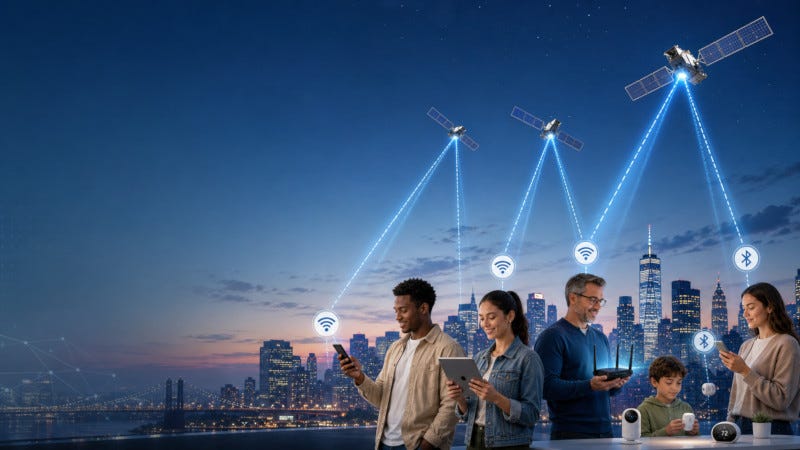
The Federal Communications Commission could open more than 225 megahertz of unlicensed spectrum to direct-to-device satellite services under a draft Notice of Proposed Rulemaking to be considered at the Commission’s August monthly meeting.
“President Trump has pushed to restore America’s leadership in next-gen tech. That is exactly what the FCC has been doing.”
Brendan Carr, FCC
FCC Chairman Brendan Carr said in a news release that if adopted, the NPRM would examine whether devices operating in some Part 15 bands could communicate with FCC-authorized satellites on an uplink or downlink basis, and whether Part 15 equipment could be used within FCC-authorized spacecraft.
The proposal centers on unlicensed wireless devices already used widely in consumer and business markets, including Wi-Fi and Bluetooth transmitters, medical imaging devices, wireless microphones, garage door openers and internet-of-things sensors. The FCC said expanding direct-to-device, or D2D, access into those bands could add capacity, support new integrated terrestrial-satellite services and give consumers another path to satellite connectivity.
The proceeding would also explore allowing unlicensed wireless devices to operate onboard spacecraft and between spacecraft. That would extend Part 15 use beyond ground-based applications and build a record on where such devices might operate safely in space.
“President Trump has pushed to restore America’s leadership in next-gen tech,” Carr said in the news release. “That is exactly what the FCC has been doing — ensuring that our nation’s consumers are the first in the world to benefit from this emerging technology.”
He said direct-to-device service means “fast and ubiquitous connectivity provided directly from next-gen satellite constellations to your smartphone or device” and called the combination of satellite links and the unlicensed device ecosystem “a game changer.”
The FCC tied the proposal to its existing Supplemental Coverage from Space framework, which it said has already supported D2D connectivity in areas with inadequate cellular coverage. The agency said the new proceeding would test whether unlicensed bands can complement other spectrum resources already being used for satellite-to-device links.
The commission also pointed to recent market activity around D2D rights. According to the release, more than $40 billion has flowed through the American space economy for D2D since the FCC adopted its Supplemental Coverage from Space framework. The agency cited SpaceX’s 2025 acquisition of 65 megahertz of D2D spectrum from EchoStar for $19.6 billion, AST’s $550 million agreement to use L-band spectrum leased to Ligado, and separate Amazon and Rocket Lab deals totaling nearly $20 billion to acquire Globalstar and Iridium, including D2D spectrum portfolios.
The FCC said its Space Bureau recently issued legal clarification reaffirming what it described as American innovators’ exclusively held D2D spectrum rights. That step, the agency said, was intended to support market discovery as investment and transaction activity grows around satellite-enabled mobile services.
A public draft of the proposal was posted on the FCC’s August 2026 Open Meeting page on Thursday.