

Ultra-Light Thruster Pointing Mechanism Targets Small Satellite LEO Constellations
New APPMAX2-XS Weighs Under 15.4 Pounds, Promises Delivery in Six Months or Less

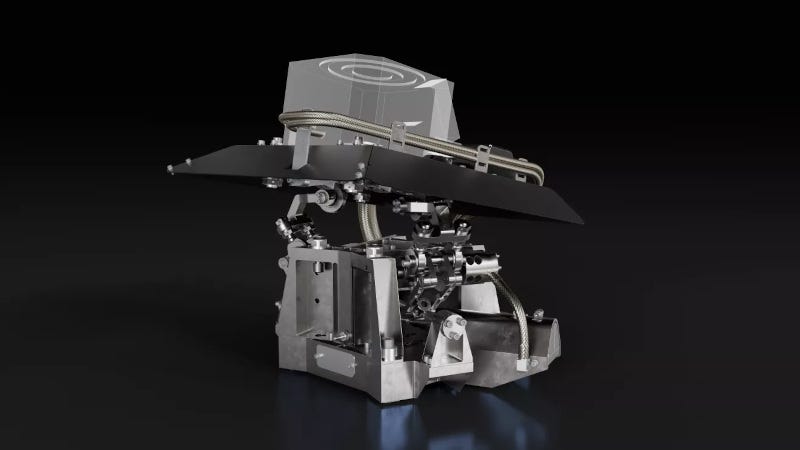
A two-axis electric propulsion pointing mechanism designed for small satellites in low Earth orbit was unveiled by Beyond Gravity at Space Tech Expo USA in Anaheim, California, on June 3.
“Our new mechanism delivers an exceptionally compact and mass-efficient solution while maintaining full flexibility across a wide range of electric propulsion systems.”
Wolfgang Pawlinetz, Beyond Gravity
The APPMAX2-XS is the newest addition to the company’s APPMAX — Advanced Electric Propulsion Pointing Mechanism — product family. It is built around commercial off-the-shelf components and industrialized production processes. Deliveries are scheduled to begin in 2027.
The mechanism addresses a recurring inefficiency in LEO constellation operations. Fixed-mounted thrusters on satellites can waste propellant during attitude control maneuvers when the thruster is not optimally aligned with the required thrust vector.
“Currently, a lot of satellites are burning propellant, but not because of the spacecraft’s thrusters,” said Dominik Inschlag, Director of Marketing and Sales at Beyond Gravity. “It is because of the pointing of the thruster.”
The APPMAX2-XS weighs less than 15.4 pounds — under seven kilograms — and is rated for thrust vectoring on small spacecraft as well as optical payload pointing. Beyond Gravity says propulsion pointing mechanisms of this type can extend satellite operational lifetime by up to two years and are cost-effective for platforms with high thruster masses.
Wolfgang Pawlinetz, vice president of Thermal and Mechanisms at Beyond Gravity, described the product’s design priorities. “Our new mechanism delivers an exceptionally compact and mass-efficient solution while maintaining full flexibility across a wide range of electric propulsion systems,” Pawlinetz said. “It is both low-cost and short-lead time. This makes it ideal for the age of flexible small LEO spacecraft.”
The six-month order-to-delivery window is central to the product’s market positioning. LEO constellation operators — who frequently build and launch satellites in batches — have historically faced long lead times for precision mechanism hardware. The APPMAX2-XS is designed to compress that timeline using standardized, commercially sourced components rather than fully custom assemblies.
Inschlag said the company sees demand across two markets. “We see a lot of potential for our new mechanism especially in Europe and the United States,” he said. “Fast availability, low mass, and competitive cost are critical factors for constellation operators. This mechanism directly addresses those priorities.”
The APPMAX2-XS sits within a category of hardware that has grown in relevance as LEO constellations scale in size and operators seek ways to extend spacecraft life and reduce operational cost. Traditional attitude control relies on the spacecraft bus itself to reorient the vehicle before firing, consuming propellant in the process. A pointing mechanism shifts that function to the thruster mount, allowing the spacecraft to maintain attitude while the thruster adjusts its vector independently.
Beyond Gravity did not disclose pricing or the number of units in initial production runs. The product is available for order, with first deliveries beginning in 2027.