

UK’s Copernicus Return Still Trails Program’s Annual Cost, Report Finds
Interim Evaluation Shows Contract Wins Rising, But UK Firms Are Losing Ground to European Rivals

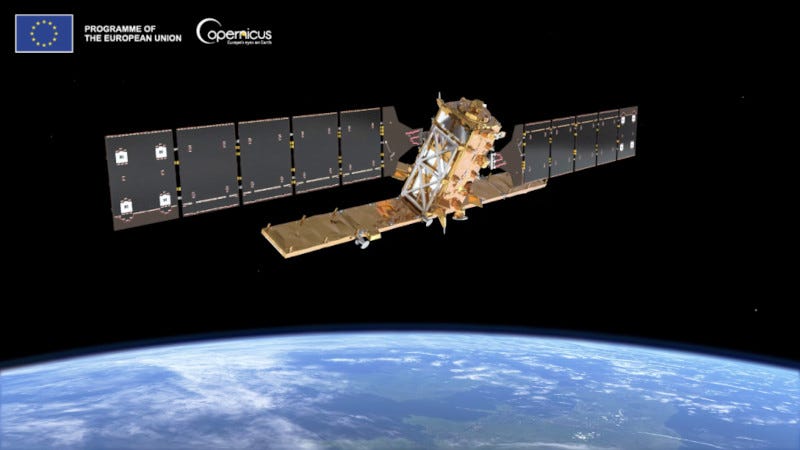
The United Kingdom’s measurable financial return from rejoining the European Union’s Copernicus Earth observation program has not yet matched the roughly $180 million it pays into the program each year, according to an interim evaluation published Aug. 3 by the UK Space Agency.
The report, commissioned by the UK Department for Science, Innovation and Technology, covers the period since January 2024, when Britain returned to Copernicus after a three-year pause that began with its 2021 exit from the EU. Researchers drew on roughly 100 interviews, 160 survey responses from data users and a review of more than 60 documents.
The evaluation put the quantifiable annual benefit of participation — combining data-access savings and contract wins — at $85 million to $144 million. That range falls short of the UK’s average annual contribution of about $180 million (£133 million) for 2024 through 2027. Researchers said the gap does not necessarily mean the investment is a poor one: it excludes unquantified benefits such as diplomatic influence, and it reflects a program the UK rejoined partway through a seven-year EU budget cycle, limiting the contracts open to British bidders.
UK organizations won $35 million (£26.1 million) in Copernicus contracts across 2024 and 2025, spread across 30 organizations. The Met Office accounted for the largest share, winning 12 contracts worth $8.9 million (£6.6 million). RAL Space and Airbus also won multiple contracts. No UK organization won a Copernicus land-monitoring service contract in that span. By comparison, UK contract returns averaged roughly $24 million per year during the country’s earlier stretch of participation from 2014 to 2023, before the withdrawal.
The report said the shortfall stems largely from timing. Because Britain rejoined mid-cycle, many multiyear Copernicus contracts were already tendered to European incumbents before UK organizations were eligible to bid again. Smaller UK firms have struggled most, the evaluation found, having lost “incumbent status” during the withdrawal period as competitors built up capabilities UK companies could not access. Researchers cited one small UK company, not named in the report, whose European operations were spun off during the withdrawal and whose remaining UK team has since shrunk to about a third of its former size.
Year-over-year growth offered a partial counterpoint to the shortfall. Contract wins rose 29% from 2024 to 2025, to $19.8 million (£14.7 million) from $15.4 million (£11.4 million), a trend the report’s authors called an early sign of recovery. UKspace, a trade body representing the sector, estimated that Copernicus procurement — including a new generation of satellite missions — could generate $351 million to $405 million (£260 million to £300 million) in UK industrial value by 2034.
On the data side, researchers estimated that UK participation delivers $76 million to $135 million (£56 million to £100 million) a year in benefits beyond what would be available through Copernicus’s free, open-access data alone. Those benefits include guaranteed access to services such as the Copernicus Emergency Management Service, used to activate flood-mapping in Scotland during flooding in late December 2024 and during Storm Éowyn in January 2025. A separate willingness-to-pay survey of 142 organizations found the average UK data user would pay $43,000 to $82,000 a year to avoid losing Copernicus access entirely, an aggregate value the report put at $149 million annually across all UK users.
Researchers also flagged a separate cost the UK avoids by staying in the program: domestically replicating Copernicus’s data storage and reprocessing would run an estimated $3.4 million to $5.4 million (£2.5 million to £4 million) a year, not including the cost of building the infrastructure itself.
The report said UK participation has restored the country’s access to European Space Agency governance forums, including the ESA Programme Board on Earth Observation, where it retains voting rights despite lacking formal voting power within the EU’s own Copernicus management structure. It also credited UK funding with helping finance a third satellite for the CO2M carbon-monitoring mission, being built in Germany.
The evaluation is the first of two phases. A fuller assessment, including case studies and international comparisons, is due in 2026-28.