

UK-Built Sensor Selected For Europe’s First Solo Lunar Landing
Contract Signed At Farnborough Is Preliminary, With Full Agreement Still Pending

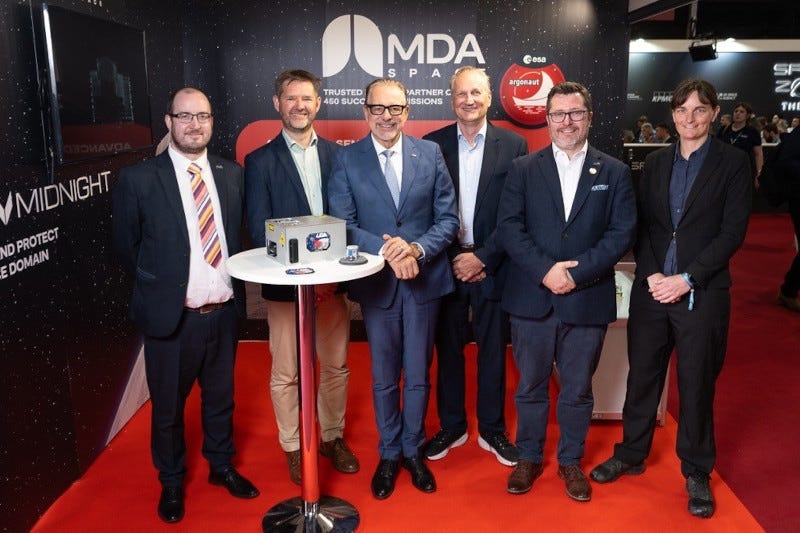
OHB System AG has selected the UK arm of MDA Space Ltd. to supply hazard-detection sensors for the European Space Agency’s Argonaut lunar lander, under a preliminary contract announced last week.
“This milestone shows the UK has the expertise to underpin Europe’s lunar ambitions — from precision landing sensors developed in Didcot to descent engines tested in Buckinghamshire.”
Liz Lloyd, UK Space Minister
The Argonaut program is ESA’s first independent lunar landing capability, designed to carry cargo and science instruments to the moon in coordination with NASA’s Artemis program. Thales Alenia Space, a joint venture between Thales and Leonardo, is the prime contractor for the mission’s Lunar Descent Element. OHB is part of the core industrial team, responsible for the lander’s guidance, navigation and control system, its telemetry, tracking and command system, and its electrical power system.
The agreement, formalized during the Farnborough International Airshow, is a Pre-Authorisation to Proceed (PATP). It allows MDA Space to begin engineering work and buy long-lead components from its UK operations, with support from the UK Space Agency, ahead of a definitive contract. Under the anticipated full agreement, MDA Space would supply two flight units of its LEIA LiDAR sensor for Argonaut’s first mission to the moon.
“This partnership with OHB underscores our expertise in autonomous landing technologies and demonstrates the strength and innovation of the UK space sector,” said Andrew Stanniland, managing director of MDA Space UK. “By providing LEIA, our advanced 3D sensor technology, MDA Space will contribute directly to enabling Europe’s independent access and sustained presence on the moon for the first time.”
LEIA, developed in the UK with UK Space Agency support, would form part of Argonaut’s hazard detection and avoidance system. The sensor is a 3D scanning LiDAR that generates real-time terrain maps, intended to let the spacecraft identify craters, boulders and rough terrain and select a landing site on its own. Unlike camera-based systems, according to the company, it can map terrain regardless of lighting conditions. Its scan pattern is designed to adjust for the lander’s motion, covering a 40-degree field of view in five seconds.
“The selection of MDA Space for the Argonaut mission is a testament to Britain’s growing leadership in lunar technology and exploration,” said Liz Lloyd, UK Space Minister. “This milestone shows the UK has the expertise to underpin Europe’s lunar ambitions — from precision landing sensors developed in Didcot to descent engines tested in Buckinghamshire. We’re proud to back MDA Space to unlock new opportunities for the future for science and ultimately our economy.”
MDA Space, headquartered in Brampton, Ontario, and dual-listed on the Toronto and New York stock exchanges, has previously supplied lunar landing sensors, including LEIA and its Full Wave Laser Range Finder, FLARE, for other commercial moon missions. A definitive contract with OHB for the Argonaut sensors has not yet been signed.