


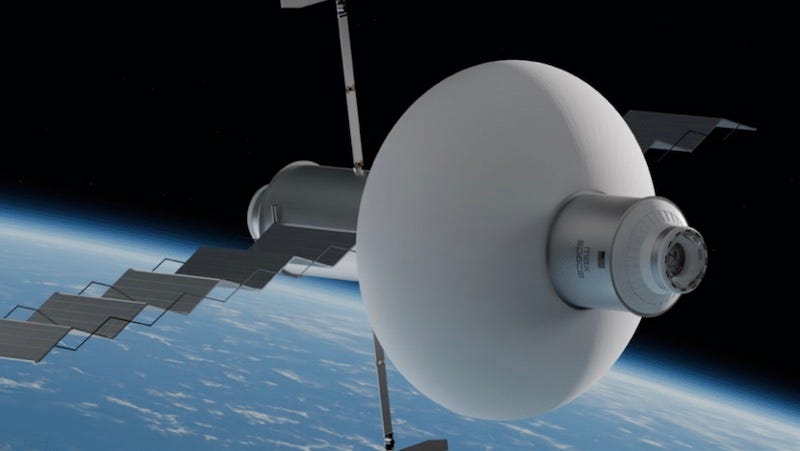
There is a new entrant in the commercial space station arena. Thunderbird Station, which is designed around a large expandable habitat, is being developed by Max Space for Earth orbit, the moon and Mars.
“Thunderbird Station is not an incremental step, it’s a fundamental redesign of what LEO, Moon and Mars space stations can be.”
Saleem Miyan, Max Space
The company also confirmed that Mission Evolution, its first in-orbit expandable habitat demonstration, is manifested on a SpaceX rideshare launch in Q1 2027
Thunderbird Station is built to support 4 or more crew members continuously, with an incredible 350m³ of pressurized volume, more than triple that of a standard ISS module. Launched on a single standard Falcon 9 rocket, the full expandable habitat launches compactly and expands 20x once deployed in orbit, requiring no in-orbit assembly.
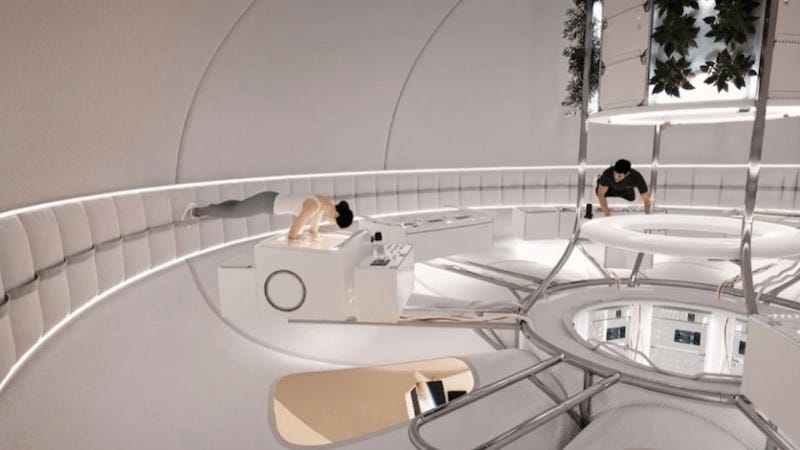
The interior features a novel reconfigurable architecture, a morphic interior structure that allows astronauts to dynamically adapt the space for research, manufacturing, or living during a mission. The design was developed in collaboration with veteran astronauts to take full advantage of three-dimensional volume in microgravity, not just traditional floor and wall space, to create the most spacious and functional habitable volume ever built.
Thunderbird Station is initially configured with over 60 payload lockers with room in the station for several times that in additional racks for government and commercial missions, including industrial scale in-space manufacturing. It is designed with three times the safety factors required by NASA for traditional metallic structures, while streamlining operations and significantly cutting costs across government, defense, and commercial missions. It scales for future stations and surface habitats on the Moon and Mars.
“Thunderbird Station is not an incremental step, it’s a fundamental redesign of what LEO, Moon and Mars space stations can be,” said Saleem Miyan, CEO and Co-Founder of Max Space. “We’re pioneering building space real estate that reflects how we’ll live and work in space this decade and beyond.”
“It’s the first time I’ve seen an interior truly designed for space, not Earth. I’m excited that my space flight experience has been able to positively guide our team’s designs and the functional customization of Thunderbird for future astronaut missions” said Nicole Stott, a veteran NASA astronaut and newly appointed Lead Astronaut at Max Space. Stott spent 104 days in orbit on ISS and aboard the Space Shuttle and participated in a spacewalk.
The primary objective of the Max Space expandable habitat demonstration, planned for early 2027, will be to test and verify the on-orbit deployment of the expandable module with its exceptional micrometeoroid protection layers. After many years of successful ground testing and development, the flight unit is in full production and is scheduled for launch Q1 2027 as part of a scheduled SpaceX mission.
Sign me up!