

The Wargame That Writes Requirements
What Apollo Insight Tells Commercial Space About What’s Coming

What This Means:
The Apollo Insight wargame is USSPACECOM’s first public step toward formalizing commercial space resilience as a contracted, operational capability. The exercise surfaced two findings that matter commercially: a technical mapping of interoperable assets, and a structural decision-latency gap that only pre-authorized frameworks and faster contracting mechanisms can close. A second tabletop exercise is scheduled for June 24, 2026. Commercial operators, cyber defense firms, and BD teams that engage now will shape the requirements. Those that wait will respond to them.
United States Space Command (USSPACECOM) doesn’t hold wargames with 60 commercial companies because it enjoys the company. It holds them to write requirements.
Apollo Insight — the March 2026 exercise that put a nuclear anti-satellite (ASAT) detonation scenario in front of senior leaders from more than 60 commercial space companies — is best understood as a pre-solicitation activity. Not a policy seminar, not an outreach event, but a pre-solicitation activity run by a branch of the U.S. government that has a very specific problem and is now mapping which commercial assets can help solve it. That characterization is an inference based on Department of War (DoW) acquisition precedent, not a named solicitation — but it is a well-grounded one, and the evidence is worth examining carefully.
Apollo Insight is also, notably, not classified. USSPACECOM publicized the exercise, named its organizer, announced its follow-on, and described its findings — at a public symposium attended by thousands of industry representatives. That level of transparency is itself a signal. When a combatant command wants industry to know it held a wargame, it is not conducting outreach. It is publishing a market notice.
The distinction matters enormously. If your business development pipeline doesn’t already have a line item for USSPACECOM’s commercial integration framework, you may not be behind on a policy conversation — you may be behind on a procurement conversation. And the window for shaping rather than responding to what comes next appears to be closing faster than most commercial space companies realize.
What USSPACECOM Actually Said
Gen. Stephen Whiting, commander of USSPACECOM, used the 41st Space Symposium in Colorado Springs to lay out the command’s organizing framework for 2026 in terms that should land differently for commercial operators than they do for a general-interest audience. The “Year of Integration,” as USSPACECOM labeled it, was not aspirational. It described operations already underway.
Whiting’s three-part commercial integration framework is the structural key: identify commercial capabilities that can serve military needs; operationalize those capabilities into ongoing command operations; actively inform and protect the commercial sector against the threats those relationships create. That third leg — “protect” — is where the procurement signal lives. When a four-star commander states that his command is responsible for protecting commercial operators, he is also, implicitly, indicating that his command intends to create a compliance and qualification standard that operators must meet to be worth protecting.
Whiting’s standing case study for what non-compliance looks like is not hypothetical. On the opening night of Russia’s invasion of Ukraine in February 2022, a cyberattack against Viasat’s KA-SAT network knocked out satellite broadband services across Ukraine and into Western Europe. Whiting has described this publicly, repeatedly, as demonstrating “the soft underbelly of our space enterprise” — and he has not been subtle about the implication for commercial operators who assume that peacetime cyber postures are adequate in a world where space and ground combat are no longer separable.
The Viasat attack is the reference point around which USSPACECOM is building its commercial integration compliance expectations. That framing — one named attack, cited repeatedly from the podium by the command’s four-star leader — tells you something important about where government intent is hardening into procurement language. When the same example appears in multiple public addresses, it is not an illustration. It is a requirements document in narrative form.
Inside Apollo Insight
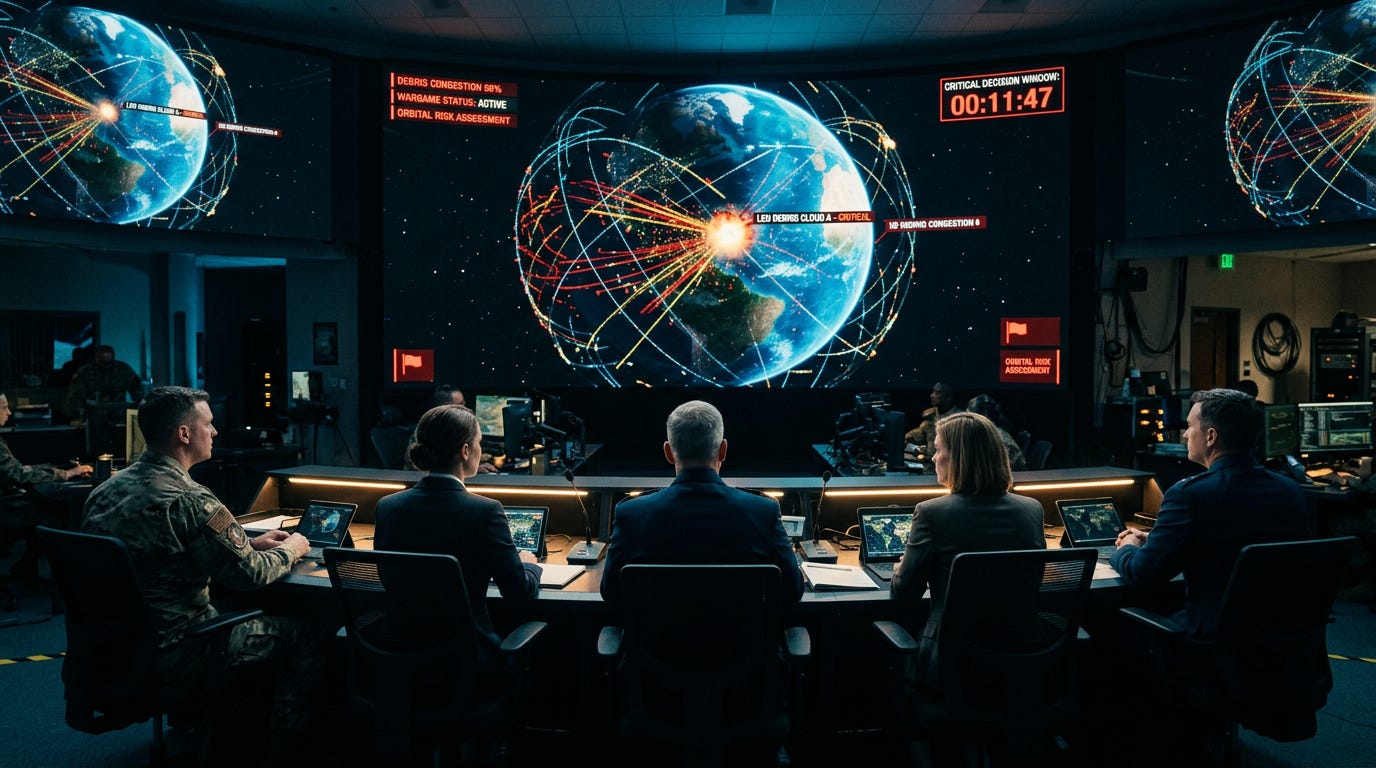
The exercise was organized under the direction of Cmdr. Heather Thomas, USSPACECOM’s Commercial Integration Branch Chief, and ran in March 2026. More than 60 commercial companies participated. The scenario: a nuclear ASAT weapon detonates in orbit. The question: which commercial technologies can contribute to a response, how fast can they be brought to bear, and where does the coordination between government and commercial operators break down?
The nuclear ASAT framing is not accidental. It represents the highest-stress version of a contested space scenario — one that creates simultaneous orbital debris fields, communications degradation, and a compressed timeline for both military and commercial response. By stress-testing against this scenario rather than a more conventional one, USSPACECOM was effectively sorting participating companies into two categories: those whose capabilities remain relevant under extreme conditions, and those whose value proposition depends on a functioning, peacetime orbital environment. That sorting exercise is exactly what a requirements-development activity looks like.
It is also worth noting what the nuclear ASAT framing signals about USSPACECOM’s planning assumptions. Running this scenario in 2026 is not a theoretical exercise. Russia and China have both demonstrated kinetic anti-satellite capabilities, and independent defense and intelligence analysis — including the Secure World Foundation’s 2025 Global Counterspace Capabilities Report and the Defense Intelligence Agency’s Challenges to Security in Space assessment — has documented Russia’s active development of nuclear ASAT capabilities and the broader maturation of adversary counterspace programs. USSPACECOM is not planning for a threat that might materialize a decade from now. Commercial operators that treat space as a stable operating environment, the foundational assumption behind most commercial space business models, are operating on a premise that USSPACECOM’s own wargame explicitly stress-tested and found inadequate.
Two findings emerged from Apollo Insight that carry direct commercial implications. The first was technical: a mapping of which commercial capabilities are genuinely interoperable with military response operations versus those that would require extended integration work before they could contribute under time pressure. Space situational awareness (SSA) sensors, satellite communications backup routing, on-orbit servicing proximity operations, and certain cyber threat detection platforms all appear to map to the interoperability side of that line. Platforms optimized for peacetime commercial customers, without hardened interfaces or pre-negotiated data-sharing agreements, landed on the other side.
The second finding, and arguably the more consequential one for the commercial market, was operational: decision-making latency in government-commercial coordination is a structural vulnerability, and it is addressable not by better hardware but by pre-negotiated authorities and faster contracting mechanisms. In the Apollo Insight scenario, the critical bottleneck was not capability availability, it was the time required for legal authorities, operational approvals, and contractual frameworks to activate under crisis conditions. Government operators knew which commercial assets they wanted to task. They simply could not task them fast enough within existing authorities.
That second finding is not a hardware contract signal. It is a services and frameworks contract signal, and it broadens the commercial opportunity considerably beyond the companies that already supply hardware to the War Department. The firms positioned to benefit from this finding are those that can build the pre-authorization architecture, the rapid-contracting vehicles, and the interface standards that allow government to task commercial assets in minutes rather than days.
Lt. Gen. Dennis Bythewood, Commander of USSPACECOM’s Combined Joint Forces Space Component, added the doctrinal context that frames the urgency. U.S. Space Force Guardians now operate under an explicit “combat arms mindset” meaning they function under the assumption that their systems are perpetually under threat and must adapt continuously to contested conditions. That mindset, when extended to commercial partners, redefines the baseline expectation: participating in USSPACECOM’s commercial integration framework is not a discretionary partnership. It is, increasingly, the price of being treated as an operationally relevant asset rather than a vendor on a preferred supplier list.
The Journal of Space Commerce covers the procurement signals, regulatory patterns, and investment intelligence that the general space press treats as policy news. Subscribe to read every piece in the 41st Space Symposium series.
