


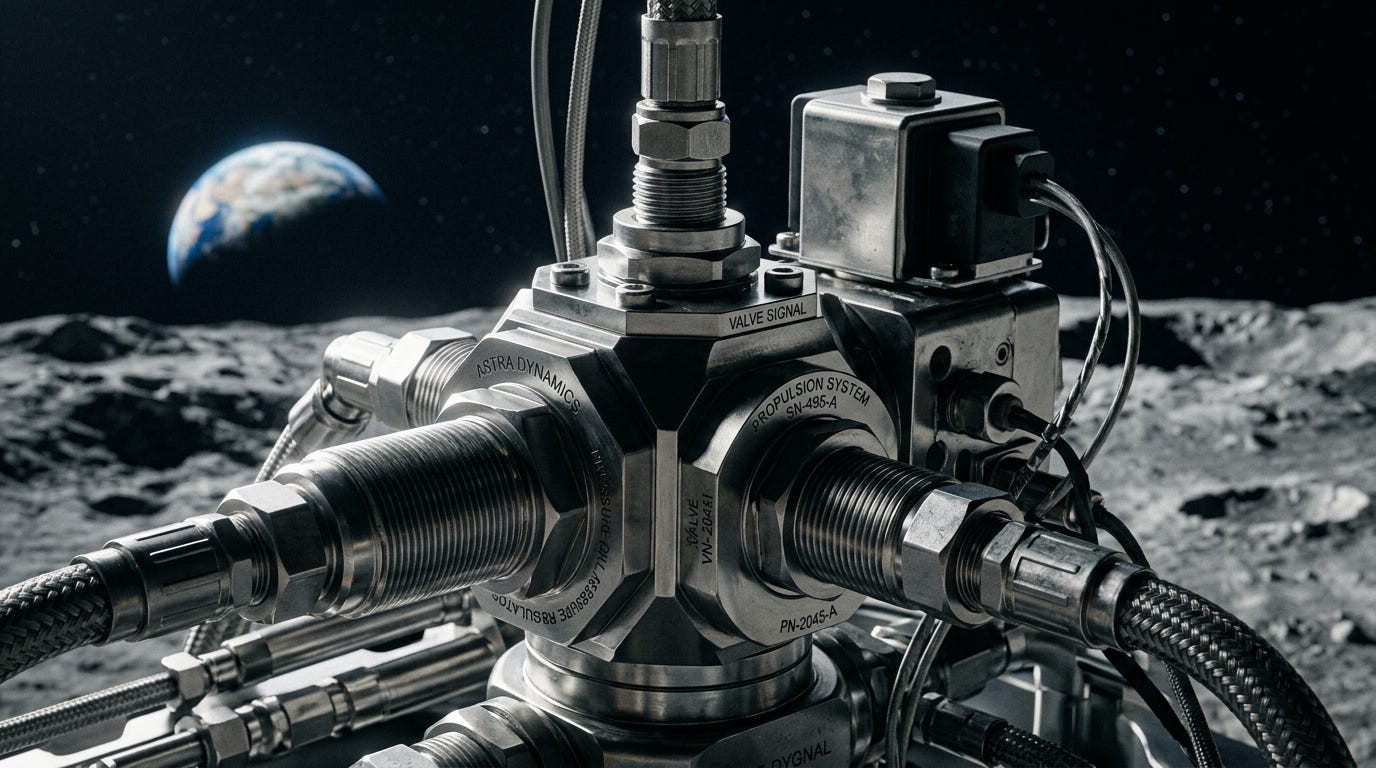
What This Means
NASA Administrator Jared Isaacman told a Senate subcommittee in April 2026 that lunar base construction will drive a 10x, almost order-of-magnitude increase in demand for precision valves and hypergolic thrusters — components that a small number of U.S. suppliers currently produce in limited annual quantities for a much smaller market. The qualification clock for a new space-grade valve or thruster supplier runs three to seven years. For supply chain leaders, program managers, and BD teams, that math means the window to begin qualification now is not early — it may already be closing.
The Signal From the Hearing Room
There are moments in budget testimony where an administrator says something that the trade press dutifully transcribes and the supply chain community quietly misses. April 2026 produced one of those moments. Testifying before the Senate Appropriations Commerce-Justice-Science subcommittee on the National Aeronautics and Space Administration (NASA) fiscal year 2027 budget, Administrator Jared Isaacman offered an unscripted appeal that cut through the prepared remarks: “Build valves. We have SIBER programs right now. I’d love nothing more than to get industry working on some of the exquisite valves we need for our vehicles. Not to mention hypergolic thrusters that are going to be in immense demand — you’re probably talking a 10x, almost order-of-magnitude increase in demand signal just by moon-based construction alone.”
That is not the language of a budget line. That is a program manager’s distress call, delivered at the highest institutional level. When a NASA administrator uses Senate testimony to personally recruit valve manufacturers, he is telling the industry something the acquisition system has not yet said through formal solicitations: the supply base is not ready, and the timeline pressure is real.
What “Exquisite Valves” Actually Means
The word choice matters. Isaacman did not say NASA needs more valves — he said it needs exquisite ones. That single adjective narrows the field considerably and understanding why requires a short detour into what lunar lander and surface systems actually demand from fluid control components.
Lunar missions require valves that operate across two fundamentally different, and demanding, service environments. The first is cryogenic service — managing liquid oxygen and liquid hydrogen in deep-cold conditions, where valve seats, seals, and actuators must cycle reliably at temperatures approaching minus 250 degrees Celsius while maintaining leak-tight integrity over extended mission durations. The second is hypergolic service, where valves control the flow of propellants like hydrazine (N2H4) and nitrogen tetroxide (NTO) that ignite spontaneously on contact. Hypergolic valves must open and close in milliseconds, tolerate propellants that corrode standard materials, and do so with zero tolerance for failure in a landing or abort scenario where there is no recovery option.
Add to this the vacuum environment, radiation exposure, thermal cycling between sunlit and shadowed surface conditions, and the requirement for long-duration storage — a lunar base is not a satellite that completes its mission in weeks — and you arrive at a component specification that eliminates most of the industrial valve market from consideration before a conversation about lead time even begins. NASA’s Kennedy Space Center qualification standards (KSC-STD-Z-0006 Rev C) specifically enumerate special valves, soft goods, and stems required for hypergol service, with component lists maintained and updated as space programs evolve. The number of companies that have successfully built and qualified hardware to these standards fits comfortably in a single-digit count.
The sections below map every named supplier across precision valves, hypergolic thrusters, and propellant production — including the sole-source dependency signals, the SIBER/SBIR on-ramps, and the five decision questions program managers and BD teams need to act on now. Subscribers get the full supply chain map, the embedded engineer analysis, and the qualification timeline math.
