

The Substrate Problem Nobody Named
Neon, SUMCO, and the Semiconductor Supply Risk Sitting Inside Every Space-Grade Component

What This Means
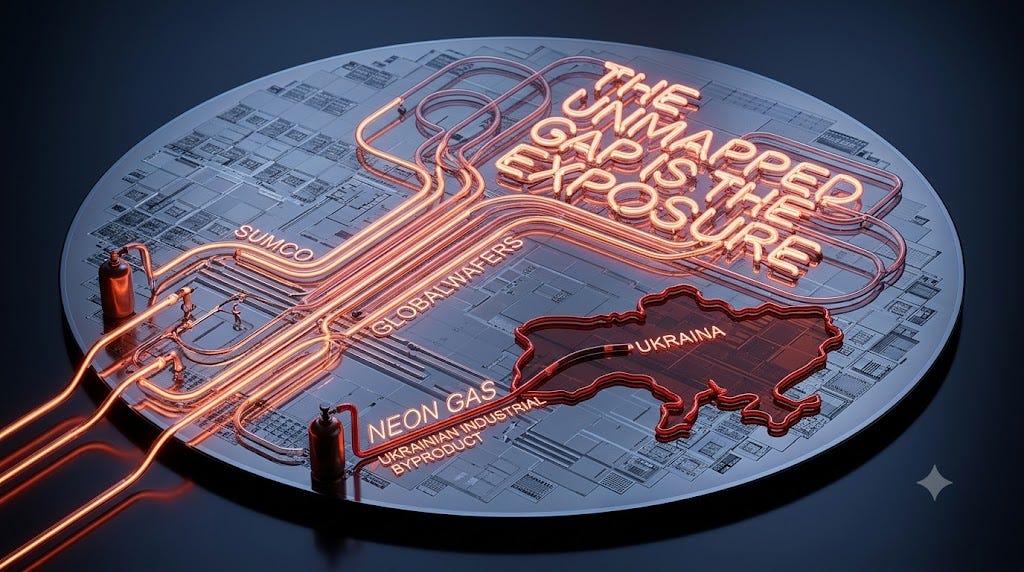
Space-grade semiconductors depend on two input categories that almost no prime contractor has mapped below the wafer level: ultra-high-purity neon gas, historically sourced at 90% concentration from Ukrainian industrial byproduct, and silicon wafer substrates supplied by a duopoly in which SUMCO Corporation and GlobalWafers together hold a dominant share of the market. The Altana report on Chinese component dependencies drew attention to the wrong layer of the supply chain. The more immediate and less visible risk sits one level deeper, in the gas and substrate inputs that feed every qualified wafer supplier, regardless of geography. Supply-chain leaders and program managers who have mapped their semiconductor vendors have almost certainly not mapped what those vendors depend on. That gap is the exposure.
When the Altana Atlas on Supply Chain Risk published its analysis of U.S. space hardware dependencies on Chinese-sourced components, it landed exactly where you would expect a supply chain report to land: on named components, on finished goods, on the visible part of the vendor list. The report was valuable. It was also incomplete in a way that matters more now than it did twelve months ago.
The component layer is where audits stop. The substrate and process-gas layer is where the actual concentration lives.
Chip fabrication for space-grade components requires two inputs that receive almost no attention in program-level supply chain reviews. The first is ultra-high-purity neon gas, used in the excimer lasers that perform photolithographic patterning on every advanced semiconductor wafer. The second is the silicon wafer substrate itself, a product manufactured at industrial scale by a small number of qualified suppliers operating capital-intensive facilities with years-long lead times for meaningful capacity addition.
Both inputs are subject to supply disruptions that no prime contractor can hedge through vendor diversification at the component level. You cannot solve a neon shortage by qualifying a second radiation-hardened processor vendor. You cannot address a silicon wafer capacity constraint by switching to a different star tracker manufacturer. The problem is upstream of all of those choices.
The Neon Dependency
Neon is a byproduct of steel production. It is separated from the gas streams generated during coke oven and blast furnace operations, purified to semiconductor-grade purity requirements, and then sold into the chip fabrication supply chain. Because neon production is tied to steel output rather than to semiconductor demand, there is no mechanism by which chip manufacturers can directly incentivize neon supply expansion. The market does not work that way.
Before the Russian invasion of Ukraine in February 2022, Ukrainian industrial gas producers, primarily Ingas and Cryoin, together supplied an estimated 45 to 54 percent of the world’s semiconductor-grade neon. Broader estimates placed Ukraine’s share of global neon relevant to chip manufacturing at approximately 90 percent of the U.S. market’s historical supply base (Congressional Research Service, 2022, citing Techcet Group data). The facilities in Mariupol and Odessa that processed the bulk of this output were disrupted by the war and have not returned to pre-2022 operating levels.
The 2022 disruption triggered a rapid and largely successful scramble by U.S. chipmakers to qualify alternative neon sources in South Korea, China, and other steel-producing regions. That scramble worked well enough to prevent a production halt. It did not eliminate the underlying vulnerability structure; it redistributed it. The alternative sources are real. They are also not unconstrained. South Korean producers face their own industrial gas market dynamics. Chinese neon producers sit within a geopolitical risk envelope that is distinct from but not obviously safer than Ukrainian supply, particularly for defense-adjacent semiconductor programs subject to export control scrutiny.
For space-grade semiconductor manufacturing specifically, the purity requirements are more demanding than for commercial chip production. Not every neon source that works for a commercial foundry qualifies for a radiation-hardened component fabrication process. The qualification gap matters. A space program manager reviewing their approved vendor list for radiation-hardened processors is not reviewing neon source qualification records. That documentation sits at the foundry level, not the component level, and it is rarely surfaced in program supply chain reviews.
The practical implication is that neon supply stress, whether from a geopolitical event affecting alternative sources or from a simultaneous demand surge as constellation programs and defense satellite programs ramp concurrently, would affect space-grade semiconductor production before it affected commercial chip production, because the qualification universe for space-grade neon is narrower.
