


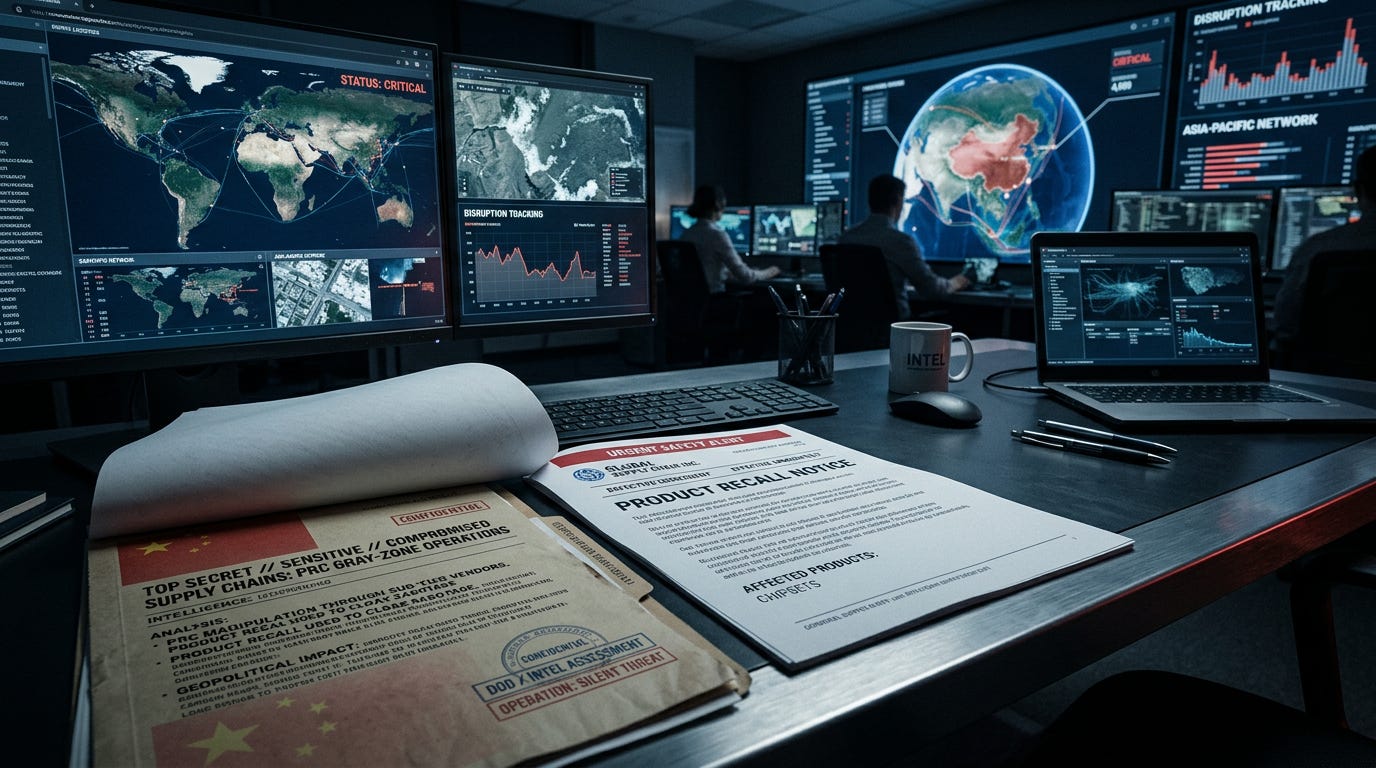
SIGNAL SUMMARY — WHAT THIS MEANS
The United States Space Force’s (USSF) Future Operating Environment 2040 (FOE) does not bury the supply chain threat in an appendix; it places it inside its darkest operational scenario as a named gray-zone instrument alongside jamming, spoofing, and cyber intrusion. In that scenario, China uses “targeted micro-supply chain disruptions framed as product recalls” to gradually weaken adversary capability while staying below the threshold of open conflict. This is not an abstract risk: the same document notes Russia’s Sfera constellation was cut from 600 to 360 satellites due to component shortages, demonstrating how even a major spacefaring nation can be bottlenecked by fragility in key inputs. Executives and program managers at commercial space companies and defense primes that rely on single-source suppliers for radiation-hardened (rad-hard) microelectronics, rare-earth magnets, or ammonium perchlorate (AP) should treat these as concrete early-warning signals, not background anecdotes.
The Signal: Precision, Not Brute Force
The FOE’s “Dark Horizons” scenario describes a 2040 environment defined by continuous, hard-to-attribute contestation below the level of declared war, with the space domain “changed through consistent attrition rather than decisive campaigns.” Within that environment, China’s gray-zone toolkit explicitly includes “sub-threshold jamming that mimics natural interference, precise spoofing masked as routine errors, and targeted micro-supply chain disruptions framed as product recalls” that “gradually weaken adversary capability and will.” The core of the tactic is the disguise: a supply disruption that arrives in the inbox as a quality issue, a safety notice, or a routine recall, and routes through commercial processes rather than military channels.
The FOE emphasizes that the cumulative effect of these measures is operational tempo erosion: launch schedules slip, satellite delivery milestones move to the right, and commanders lose confidence in “target custody and node status” amid ambiguous outages and delays. None of these individual events, on its own, looks like an act of war. Collectively, they shift the tempo of a campaign in favor of the actor orchestrating the disruptions, especially when combined with Unrestricted Spectrum Warfare (USW) across the electromagnetic spectrum. The question for any program manager is not whether supply chain interference is a threat vector; it is whether your particular program looks like an attractive target for a “product recall that isn’t.”
The Supply Chain Map: Where the Exposure Lives
The FOE describes China’s broader strategy as a fusion of joint space-military innovation and economic coercion, enabled by tight Party control over ostensibly commercial actors. Military-civil fusion, personally chaired by Xi Jinping, uses Party committees, state ownership, and guidance funds to integrate firms like CGSTL (Jilin-1), China Siwei, and Spacety into state demand for high-tempo Electro-Optical (EO) and Synthetic Aperture Radar (SAR) systems. That same fusion architecture gives Beijing structural visibility into global component flows in which Chinese manufacturers participate, including sectors critical to Western space programs.
Three categories stand out across U.S. defense and space systems.
…the connections drawn here are directional assessments based on technology requirements and public contracting records, not disclosed program-by-program data, and should be treated as such until validated by internal audits or official filings.
